New Zealand Scaup

New Zealand Scaup

Aythya novaeseelandiae

Silhouette: Andy Wilson · PhyloPic

LCLeast ConcernNTVUENCR Endemic
Daily sighting probability ~10% · With luck
at Auckland

In 3 days ~30% in a week ~60%

515 Verified sightings at Auckland
1,402 In 1 park From 2019 to 2026
February Best month
☀️ Diurnal When it's spotted

About the New Zealand Scaup

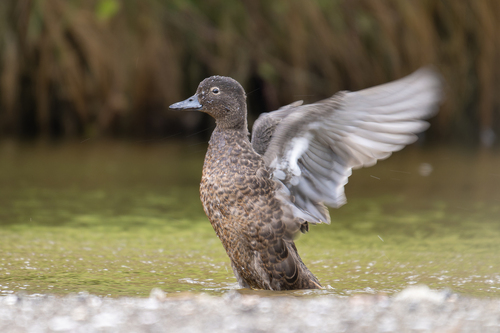
The New Zealand scaup (Aythya novaeseelandiae), also known as the black teal (or pāpango and several other names in Māori), is a diving duck species of the genus Aythya endemic to New Zealand. They weigh around 650 grams (23 oz) and measure around 40 centimetres (16 in), and have dark-coloured plumage. They are found throughout New Zealand in deep natural and man-made lakes and ponds.

New Zealand scaup lay around 7 eggs and the ducklings are immediately capable of diving to feed. Adult scaups can dive to at least 3 metres and for as long as a minute for aquatic plants and invertebrates. Scaups started declining in the late 1800s until they were fully protected in 1934, and their population is now increasing thanks to predator control and new habitat.

The New Zealand scaup was formally described in 1789 by the German naturalist Johann Friedrich Gmelin in his revised and expanded edition of Carl Linnaeus's Systema Naturae. He placed it with all the ducks, geese and swans in the genus Anas and coined the binomial name Anas novaeseelandiae. Gmelin based his description of the "New-Zealand duck" that had been described in 1785 by the English ornithologist John Latham in his... Wikipedia →

Sounds

Song0:40

New Zealand · 2026

© Nathan El · XC1105862 · CC BY-NC-SA 4.0

Call0:12

New Zealand · 2014

© nick talbot · XC198201 · CC BY-NC-SA 4.0

Recording0:22

New Zealand · 2024

© UreweraWhio · iNaturalist · CC BY-NC 4.0

Global Distribution

Parks Where Found

# Park Country Daily sighting probability
1 Fiordland National Park 🇳🇿 New Zealand
~50%

More parks will be added in future updates.

Cities Where Found

# City Country Daily sighting probability
1 Auckland 🇳🇿 New Zealand
~10%

Zoos & Centres Where Found

# Zoo / Centre Country
1 Cincinnati Zoo and Botanical Garden 🇺🇸 United States In captivity
2 Zoo Aquarium de Madrid 🇪🇸 Spain In captivity
3 Cologne Zoological Garden 🇩🇪 Germany In captivity
4 Budapest Zoo & Botanical Garden 🇭🇺 Hungary In captivity
5 Auckland Zoo 🇳🇿 New Zealand In captivity
6 Paradise Valley Springs 🇳🇿 New Zealand In captivity
7 Bird Park Steinen 🇩🇪 Germany In captivity
8 Kiwi Park 🇳🇿 New Zealand In captivity
9 Ōtorohanga Kiwi House 🇳🇿 New Zealand In captivity
10 Texas State Aquarium 🇺🇸 United States In captivity
11 Cologne Zoo Aquarium 🇩🇪 Germany In captivity

Before you go

What are the chances of seeing a New Zealand Scaup in Auckland?

With luck

About 10% of wildlife watchers report a New Zealand Scaup sighting in Auckland on a given day, based on 515 verified sightings from GBIF citizen-science data. It is the 43rd most-seen of the 93 birds we can rate there. Over three days the chance rises to about 30%, and over a week to about 60%, if each day is a fresh chance.

When is the best time to see a New Zealand Scaup in Auckland?

January and February

In those months about 20% of wildlife watchers report a New Zealand Scaup in Auckland on a given day, against about 10% in March to December, the lowest months.

What time of day is best to see a New Zealand Scaup?

Between 11 am and 2 pm

Across all the parks we cover, that three-hour window holds the most New Zealand Scaup sightings with a recorded time, and nearly all of them come between 6 am and 6 pm: it is a daytime animal.

Where else can you see a New Zealand Scaup?

Only Auckland, in our data

Auckland is the only city on Wallace's Line with enough records to rate New Zealand Scaup sightings: about 10% of wildlife watchers there report one on a given day.

Which relatives of the New Zealand Scaup live in Auckland?

Same family: Anatidae

The closest relatives of the New Zealand Scaup that you can see in Auckland (family Anatidae, Ducks, Geese, and Swans) are Mallard (about 50%), Paradise Shelduck (about 40%) and Black Swan (about 30%), with each one's daily chance of a sighting.

Where does the New Zealand Scaup sighting chance come from?

GBIF citizen-science records

It is estimated from how often the New Zealand Scaup is recorded against all the birds logged in Auckland (515 verified sightings), calibrated against known sighting rates. Figures are rounded to the nearest 10% because citizen-science data supports honest approximations, not decimals, and months with records from fewer than five people show "—". How it works.

← Back to Auckland