
Poisonous Rock Frog

Poisonous Rock Frog

Odorrana hosii

Silhouette: Michael Scroggie, from original photograph by John Bettaso, USFWS (original photograph in public domain). · PhyloPic

LCLeast ConcernNTVUENCR
Daily sighting probability ~10% · With luck
at Bandung

In 3 days ~30% in a week ~60%

12 Verified sightings at Bandung
78 In all 3 parks From 2019 to 2026
February Best month
☀️ Diurnal When it's spotted

About the Poisonous Rock Frog

Hose's frog (Odorrana hosii, often misspelled as O. hosei) is a true frog species with a wide range in Southeast Asia. This species was named after zoologist Charles Hose. Its closest living relatives appear to be O. chloronota which occurs to the north of Hose's frog's range, as well as O. livida and O. morafkai with a more limited range in Myanmar and Vietnam, respectively; these four appear to form a close-knit group wherein the northern species are barely closer to each other than Hose's frog is to any of them. Also quite closely related is O. megatympanum, another Vietnamese endemic.

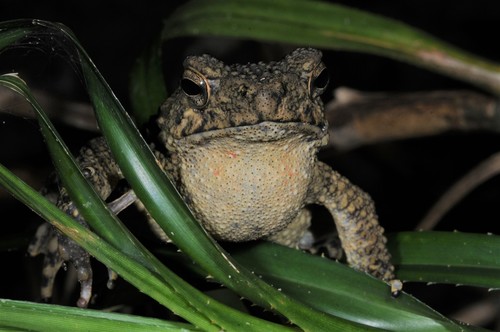
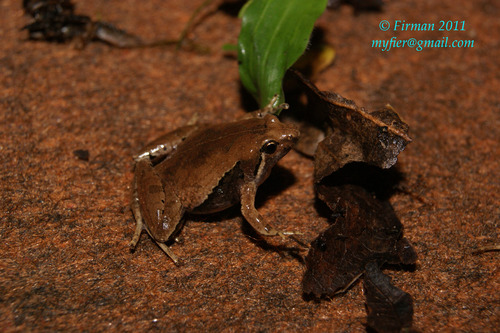
This frog has a robust body with long, slender legs; males measure 50–60 mm, females 85–100 mm. The dorsal are dark green with brown sides, the ventral are pale, the limbs are marked with dark crossbars. Its finger- and toe-tips bear grooved discs.

This frog also have many varians of dorsal colour. Including full green, full brown, green with brown dots, and brown with green dots. Its call heard like "cit" of rats. Its tadpoles apparently lack suctorial discs. Hose's frog has been recorded from the Malay Peninsula south of the Kra Isthmus, on Phuket... Wikipedia →

Global Distribution

Parks Where Found

# Park Country Daily sighting probability
1 Gunung Leuser National Park 🇮🇩 Indonesia
~30%
2 Khao Sok National Park 🇹🇭 Thailand
~30%
3 Kinabalu Park 🇲🇾 Malaysia
~20%

Cities Where Found

# City Country Daily sighting probability
1 Bandung 🇮🇩 Indonesia
~10%
2 Jakarta 🇮🇩 Indonesia
~10%

Zoos & Centres Where Found

# Zoo / Centre Country
1 Entopia 🇲🇾 Malaysia In captivity

Before you go

What are the chances of seeing a Poisonous Rock Frog in Bandung?

With luck

About 10% of wildlife watchers report a Poisonous Rock Frog sighting in Bandung on a given day, based on 12 verified sightings from GBIF citizen-science data. It is the 6th most-seen of the 9 amphibians we can rate there. Over three days the chance rises to about 30%, and over a week to about 60%, if each day is a fresh chance.

When is the best time to see a Poisonous Rock Frog in Bandung?

January and February

In those months about 30% of wildlife watchers report a Poisonous Rock Frog in Bandung on a given day, against under 5% in March–October and December, the lowest months. Those are among Bandung's wettest months, with about 350 mm of rain a month against 45 mm in August.

What time of day is best to see a Poisonous Rock Frog?

Between 2 and 5 pm

Across all the parks we cover, that three-hour window holds the most Poisonous Rock Frog sightings with a recorded time, and about 8 in 10 of them come between 6 am and 6 pm: it is a daytime animal.

Is Bandung the best place to see a Poisonous Rock Frog?

Yes

Of the 2 cities where we can rate Poisonous Rock Frog sightings, Bandung has the highest daily chance: about 10%. Next come Jakarta (Indonesia, about 10%).

Where does the Poisonous Rock Frog sighting chance come from?

GBIF citizen-science records

It is estimated from how often the Poisonous Rock Frog is recorded against all the amphibians logged in Bandung (12 verified sightings), calibrated against known sighting rates. Figures are rounded to the nearest 10% because citizen-science data supports honest approximations, not decimals, and months with records from fewer than five people show "—". How it works.

← Back to Bandung