Pale Thrush

Pale Thrush

Turdus pallidus

Silhouette: Sharon Wegner-Larsen · PhyloPic

LCLeast ConcernNTVUENCR
Daily sighting probability <5% · Rare
at Beijing

In 3 days <5%

8 Verified sightings at Beijing
153 In 1 park From 2019 to 2026
March Best month
☀️ Diurnal When it's spotted

About the Pale Thrush

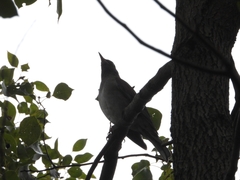
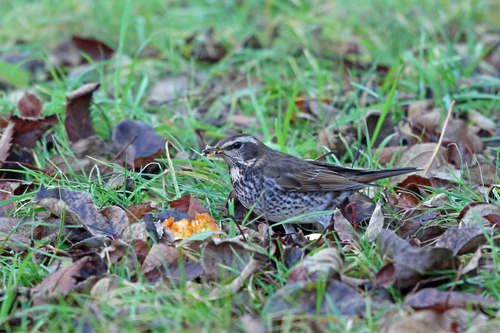
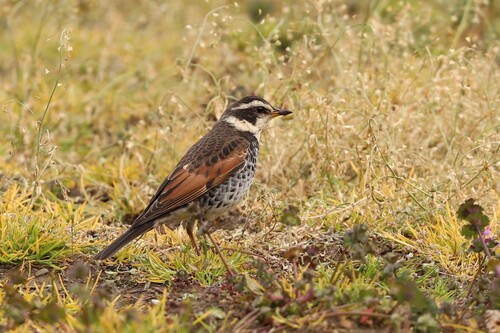
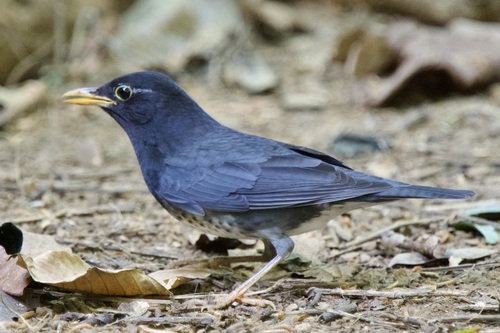
The pale thrush (Turdus pallidus) is a passerine bird of the eastern Palearctic belonging to the genus Turdus in the thrush family Turdidae. It is closely related to the eye-browed thrush and grey-backed thrush. The pale thrush was formally described in 1789 by the German naturalist Johann Friedrich Gmelin in his revised and expanded edition of Carl Linnaeus's Systema Naturae. He placed it with the thrushes in the genus Turdus and coined the binomial name Turdus pallidus. The scientific name comes from Latin Turdus meaning "thrush" and pallidus meaning "pallid" or "pale". Gmelin based his account on the "Pale thrush" that had been described in 1783 by the English ornithologist John Latham in his multi-volume work A General Synopsis of Birds. The species is monotypic: no subspecies are recognised.

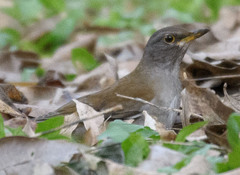
It is 23 cm long. The feet are pale pinkish-brown and the bill is grey above and yellow below. The male is brown above with a blue-grey head and throat. The underparts are pale brown, darker on the flanks and whitish on the belly and undertail-coverts. The flight feathers of the wing are dark grey and the underwing-coverts are grey or white. The tail is dark... Wikipedia →

Sounds

Call0:24

China · 2025

© Bo Shunqi 薄顺奇 · XC1180635 · CC BY-NC-SA 4.0

Song0:10

Russian Federation · 1994

© Vadim Ivushkin · XC805719 · CC BY-NC-SA 4.0

Alarm call0:10

China · 2020

© Ray Tsu 诸仁 · XC748573 · CC BY-NC-SA 4.0

Global Distribution

Parks Where Found

# Park Country Daily sighting probability
1 Taroko National Park 🇹🇼 Taiwan
~10%

More parks will be added in future updates.

Cities Where Found

# City Country Daily sighting probability
1 Fukuoka 🇯🇵 Japan
~40%
2 Shanghai 🇨🇳 China
~30%
3 Fuzhou 🇨🇳 China
~20%
4 Sendai 🇯🇵 Japan
~20%
5 Osaka 🇯🇵 Japan
~20%
6 Nagoya 🇯🇵 Japan
~20%
7 Xiamen City 🇨🇳 China
~10%
8 Jinhua 🇨🇳 China
~10%
9 Tokyo 🇯🇵 Japan
~10%
10 Hiroshima 🇯🇵 Japan
~10%

Zoos & Centres Where Found

# Zoo / Centre Country
1 Ueno Zoo 🇯🇵 Japan In captivity
2 Ueno Zoological Gardens (West Garden) 🇯🇵 Japan In captivity

Before you go

What are the chances of seeing a Pale Thrush in Beijing?

Rare

Under 5% of wildlife watchers report a Pale Thrush sighting in Beijing on a given day, based on 8 verified sightings from GBIF citizen-science data. It is the 296th most-seen of the 324 birds we can rate there. Over three days the chance rises to under 5%, if each day is a fresh chance.

When is the best time to see a Pale Thrush in Beijing?

Any time of year

In every month with enough records, under 5% of wildlife watchers report a Pale Thrush in Beijing on a given day, so our monthly data shows no clear season.

What time of day is best to see a Pale Thrush?

Between 8 and 11 am

Across all the parks we cover, that three-hour window holds the most Pale Thrush sightings with a recorded time, and about 9 in 10 of them come between 6 am and 6 pm: it is a daytime animal.

Is Beijing the best place to see a Pale Thrush?

26th of 26

Of the 26 cities where we can rate Pale Thrush sightings, Beijing ranks 26th at under 5%. The best odds are in Fukuoka (Japan, about 40%), Shanghai (China, about 30%) and Fuzhou (China, about 20%).

Which relatives of the Pale Thrush live in Beijing?

Same genus: Turdus

The closest relatives of the Pale Thrush that you can see in Beijing (genus Turdus, Typical Thrushes) are Chinese Blackbird (about 60%), Naumann's Thrush (about 20%) and Red-throated Thrush (about 10%), with each one's daily chance of a sighting.

Where does the Pale Thrush sighting chance come from?

GBIF citizen-science records

It is estimated from how often the Pale Thrush is recorded against all the birds logged in Beijing (8 verified sightings), calibrated against known sighting rates. Figures are rounded to the nearest 10% because citizen-science data supports honest approximations, not decimals, and months with records from fewer than five people show "—". How it works.

← Back to Beijing