Scaly-sided Merganser

Scaly-sided Merganser

Mergus squamatus

Silhouette: Sheatherius · PhyloPic

LCNTVUENEndangeredCR
Daily sighting probability <5% · Rare
at Beijing

In 3 days <5%

5 Verified sightings at Beijing
December Best month
☀️ Diurnal When it's spotted

About the Scaly-sided Merganser

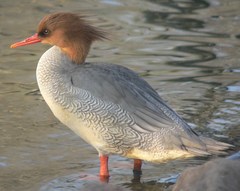
The scaly-sided merganser or Chinese merganser (Mergus squamatus) is an endangered typical merganser (genus Mergus). It lives in Manchuria and extreme Southeast Siberia, breeding in the north and wintering in the south. This striking sea duck has a thin red bill and a scaled dark pattern on the flanks and rump. Both sexes have a crest of wispy elongated feathers, reaching almost to the shoulders in adult males and being fairly short in females and immatures. The adult male has a black head and neck, white breast and underparts, and blackish mantle and wings, except for the white innerwings. The scaling is also black, while the tail is medium grey. The female has a buffish head and otherwise replaces the male's black with grey colour. The legs are orange-red and the irides dark brown in both sexes.

Their breeding habitat is rivers in primary forest in the southeastern Russian Far East, perhaps in North Korea, and in two locations Changbai Mountains and small isolated location in Lesser Xingan Mtns. in northeastern China. The bulk of the species' population breed in Russian Far East (85%) and Changbaishan both in China and DPRK M. squamatus are migratory... Wikipedia →

Sounds

Song0:07

China · 2011

© QING ZENG · XC435910 · CC BY-NC-SA 4.0

Global Distribution

Parks Where Found

# Park Country Daily sighting probability

More parks will be added in future updates.

Cities Where Found

# City Country Daily sighting probability
1 Beijing 🇨🇳 China
<5%

Zoos & Centres Where Found

# Zoo / Centre Country
1 Disney's Animal Kingdom 🇺🇸 United States In captivity
2 Denver Zoo 🇺🇸 United States In captivity
3 Ostrava Zoo 🇨🇿 Czechia In captivity
4 Zoo Miami 🇺🇸 United States In captivity
5 San Diego Zoo Safari Park 🇺🇸 United States In captivity
6 Bronx Zoo 🇺🇸 United States In captivity
7 Toledo Zoo 🇺🇸 United States In captivity
8 Fort Worth Zoo 🇺🇸 United States In captivity
9 Akron Zoo 🇺🇸 United States In captivity
10 Aquazoo Friesland 🇳🇱 Netherlands In captivity
11 Stone Zoo 🇺🇸 United States In captivity
12 Buttonwood Park Zoo 🇺🇸 United States In captivity
13 Tracy Aviary 🇺🇸 United States In captivity
14 National Aviary 🇺🇸 United States In captivity
15 't Brinkie 🇳🇱 Netherlands In captivity
16 Gator Park 🇺🇸 United States In captivity
17 Mořský svět 🇨🇿 Czechia In captivity
18 ResQue Ranch Inc. 🇺🇸 United States In captivity
19 Seattle Marine Aquarium 🇺🇸 United States In captivity
20 Zoological Wildlife Foundation 🇺🇸 United States In captivity

Before you go

What are the chances of seeing a Scaly-sided Merganser in Beijing?

Rare

Under 5% of wildlife watchers report a Scaly-sided Merganser sighting in Beijing on a given day, based on 5 verified sightings from GBIF citizen-science data. It is the 318th most-seen of the 324 birds we can rate there. Over three days the chance rises to under 5%, if each day is a fresh chance.

When is the best time to see a Scaly-sided Merganser in Beijing?

Any time of year

In every month with enough records, under 5% of wildlife watchers report a Scaly-sided Merganser in Beijing on a given day, so our monthly data shows no clear season.

What time of day is best to see a Scaly-sided Merganser?

Between 9 am and noon

Across all the parks we cover, that three-hour window holds the most Scaly-sided Merganser sightings with a recorded time, and about 9 in 10 of them come between 6 am and 6 pm: it is a daytime animal.

Where else can you see a Scaly-sided Merganser?

Only Beijing, in our data

Beijing is the only city on Wallace's Line with enough records to rate Scaly-sided Merganser sightings: under 5% of wildlife watchers there report one on a given day.

Where does the Scaly-sided Merganser sighting chance come from?

GBIF citizen-science records

It is estimated from how often the Scaly-sided Merganser is recorded against all the birds logged in Beijing (5 verified sightings), calibrated against known sighting rates. Figures are rounded to the nearest 10% because citizen-science data supports honest approximations, not decimals, and months with records from fewer than five people show "—". How it works.

← Back to Beijing