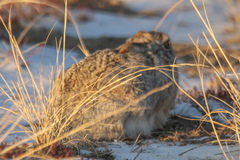
Tolai Hare

Tolai Hare

Lepus tolai

Silhouette: Jan A. Venter, Herbert H. T. Prins, David A. Balfour & Rob Slotow (vectorized by T. Michael Keesey) · PhyloPic

LCLeast ConcernNTVUENCR
Daily sighting probability <5% · Rare
at Beijing

In 3 days ~10% in a week ~30%

10 Verified sightings at Beijing
5 In 1 park From 2019 to 2026
February Best month
🌅 Crepuscular When it's spotted

About the Tolai Hare

The tolai hare (Lepus tolai) is a species of hare native to Central Asia, including much of Mongolia, eastern Iran, Afghanistan, southern Kazakhstan, Turkmenistan, Uzbekistan, Kyrgyzstan, and North and Central China. It inhabits semi-desert, steppes, rocky habitats, grasslands, and river valleys. A yellow, brown or grey-furred hare with long, black tipped ears, the adult tolai hare weighs between 1.7 and 2.7 kilograms (3.7 and 6.0 pounds) and measures between 40 and 59 centimetres (16 and 23 inches). It is mainly active at dusk and night but is occasionally active during the day to forage for seeds, roots, and other plant matter. Young hares are often more active in daylight hours.

A widespread, fairly common species, the tolai hare has a stable population. It breeds often, two to three times per year, and is hunted for its meat, fur, and for use in traditional medicine. Hustai National Park is one of several protected areas where the hare can be found. Authorities in China and Mongolia, as well as the International Union for Conservation of Nature, consider it a least-concern species.

The tolai hare was first described by the German naturalist Peter Simon... Wikipedia →

Global Distribution

Parks Where Found

# Park Country Daily sighting probability
1 Gobi Gurvansaikhan National Park 🇲🇳 Mongolia
~40%

More parks will be added in future updates.

Cities Where Found

# City Country Daily sighting probability
1 Beijing 🇨🇳 China
<5%

Before you go

What are the chances of seeing a Tolai Hare in Beijing?

Rare

Under 5% of wildlife watchers report a Tolai Hare sighting in Beijing on a given day, based on 10 verified sightings from GBIF citizen-science data. It is the 6th most-seen of the 8 mammals we can rate there. Over three days the chance rises to about 10%, and over a week to about 30%, if each day is a fresh chance.

When is the best time to see a Tolai Hare in Beijing?

February, April–May and December

In those months about 10% of wildlife watchers report a Tolai Hare in Beijing on a given day, against under 5% in January, March and June–November, the lowest months. Those are among Beijing's driest months, with about 20 mm of rain a month against 150 mm in July.

What time of day is best to see a Tolai Hare?

Between 11 am and 2 pm

Across all the parks we cover, that three-hour window holds the most Tolai Hare sightings with a recorded time, and about 6 in 10 of them come between 6 am and 6 pm: it is most active around dawn and dusk.

Where else can you see a Tolai Hare?

Only Beijing, in our data

Beijing is the only city on Wallace's Line with enough records to rate Tolai Hare sightings: under 5% of wildlife watchers there report one on a given day.

Where does the Tolai Hare sighting chance come from?

GBIF citizen-science records

It is estimated from how often the Tolai Hare is recorded against all the mammals logged in Beijing (10 verified sightings), calibrated against known sighting rates. Figures are rounded to the nearest 10% because citizen-science data supports honest approximations, not decimals, and months with records from fewer than five people show "—". How it works.

← Back to Beijing