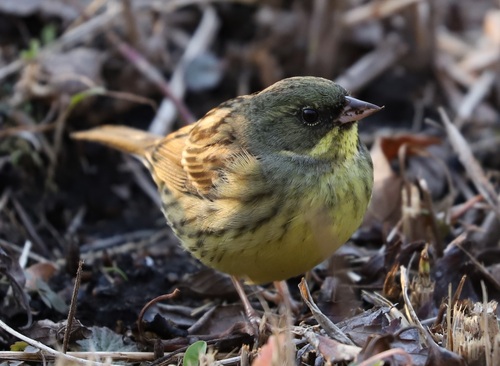
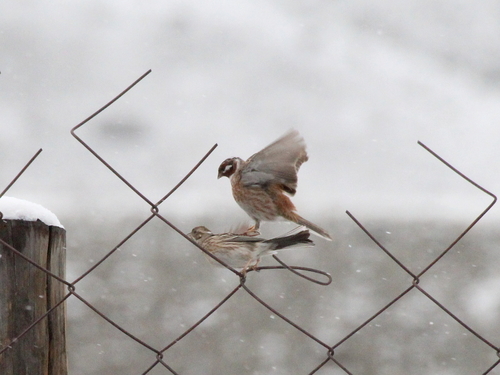
Yellow-breasted Bunting

Yellow-breasted Bunting

Emberiza aureola

Silhouette: L. Shyamal · PhyloPic

LCNTVUENCRCritically Endangered
Daily sighting probability ~10% · With luck
at Beijing

In 3 days ~20% in a week ~40%

37 Verified sightings at Beijing
69 In 1 park From 2019 to 2026
August Best month
☀️ Diurnal When it's spotted

About the Yellow-breasted Bunting

The yellow-breasted bunting (Emberiza aureola) is a passerine bird in the bunting family Emberizidae that is found across the Boreal and East Palearctic. The genus name Emberiza is from Old German Embritz, a bunting. The specific aureola is Latin for "golden". The bird's call is a distinctive zick, and the song is a clear tru-tru, tri-tri.

Until 2004, the International Union for Conservation of Nature considered the yellow-breasted bunting to be a species of least concern. Since 2004, it has been gradually upgraded to a status of Critically Endangered due to rapid drops in population sizes. It is subject to heavy hunting pressure in China, through which most specimens pass during migration.

The yellow-breasted bunting is a small passerine, ranging from 14 to 16 cm (5.5 to 6.3 in) in length, and weighing 17 to 26 g (0.6 to 0.9 oz). For a bunting, it is large and rather stocky. The breeding male has bright white underparts with black flank streaks, brown upperparts, black face and throat bar, and a pink lower mandible. The female has a heavily streaked grey-brown back, and less intensely yellow underparts. She has a whitish face with dark crown, eye and cheek stripes... Wikipedia →


Sounds

Recording1:07

Russia · 2026

© naturalisttt · iNaturalist · CC BY-NC 4.0

Recording0:27

Russia · 2026

© nadezhda_boiko · iNaturalist · CC BY-NC 4.0

Recording0:08

Russia · 2025

© Сергей · iNaturalist · CC BY-NC 4.0

Global Distribution

Parks Where Found

# Park Country Daily sighting probability
1 Chitwan National Park 🇳🇵 Nepal
<5%

More parks will be added in future updates.

Cities Where Found

# City Country Daily sighting probability
1 Kolkata 🇮🇳 India
~10%
2 Beijing 🇨🇳 China
~10%
3 Kathmandu 🇳🇵 Nepal
<5%
4 Bangkok 🇹🇭 Thailand
<5%
5 Guangzhou 🇨🇳 China
<5%
6 Hong Kong 🇨🇳 China
<5%
7 Taipei 🇹🇼 Taiwan
<5%

Before you go

What are the chances of seeing a Yellow-breasted Bunting in Beijing?

With luck

About 10% of wildlife watchers report a Yellow-breasted Bunting sighting in Beijing on a given day, based on 37 verified sightings from GBIF citizen-science data. It is the 74th most-seen of the 324 birds we can rate there. Over three days the chance rises to about 20%, and over a week to about 40%, if each day is a fresh chance.

When is the best time to see a Yellow-breasted Bunting in Beijing?

August and September

In those months about 20% of wildlife watchers report a Yellow-breasted Bunting in Beijing on a given day, against under 5% in June–July and November–April, the lowest months. Those are among Beijing's wettest months, with about 85 mm of rain a month against almost none in January.

What time of day is best to see a Yellow-breasted Bunting?

Between 8 and 11 am

Across all the parks we cover, that three-hour window holds the most Yellow-breasted Bunting sightings with a recorded time, and about 8 in 10 of them come between 6 am and 6 pm: it is a daytime animal.

Is Beijing the best place to see a Yellow-breasted Bunting?

Among the best

Of the 7 cities where we can rate Yellow-breasted Bunting sightings, Beijing ranks 2nd at about 10%, level with the leaders once rounded. The best odds are in Kolkata (India, about 10%).

Which relatives of the Yellow-breasted Bunting live in Beijing?

Same genus: Emberiza

The closest relatives of the Yellow-breasted Bunting that you can see in Beijing (genus Emberiza, Old World Buntings) are Little Bunting (about 20%), Yellow-throated Bunting (about 10%) and Pallas's Bunting (about 10%), with each one's daily chance of a sighting.

Where does the Yellow-breasted Bunting sighting chance come from?

GBIF citizen-science records

It is estimated from how often the Yellow-breasted Bunting is recorded against all the birds logged in Beijing (37 verified sightings), calibrated against known sighting rates. Figures are rounded to the nearest 10% because citizen-science data supports honest approximations, not decimals, and months with records from fewer than five people show "—". How it works.

← Back to Beijing