Citron Bug

Citron Bug

Leptoglossus gonagra

Daily sighting probability <5% · Rare
at Belo Horizonte

In 3 days ~10% in a week ~30%

7 Verified sightings at Belo Horizonte
7 In 1 park From 2019 to 2026
April Best month
☀️ Diurnal When it's spotted

About the Citron Bug

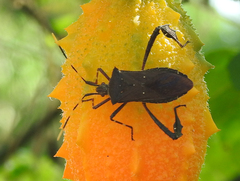
Leptoglossus gonagra, known as the passionvine bug, citron bug or squash bug in different parts of its range, is a species of leaf-footed bug in the family Coreidae. It is found in Africa, the Caribbean, Central America, North America, South America, Southern Asia, the Pacific Ocean and Oceania.

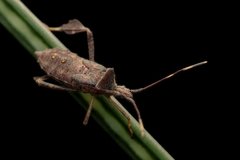
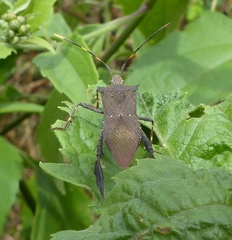
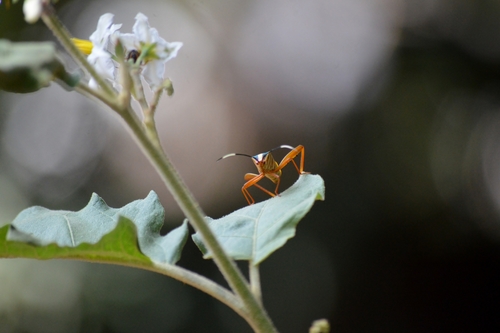
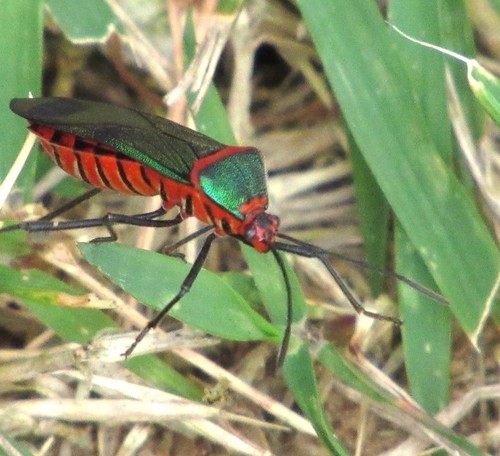
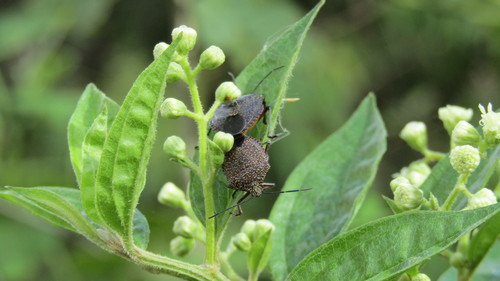
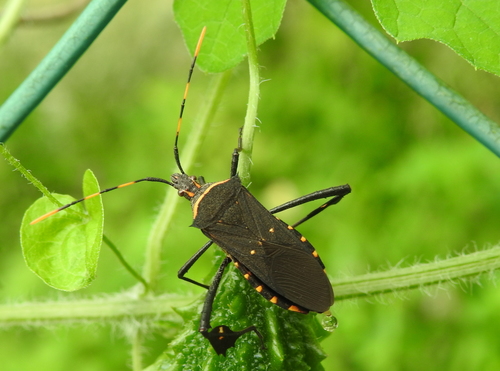
This leaf-footed plant bug is elongated and about 18 mm (0.7 in) long and 6 mm (0.2 in) wide. The long antennae are banded in black and orange, and there is a pale orangish transverse band at the front of the broad plate covering the prothorax. The remaining surface is dark brown or a dull purplish-black, with small orange spots on the underside of the thorax and abdomen, and a pair of orange spots on the two rear, enlarged, flattened tibiae.

Leptoglossus gonagra is found in much of sub-Saharan Africa, southern Asia, the Pacific area, northern Australia, North, Central and South America and the Caribbean area. Its host range includes mung beans, navy beans, cowpeas, legumes, passion fruit, cacao, coffee, avocado, macadamia, mango, cashew, citrus, pomegranate and cucurbits.

The female attaches chains of about 16 eggs in lines... Wikipedia →
Global Distribution

Parks Where Found

# Park Country Daily sighting probability
1 Kruger National Park 🇿🇦 South Africa
<5%

More parks will be added in future updates.

Cities Where Found

# City Country Daily sighting probability
1 Cebu City 🇵🇭 Philippines
~30%
2 Valencia 🇻🇪 Venezuela
~20%
3 Davao City 🇵🇭 Philippines
~20%
4 Nairobi 🇰🇪 Kenya
~10%
5 Jakarta 🇮🇩 Indonesia
~10%
6 Manila 🇵🇭 Philippines
~10%
7 San José 🇨🇷 Costa Rica
<5%
8 Medellín 🇨🇴 Colombia
<5%
9 Belo Horizonte 🇧🇷 Brazil
<5%
10 São Paulo 🇧🇷 Brazil
<5%

Before you go

What are the chances of seeing a Citron Bug in Belo Horizonte?

Rare

Under 5% of wildlife watchers report a Citron Bug sighting in Belo Horizonte on a given day, based on 7 verified sightings from GBIF citizen-science data. It is the 121st most-seen of the 186 insects we can rate there. Over three days the chance rises to about 10%, and over a week to about 30%, if each day is a fresh chance.

When is the best time to see a Citron Bug in Belo Horizonte?

February and April–June

In those months about 10% of wildlife watchers report a Citron Bug in Belo Horizonte on a given day, against under 5% in March and July–January, the lowest months. Those are among Belo Horizonte's driest months, with about 55 mm of rain a month against 270 mm in December.

What time of day is best to see a Citron Bug?

Between 8 and 11 am

Across all the parks we cover, that three-hour window holds the most Citron Bug sightings with a recorded time, and about 9 in 10 of them come between 6 am and 6 pm: it is a daytime animal.

Is Belo Horizonte the best place to see a Citron Bug?

9th of 18

Of the 18 cities where we can rate Citron Bug sightings, Belo Horizonte ranks 9th at under 5%. The best odds are in Cebu City (Philippines, about 30%), Valencia (Venezuela, about 20%) and Davao City (Philippines, about 20%).

Which relatives of the Citron Bug live in Belo Horizonte?

Same family: Coreidae

The closest relatives of the Citron Bug that you can see in Belo Horizonte (family Coreidae, Leaf-footed Bugs) are Hypselonotus interruptus (about 10%) and Lucullia flavovittata (about 10%), with each one's daily chance of a sighting.

Where does the Citron Bug sighting chance come from?

GBIF citizen-science records

It is estimated from how often the Citron Bug is recorded against all the insects logged in Belo Horizonte (7 verified sightings), calibrated against known sighting rates. Figures are rounded to the nearest 10% because citizen-science data supports honest approximations, not decimals, and months with records from fewer than five people show "—". How it works.

← Back to Belo Horizonte