Common Krait

Common Krait

Bungarus caeruleus

Silhouette: Michael Scroggie, from original photograph by Gary M. Stolz, USFWS (original photograph in public domain). · PhyloPic

LCLeast ConcernNTVUENCR
Daily sighting probability ~10% · With luck
at Bengaluru

In 3 days ~20% in a week ~30%

6 Verified sightings at Bengaluru
September Best month
☀️🌙 Day & Night When it's spotted

About the Common Krait

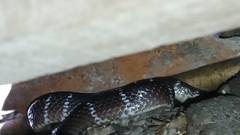
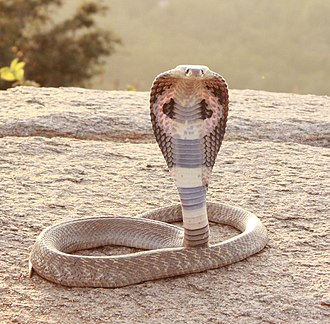
The common krait (Bungarus caeruleus) is a highly venomous snake species belonging to the genus Bungarus in the family Elapidae. It has a black or bluish-black body with narrow white crossbands, typically reaching a length of 0.91 to 1.22 m (3 to 4 ft). It is widely distributed across India, Pakistan, Bangladesh, Sri Lanka and Nepal, inhabiting grasslands, agricultural fields, and human settlements. It is known for its potent neurotoxic venom and responsible for the majority of medically significant snakebites in the Indian subcontinent.

The average length of the common krait is 0.9 m (2 ft 11 in), but it can grow to 1.75 m (5 ft 9 in). Males are longer than females, with proportionately longer tails. The head is flat and the neck is hardly visible. The body is cylindrical, tapering towards the tail. The tail is short and rounded. The eyes are rather small, with rounded pupils, indistinguishable in life. The head shields are normal, with no loreals; four shields occur along the margin of the lower lip; the third and fourth supraoculars touch the eye. The scales are highly polished, in 15–17 rows; the vertebral row is distinctly enlarged and hexagonal. Ventrals number... Wikipedia →

Global Distribution

Parks Where Found

# Park Country Daily sighting probability

More parks will be added in future updates.

Cities Where Found

# City Country Daily sighting probability
1 Lucknow 🇮🇳 India
~30%
2 Pune 🇮🇳 India
~10%
3 Bengaluru 🇮🇳 India
~10%

Zoos & Centres Where Found

# Zoo / Centre Country
1 Crocodile Bank 🇮🇳 India In captivity
2 Thrissur Zoo 🇮🇳 India In captivity

Before you go

What are the chances of seeing a Common Krait in Bengaluru?

With luck

About 10% of wildlife watchers report a Common Krait sighting in Bengaluru on a given day, based on 6 verified sightings from GBIF citizen-science data. It is the 25th most-seen of the 26 reptiles we can rate there. Over three days the chance rises to about 20%, and over a week to about 30%, if each day is a fresh chance.

When is the best time to see a Common Krait in Bengaluru?

May, August–September and November

In those months about 10% of wildlife watchers report a Common Krait in Bengaluru on a given day, against under 5% in June–July, October and December–April, the lowest months. Those are among Bengaluru's wettest months, with about 110 mm of rain a month against almost none in January.

What time of day is best to see a Common Krait?

Between 7 and 10 pm

Across all the parks we cover, that three-hour window holds the most Common Krait sightings with a recorded time, and about 6 in 10 of them come between 6 pm and 6 am: it is seen both by day and at night.

Is Bengaluru the best place to see a Common Krait?

3rd of 3

Of the 3 cities where we can rate Common Krait sightings, Bengaluru ranks 3rd at about 10%. The best odds are in Lucknow (India, about 30%) and Pune (India, about 10%).

Where does the Common Krait sighting chance come from?

GBIF citizen-science records

It is estimated from how often the Common Krait is recorded against all the reptiles logged in Bengaluru (6 verified sightings), calibrated against known sighting rates. Figures are rounded to the nearest 10% because citizen-science data supports honest approximations, not decimals, and months with records from fewer than five people show "—". How it works.

← Back to Bengaluru