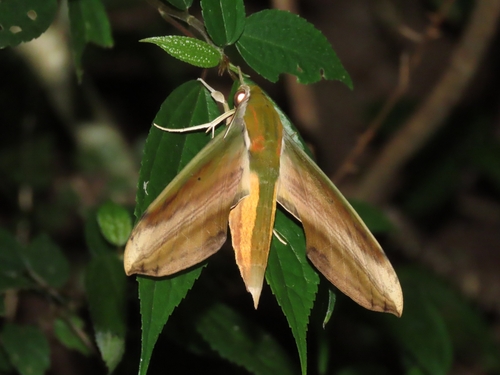
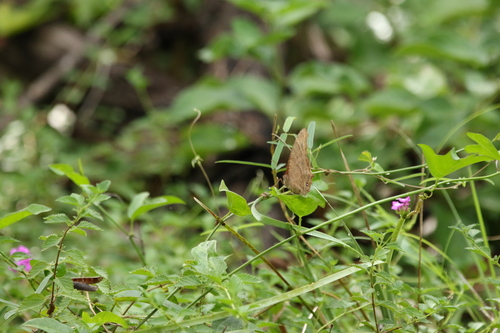
Greater Death's Head Hawkmoth

Greater Death's Head Hawkmoth

Acherontia lachesis

Daily sighting probability ~10% · With luck
at Bengaluru

In 3 days ~20% in a week ~30%

15 Verified sightings at Bengaluru
9 In 1 park From 2019 to 2026
October Best month
☀️🌙 Day & Night When it's spotted

About the Greater Death's Head Hawkmoth

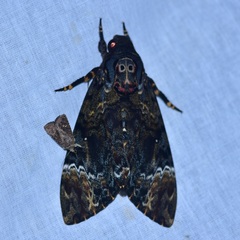
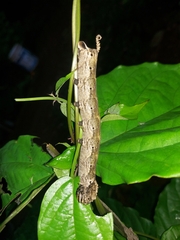
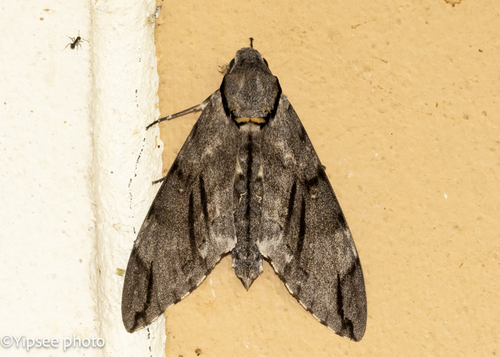
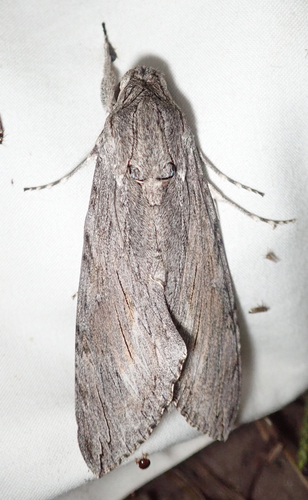
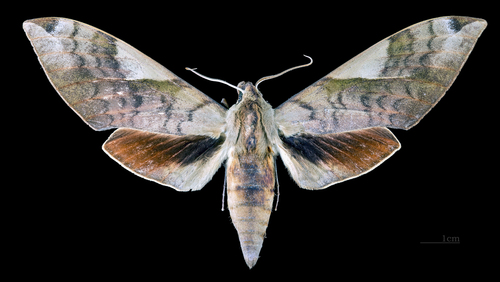
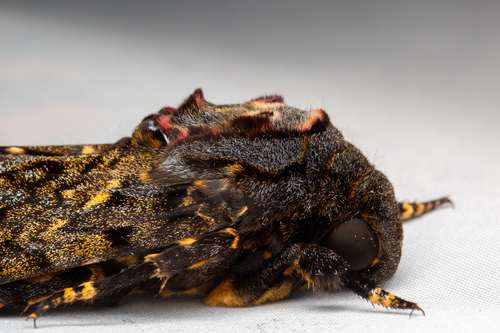
Acherontia lachesis, the greater death's head hawkmoth or bee robber, is a large (up to 13 cm wingspan) sphingid moth found in India, Sri Lanka and much of the East Asian region. It is one of the three species of death's-head hawkmoth genus, Acherontia. The species was first described by Johan Christian Fabricius in 1798. It is nocturnal and very fond of honey; they can mimic the scent of honey bees so that they can enter a hive unharmed to get honey. Their tongue, which is stout and very strong, enables them to pierce the wax cells and suck the honey out. This species occurs throughout almost the entire Oriental region, from India, Pakistan and Nepal to the Philippines, and from southern Japan and the southern Russian Far East to Indonesia, where it attacks colonies of several different honey bee species. It has recently become established on the Hawaiian Islands.

A. lachesis is much larger than Acherontia styx. The segmental bands and grey stripe occupy so much of the abdomen that only small patches of yellow are left. The hindwing has a large black patch at the base. The medial and post-medial bands are so broad that only narrow bands of yellow remain. The ventral... Wikipedia →

Global Distribution

Parks Where Found

# Park Country Daily sighting probability
1 Khao Yai National Park 🇹🇭 Thailand
~10%

More parks will be added in future updates.

Cities Where Found

# City Country Daily sighting probability
1 Jakarta 🇮🇩 Indonesia
~10%
2 Tainan 🇹🇼 Taiwan
~10%
3 Kaohsiung 🇹🇼 Taiwan
~10%
4 Zhuhai [Macau] 🇨🇳 China
~10%
5 Hong Kong 🇨🇳 China
~10%
6 Bengaluru 🇮🇳 India
~10%
7 Taipei 🇹🇼 Taiwan
~10%
8 Chennai 🇮🇳 India
~10%
9 Tuen Mun 🇨🇳 China
~10%
10 Hyderabad 🇮🇳 India
~10%

Before you go

What are the chances of seeing a Greater Death's Head Hawkmoth in Bengaluru?

With luck

About 10% of wildlife watchers report a Greater Death's Head Hawkmoth sighting in Bengaluru on a given day, based on 15 verified sightings from GBIF citizen-science data. It is the 234th most-seen of the 477 insects we can rate there. Over three days the chance rises to about 20%, and over a week to about 30%, if each day is a fresh chance.

When is the best time to see a Greater Death's Head Hawkmoth in Bengaluru?

September to March

In those months about 10% of wildlife watchers report a Greater Death's Head Hawkmoth in Bengaluru on a given day, against under 5% in April to August, the lowest months.

What time of day is best to see a Greater Death's Head Hawkmoth?

Between 6 and 9 am

Across all the parks we cover, that three-hour window holds the most Greater Death's Head Hawkmoth sightings with a recorded time, and about half of them come between 6 am and 6 pm: it is seen both by day and at night.

Is Bengaluru the best place to see a Greater Death's Head Hawkmoth?

Among the best

Of the 15 cities where we can rate Greater Death's Head Hawkmoth sightings, Bengaluru ranks 6th at about 10%, level with the leaders once rounded. The best odds are in Jakarta (Indonesia, about 10%), Tainan (Taiwan, about 10%) and Kaohsiung (Taiwan, about 10%).

Where does the Greater Death's Head Hawkmoth sighting chance come from?

GBIF citizen-science records

It is estimated from how often the Greater Death's Head Hawkmoth is recorded against all the insects logged in Bengaluru (15 verified sightings), calibrated against known sighting rates. Figures are rounded to the nearest 10% because citizen-science data supports honest approximations, not decimals, and months with records from fewer than five people show "—". How it works.
← Back to Bengaluru