Wandering Midget

Wandering Midget

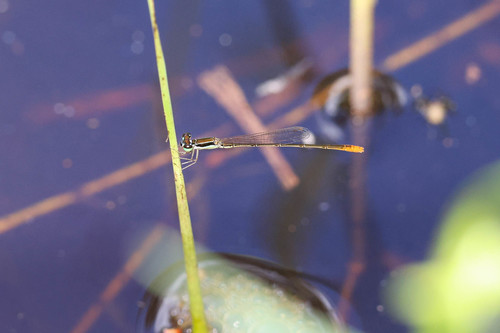
Agriocnemis pygmaea

Daily sighting probability ~40% · Likely
at Berhampore

In 3 days ~80% in a week >90%

19 Verified sightings at Berhampore
8 In 1 park From 2019 to 2026
September Best month
☀️🌙 Day & Night When it's spotted

About the Wandering Midget

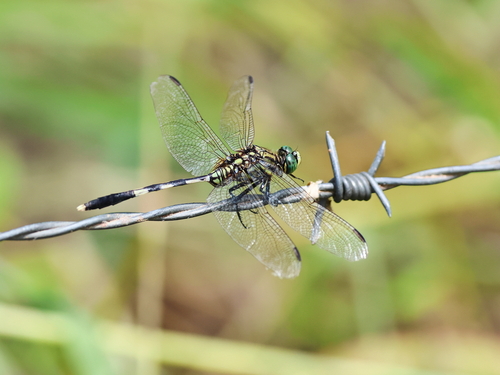
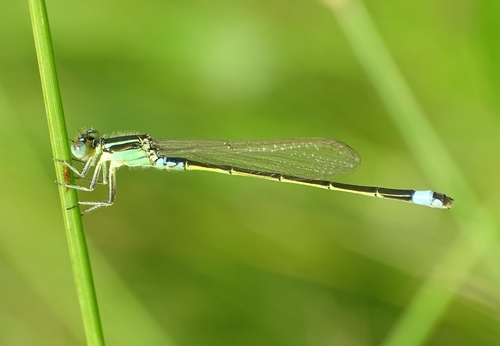
Agriocnemis pygmaea (pygmy wisp) is a species of damselfly in the family Coenagrionidae. It is also known as wandering midget, pygmy dartlet or wandering wisp. It is well distributed across Asia and parts of Australia. Agriocnemis pygmaea is a small damselfly with black capped green eyes, black thorax with apple green stripes on lateral sides. Segments 1 to 7 of its abdomen is black on dorsum and pale green on ventral half. The remaining segments are orange-red. Very old males may get pruinosed on the dorsum of the head and the thorax with snowy white, making all the markings beneath being quite obscured. Female is more robust and exhibits several color morphs. The green color of the male is replaced by red in the females in the red forms. In androchrome forms, the female has same green colors as in the male. Female colour variation is depended on ontogenic colour change

associated with sexual development too. Agriocnemis pygmaea breeds in marshes and ponds. The genus name Agriocnemis is derived from two Greek words: agrion or ἄγριος, meaning wild, and cnemis or κνημίς, meaning legging. Agrion was the name given in 1775 by Johan Fabricius... Wikipedia →

Global Distribution

Parks Where Found

# Park Country Daily sighting probability
1 Sundarbans National Park 🇮🇳 India
~30%

More parks will be added in future updates.

Cities Where Found

# City Country Daily sighting probability
1 Berhampore 🇮🇳 India
~40%
2 Tiruchirappalli 🇮🇳 India
~40%
3 Kolkata 🇮🇳 India
~30%
4 Chennai 🇮🇳 India
~30%
5 Prayagraj 🇮🇳 India
~30%
6 Jamshedpur 🇮🇳 India
~30%
7 Thrissur 🇮🇳 India
~30%
8 Vadodara 🇮🇳 India
~30%
9 Surat 🇮🇳 India
~30%
10 Kota 🇮🇳 India
~30%

Before you go

What are the chances of seeing a Wandering Midget in Berhampore?

Likely

About 40% of wildlife watchers report a Wandering Midget sighting in Berhampore on a given day, based on 19 verified sightings from GBIF citizen-science data. It is the 2nd most-seen of the 21 insects we can rate there. Over three days the chance rises to about 80%, and over a week to over 90%, if each day is a fresh chance.

When is the best time to see a Wandering Midget in Berhampore?

September

In that month about 80% of wildlife watchers report a Wandering Midget in Berhampore on a given day, against under 5% in August and October–November, the lowest months. That is one of Berhampore's wettest months, with about 210 mm of rain against 5 mm in December.

What time of day is best to see a Wandering Midget?

Between 10 am and 1 pm

Across all the parks we cover, that three-hour window holds the most Wandering Midget sightings with a recorded time, and about 6 in 10 of them come between 6 am and 6 pm: it is seen both by day and at night.

Is Berhampore the best place to see a Wandering Midget?

Yes

Of the 41 cities where we can rate Wandering Midget sightings, Berhampore has the highest daily chance: about 40%. Next come Tiruchirappalli (India, about 40%) and Kolkata (India, about 30%).

Where does the Wandering Midget sighting chance come from?

GBIF citizen-science records

It is estimated from how often the Wandering Midget is recorded against all the insects logged in Berhampore (19 verified sightings), calibrated against known sighting rates. Figures are rounded to the nearest 10% because citizen-science data supports honest approximations, not decimals, and months with records from fewer than five people show "—". How it works.
← Back to Berhampore