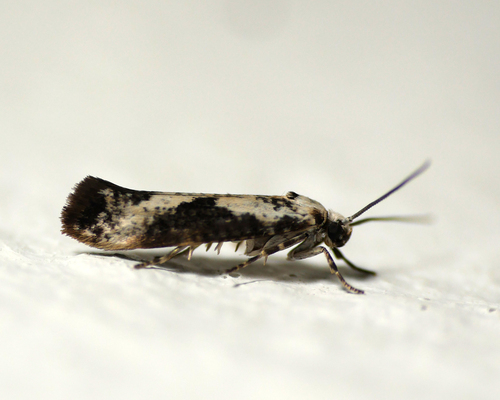
Ash Bud Moth

Ash Bud Moth

Prays fraxinella

Daily sighting probability <5% · Rare
at Birmingham

In 3 days ~10% in a week ~20%

5 Verified sightings at Birmingham
June Best month
☀️🌙 Day & Night When it's spotted

About the Ash Bud Moth

Prays fraxinella, also known as the ash bud moth, is a moth of the family Plutellidae found in Europe. The larvae are leaf miners, feeding on the leaves and buds of ash trees. The wingspan is 14–18 mm. The head is white or greyish ochreous. Forewings are white or greyish-ochreous; some blackish dorsal strigulae; a triangular blackish blotch, lighter or mixed with whitish on costa, extending along costa from near base to 2/3; some irregular blackish marks towards termen; sometimes the whole wing is unicolorous dark fuscous. Hind wings are rather dark grey. The larva is greenish, marbled with red -brown above; dorsal line deep green; head pale brown, dark-spotted; 2 with two black spots.

Adults are on wing from May to June and again in August in two generations depending on the location. Prays fraxinella has two colour forms, the typical white and black colouration and the melanic form f.rustica. Recently, the form f.rustica, that has an orange head has been separated into an entirely new species, Prays ruficeps.

Ovum Eggs are laid on the twigs of ash (Fraxinus excelsior) and manna ash (Fraxinus ornus) in June and July. Larva When fully fed the larvae are 12 mm long... Wikipedia →
Global Distribution

Parks Where Found

# Park Country Daily sighting probability

More parks will be added in future updates.

Cities Where Found

# City Country Daily sighting probability
1 London 🇬🇧 United Kingdom
<5%
2 Birmingham 🇬🇧 United Kingdom
<5%
3 Moscow 🇷🇺 Russia
<5%

Before you go

What are the chances of seeing an Ash Bud Moth in Birmingham?

Rare

Under 5% of wildlife watchers report an Ash Bud Moth sighting in Birmingham on a given day, based on 5 verified sightings from GBIF citizen-science data. It is the 745th most-seen of the 811 insects we can rate there. Over three days the chance rises to about 10%, and over a week to about 20%, if each day is a fresh chance.

When is the best time to see an Ash Bud Moth in Birmingham?

June

In that month about 10% of wildlife watchers report an Ash Bud Moth in Birmingham on a given day, against under 5% in July to May, the lowest months.

What time of day is best to see an Ash Bud Moth?

Between 9 am and noon

Across all the parks we cover, that three-hour window holds the most Ash Bud Moth sightings with a recorded time, and about 6 in 10 of them come between 6 am and 6 pm: it is seen both by day and at night.

Is Birmingham the best place to see an Ash Bud Moth?

Among the best

Of the 3 cities where we can rate Ash Bud Moth sightings, Birmingham ranks 2nd at under 5%, level with the leaders once rounded. The best odds are in London (United Kingdom, under 5%).

Which relatives of the Ash Bud Moth live in Birmingham?

Same order: Lepidoptera

The closest relatives of the Ash Bud Moth that you can see in Birmingham (order Lepidoptera, Butterflies and Moths) are Speckled Wood (about 50%), European Comma (about 30%) and Gatekeeper (about 30%), with each one's daily chance of a sighting.

Where does the Ash Bud Moth sighting chance come from?

GBIF citizen-science records

It is estimated from how often the Ash Bud Moth is recorded against all the insects logged in Birmingham (5 verified sightings), calibrated against known sighting rates. Figures are rounded to the nearest 10% because citizen-science data supports honest approximations, not decimals, and months with records from fewer than five people show "—". How it works.

← Back to Birmingham