Orange-Tip

Orange-Tip

Anthocharis cardamines

Daily sighting probability ~30% · Possible
at Birmingham

In 3 days ~60% in a week ~90%

296 Verified sightings at Birmingham
480 In all 17 parks From 2019 to 2026
April Best month
☀️ Diurnal When it's spotted

About the Orange-Tip

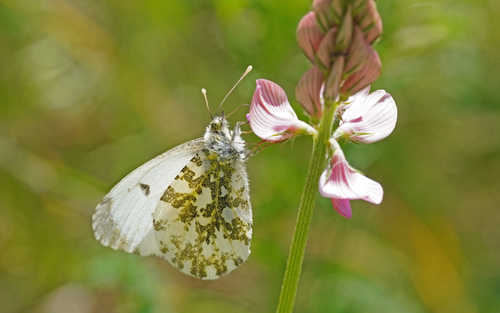
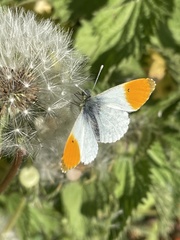
Anthocharis cardamines, the orange tip, is a butterfly in the family Pieridae, which contains about 1,100 species. A. cardamines is mainly found throughout Europe and temperate Asia (Palearctic). The males feature wings with a signature orange pigmentation, which is the origin of A. cardamines' common name.

Males and females of this species occupy different habitats: males mostly frequent the edges of forests whereas females frequent meadows. A. cardamines feeds on most plants found within its habitat but the females selectively oviposit on young inflorescence of crucifers.

Mating is usually controlled by females as virgin females found in flight are always pursued by males immediately. Females can signal different meanings to the approaching males by using their abdomen. There is evidence that mated females have an anti-aphrodisiac and that their usage of the abdomen has a closely related function in presenting these pheromones to males.

This species has been affected by changing temperatures, and its first appearance has shifted forward 17.3 days in the Spring. The common name derives from the bright orange tips of the male's forewings. The males are a common sight... Wikipedia →
Global Distribution

Parks Where Found

# Park Country Daily sighting probability
1 Białowieża National Park 🇵🇱 Poland
~30%
2 Biebrza National Park 🇵🇱 Poland
~20%
3 Aigüestortes National Park 🇪🇸 Spain
~20%
4 Mercantour National Park 🇫🇷 France
~20%
5 Triglav National Park 🇸🇮 Slovenia
~20%
6 Cairngorms National Park 🇬🇧 United Kingdom
~20%
7 Pyrénées National Park 🇫🇷 France
~20%
8 Cévennes National Park 🇫🇷 France
~10%
9 Hohe Tauern National Park 🇦🇹 Austria
~10%
10 Vanoise National Park 🇫🇷 France
~10%
11 Ecrins National Park 🇫🇷 France
~10%
12 Picos de Europa National Park 🇪🇸 Spain
~10%
13 Bavarian Forest National Park 🇩🇪 Germany
~10%
14 Sierra de Guadarrama National Park 🇪🇸 Spain
~10%
15 Snowdonia National Park 🇬🇧 United Kingdom
~10%
16 Fertő-Hanság National Park 🇭🇺 Hungary
~10%
17 Wadden Sea National Park 🇩🇪 Germany
~10%

Cities Where Found

# City Country Daily sighting probability
1 Birmingham 🇬🇧 United Kingdom
~30%
2 Manchester 🇬🇧 United Kingdom
~30%
3 Liverpool 🇬🇧 United Kingdom
~20%
4 Jerusalem 🇮🇱 Israel
~20%
5 Copenhagen 🇩🇰 Denmark
~20%
6 Prague 🇨🇿 Czechia
~10%
7 Paris 🇫🇷 France
~10%
8 Leeds 🇬🇧 United Kingdom
~10%
9 London 🇬🇧 United Kingdom
~10%
10 Kharkiv 🇺🇦 Ukraine
~10%

Before you go

What are the chances of seeing an Orange-Tip in Birmingham?

Possible

About 30% of wildlife watchers report an Orange-Tip sighting in Birmingham on a given day, based on 296 verified sightings from GBIF citizen-science data. It is the 27th most-seen of the 811 insects we can rate there. Over three days the chance rises to about 60%, and over a week to about 90%, if each day is a fresh chance.

When is the best time to see an Orange-Tip in Birmingham?

April

In that month about 60% of wildlife watchers report an Orange-Tip in Birmingham on a given day, against under 5% in July to February, the lowest months.

What time of day is best to see an Orange-Tip?

Between 11 am and 2 pm

Across all the parks we cover, that three-hour window holds the most Orange-Tip sightings with a recorded time, and about 9 in 10 of them come between 6 am and 6 pm: it is a daytime animal.

Is Birmingham the best place to see an Orange-Tip?

Yes

Of the 33 cities where we can rate Orange-Tip sightings, Birmingham has the highest daily chance: about 30%. Next come Manchester (United Kingdom, about 30%) and Liverpool (United Kingdom, about 20%).

Which relatives of the Orange-Tip live in Birmingham?

Same family: Pieridae

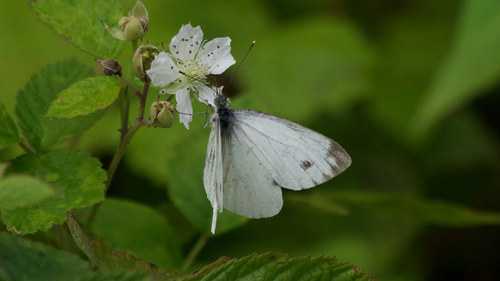
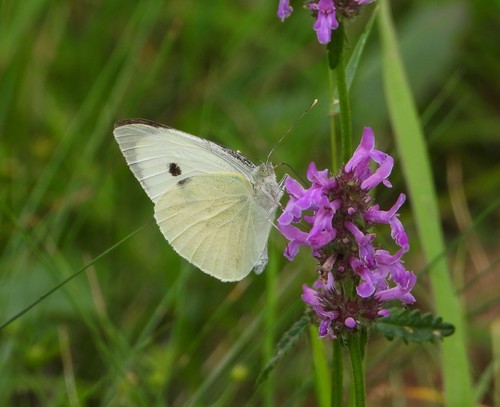
The closest relatives of the Orange-Tip that you can see in Birmingham (family Pieridae, Whites, Yellows, and Sulphurs) are Green-Veined White (about 30%), Small White (about 20%) and Large White (about 20%), with each one's daily chance of a sighting.

Where does the Orange-Tip sighting chance come from?

GBIF citizen-science records

It is estimated from how often the Orange-Tip is recorded against all the insects logged in Birmingham (296 verified sightings), calibrated against known sighting rates. Figures are rounded to the nearest 10% because citizen-science data supports honest approximations, not decimals, and months with records from fewer than five people show "—". How it works.

← Back to Birmingham