Fern Smut

Fern Smut

Psychoides filicivora

Daily sighting probability <5% · Rare
at Birmingham

In 3 days ~10% in a week ~20%

6 Verified sightings at Birmingham
October Best month

About the Fern Smut

Psychoides filicivora is a moth of the family Tineidae first described by Edward Meyrick in 1937. First found in Ireland in 1909, it is possible that the moth was introduced from imported ferns from Asia. The moth can be found from spring though autumn in a series of generations. The species overwinters as a larva.

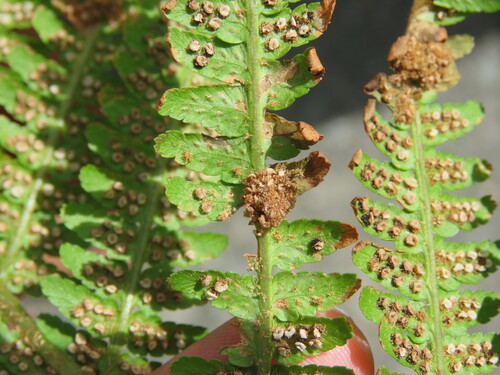
Larvae live on a variety of ferns feeding on the sporangia, or the lower surface of the frond, under the cover of sporangia spun in an irregular pile. The feeding signs of the similar fern-feeding moth, P. verhuella form a loose portable case out of spun sporangia and looks like misplaced sorus. The feeding causes browning of the upper frond. Fully grown, the larvae are c. 4–5 mm long with a pale-brown head and a pale-brown posterial margin, which has a split in the middle. The pale-brown head, translucent prothoracic plate and pale-brown tail distinguish P. filicivora from the similar larvae of P. verhuella, which has a black head and black prothoracic plate.

The following ferns have been recorded as food plants, soft shield-fern (Polystichum setiferum) male fern (Dryopteris filix-mas) hart-tongue fern (Phyllitis scolopendrium) black spleenwort... Wikipedia →

Global Distribution

Parks Where Found

# Park Country Daily sighting probability

More parks will be added in future updates.

Cities Where Found

# City Country Daily sighting probability
1 Birmingham 🇬🇧 United Kingdom
<5%

Before you go

What are the chances of seeing a Fern Smut in Birmingham?

Rare

Under 5% of wildlife watchers report a Fern Smut sighting in Birmingham on a given day, based on 6 verified sightings from GBIF citizen-science data. It is the 668th most-seen of the 811 insects we can rate there. Over three days the chance rises to about 10%, and over a week to about 20%, if each day is a fresh chance.

When is the best time to see a Fern Smut in Birmingham?

May and October

In those months about 10% of wildlife watchers report a Fern Smut in Birmingham on a given day, against under 5% in June–September and November–April, the lowest months.

Where else can you see a Fern Smut?

Only Birmingham, in our data

Birmingham is the only city on Wallace's Line with enough records to rate Fern Smut sightings: under 5% of wildlife watchers there report one on a given day.

Which relatives of the Fern Smut live in Birmingham?

Same order: Lepidoptera

The closest relatives of the Fern Smut that you can see in Birmingham (order Lepidoptera, Butterflies and Moths) are Speckled Wood (about 50%), European Comma (about 30%) and Gatekeeper (about 30%), with each one's daily chance of a sighting.

Where does the Fern Smut sighting chance come from?

GBIF citizen-science records

It is estimated from how often the Fern Smut is recorded against all the insects logged in Birmingham (6 verified sightings), calibrated against known sighting rates. Figures are rounded to the nearest 10% because citizen-science data supports honest approximations, not decimals, and months with records from fewer than five people show "—". How it works.

← Back to Birmingham