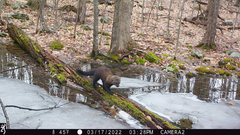
Fisher

Fisher

Pekania pennanti

Silhouette: Nobu Tamura · PhyloPic

Daily sighting probability ~10% · With luck
at Boston

In 3 days ~20% in a week ~30%

48 Verified sightings at Boston
6 In 1 park From 2019 to 2026
January Best month
☀️ Diurnal When it's spotted

About the Fisher

The fisher (Pekania pennanti) is a carnivorous mammal native to North America, a forest-dwelling creature whose range covers much of the boreal forest in Canada to the northern United States. It is a member of the mustelid family and is the only living member of the genus Pekania. Although it is sometimes referred to as a fisher cat, it is not a feline.

The fisher is similar to, but larger than, the American marten (Martes americana) and Pacific marten (Martes caurina). In some regions, the fisher is known as a pekan, derived from its name in the Abenaki language, or wejack, an Algonquian word (cf. Cree ocêk, Ojibwa ojiig) borrowed by fur traders. Other Indigenous names for the fisher are Chipewyan thacho and Carrier chunihcho, both meaning "big marten", and Wabanaki uskool.

Fishers have few predators besides humans. They have been trapped since the 18th century for their fur. Their pelts were in such demand that they became locally extinct in several parts of the United States in the early part of the 20th century. Conservation and protection measures have allowed the species to rebound, but their current range is still reduced from its historical limits. In the 1920s, when pelt prices were high, some fur farmers attempted to raise fishers. However, their unusual delayed reproduction made breeding difficult. When pelt prices fell in the late 1940s, most fisher farming ended. While fishers usually avoid human contact, encroachments into forest habitats have resulted in some conflicts.

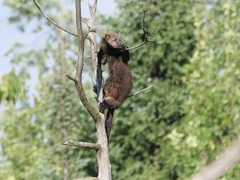
Male and female fishers look similar, but can be differentiated by size, with males being up to twice as large as the females. The fur of the fisher varies seasonally, being denser and glossier in the winter. During the summer, the color becomes more mottled, as the fur goes through a moulting cycle. The fisher prefers to hunt in the full forest. Although an agile climber, it spends most of its time on the forest floor, where it prefers to forage around fallen trees. An omnivore, it feeds on a wide variety of small animals and occasionally on fruits and mushrooms. It prefers the snowshoe hare and is one of the few animals able to prey successfully on porcupines. Despite its common name, it rarely eats fish. The reproductive cycle lasts almost a year. Female fishers give birth to a litter of three or four kits in the spring. They nurse and care for them until late summer, when they are old enough to set out on their own. Females enter estrus shortly after giving birth and leave the den to find a mate. Wikipedia →

Sounds

Recording0:08

United States · 2020

© froglover_84 · iNaturalist · CC BY-NC 4.0

Recording0:15

United States · 2026

© jwelgan · iNaturalist · CC BY-NC 4.0

Recording0:23

Canada · 2022

© Ben · iNaturalist · CC BY-NC 4.0

Global Distribution

Parks Where Found

# Park Country Daily sighting probability
1 Elk Island National Park 🇨🇦 Canada
~10%

More parks will be added in future updates.

Cities Where Found

# City Country Daily sighting probability
1 Boston 🇺🇸 United States
~10%

Zoos & Centres Where Found

# Zoo / Centre Country
1 Prague Zoo 🇨🇿 Czechia In captivity
2 Ecomuseum Zoo 🇨🇦 Canada In captivity
3 Zoo Sauvage de St-Félicien 🇨🇦 Canada In captivity
4 Squam Lakes Natural Science Center 🇺🇸 United States In captivity
5 West Virginia State Wildlife Center 🇺🇸 United States In captivity
6 Lehigh Valley Zoo 🇺🇸 United States In captivity
7 Leesburg Animal Park 🇺🇸 United States In captivity
8 Rákosův pavilon 🇨🇿 Czechia In captivity
9 Velemlokárium 🇨🇿 Czechia In captivity

Before you go

What are the chances of seeing a Fisher in Boston?

With luck

About 10% of wildlife watchers report a Fisher sighting in Boston on a given day, based on 48 verified sightings from GBIF citizen-science data. It is the 17th most-seen of the 25 mammals we can rate there. Over three days the chance rises to about 20%, and over a week to about 30%, if each day is a fresh chance.

When is the best time to see a Fisher in Boston?

January

In that month about 20% of wildlife watchers report a Fisher in Boston on a given day, against under 5% in March, May and July–October, the lowest months.

What time of day is best to see a Fisher?

Between 3 and 6 pm

Across all the parks we cover, that three-hour window holds the most Fisher sightings with a recorded time, and about 7 in 10 of them come between 6 am and 6 pm: it is a daytime animal.

Where else can you see a Fisher?

Only Boston, in our data

Boston is the only city on Wallace's Line with enough records to rate Fisher sightings: about 10% of wildlife watchers there report one on a given day.

Where does the Fisher sighting chance come from?

GBIF citizen-science records

It is estimated from how often the Fisher is recorded against all the mammals logged in Boston (48 verified sightings), calibrated against known sighting rates. Figures are rounded to the nearest 10% because citizen-science data supports honest approximations, not decimals, and months with records from fewer than five people show "—". How it works.

← Back to Boston