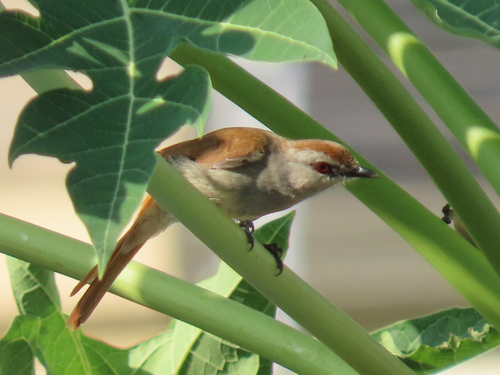
Compact Weaver

Compact Weaver

Ploceus superciliosus

Silhouette: PhyloPic

LCLeast ConcernNTVUENCR
Daily sighting probability ~10% · With luck
at Brazzaville

In 3 days ~20% in a week ~40%

6 Verified sightings at Brazzaville
260 In all 4 parks From 2019 to 2026
December Best month
☀️ Diurnal When it's spotted

About the Compact Weaver

The compact weaver (Pachyphantes superciliosus) is a species of bird in the family Ploceidae. It is the only species placed in the genus Pachyphantes. It has a highly discontinuous distribution from Senegal to Liberia, east to Ethiopia and south to Angola and the Democratic Republic of the Congo.

The compact weaver was formally described in 1873 as Hyphantornis superciliosus by the English ornithologist George Ernest Shelley based on specimens collected in West Africa. The specific epithet is Latin meaning "haughty" or "eyebrowed" from supercilium meaning "eyebrow". The compact weaver is now the only species placed in the genus Pachyphantes that was introduced for the species by Shelley in 1896. The genus name combines the Ancient Greek παχυς/pakhus meaning "large" or "thick" with ὑφαντης/huphantēs meaning "weaver". A molecular genetic study of the weaverbirds published in 2017 found that the compact weaver was sister to clade containing the fodies in the genus Foudia. The species is monotypic: no subspecies are recognised.

Its natural habitat is subtropical or tropical seasonally wet or flooded lowland grassland. ��2�... Wikipedia →

Sounds

Song0:29

Gabon · 2024

© Paul Lenrumé · XC939873 · CC BY-NC-SA 4.0

Call0:26

Nigeria · 2021

© Sun Madakan · XC667068 · CC BY-NC-SA 4.0

Call0:06

Uganda · 2022

© Peter Boesman · XC739937 · CC BY-NC-ND 4.0

Global Distribution

Parks Where Found

# Park Country Daily sighting probability
1 Kibale National Park 🇺🇬 Uganda
~10%
2 Queen Elizabeth National Park 🇺🇬 Uganda
~10%
3 Murchison Falls National Park 🇺🇬 Uganda
<5%
4 Bwindi Impenetrable National Park 🇺🇬 Uganda
<5%

Cities Where Found

# City Country Daily sighting probability
1 Brazzaville 🇨🇬 Republic of the Congo
~10%
2 Kampala 🇺🇬 Uganda
<5%

Before you go

What are the chances of seeing a Compact Weaver in Brazzaville?

With luck

About 10% of wildlife watchers report a Compact Weaver sighting in Brazzaville on a given day, based on 6 verified sightings from GBIF citizen-science data. It is the 77th most-seen of the 82 birds we can rate there. Over three days the chance rises to about 20%, and over a week to about 40%, if each day is a fresh chance.

When is the best time to see a Compact Weaver in Brazzaville?

December

In that month about 30% of wildlife watchers report a Compact Weaver in Brazzaville on a given day, against under 5% in January–March, July–September and November, the lowest months. That is one of Brazzaville's wettest months, with about 260 mm of rain against almost none in July. June has too few records to rate.

What time of day is best to see a Compact Weaver?

Between 7 and 10 am

Across all the parks we cover, that three-hour window holds the most Compact Weaver sightings with a recorded time, and about 9 in 10 of them come between 6 am and 6 pm: it is a daytime animal.

Is Brazzaville the best place to see a Compact Weaver?

Yes

Of the 2 cities where we can rate Compact Weaver sightings, Brazzaville has the highest daily chance: about 10%. Next come Kampala (Uganda, under 5%).

Which relatives of the Compact Weaver live in Brazzaville?

Same genus: Ploceus

The closest relatives of the Compact Weaver that you can see in Brazzaville (genus Ploceus, Typical Weavers) are Slender-billed Weaver (about 70%), Black-necked Weaver (about 30%) and Black-headed Weaver (about 10%), with each one's daily chance of a sighting.

Where does the Compact Weaver sighting chance come from?

GBIF citizen-science records

It is estimated from how often the Compact Weaver is recorded against all the birds logged in Brazzaville (6 verified sightings), calibrated against known sighting rates. Figures are rounded to the nearest 10% because citizen-science data supports honest approximations, not decimals, and months with records from fewer than five people show "—". How it works.

← Back to Brazzaville