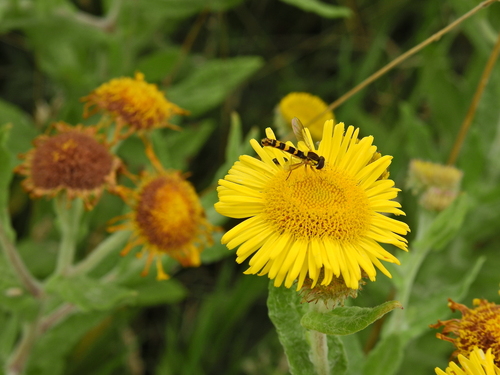
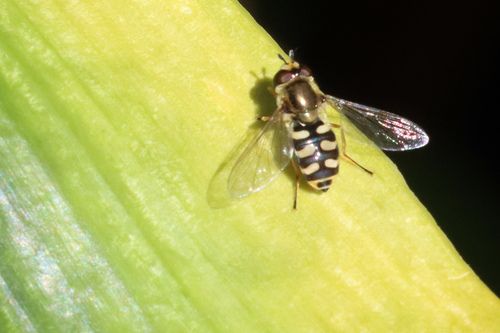
Hairy-Eyed Flower Fly

Hairy-Eyed Flower Fly

Syrphus torvus

Daily sighting probability ~10% · With luck
at Brussels

In 3 days ~20% in a week ~40%

15 Verified sightings at Brussels
11 In all 2 parks From 2019 to 2026
October Best month
☀️ Diurnal When it's spotted

About the Hairy-Eyed Flower Fly

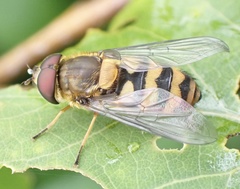
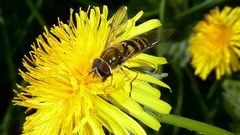
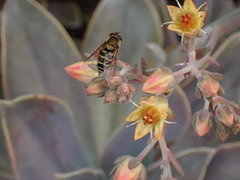
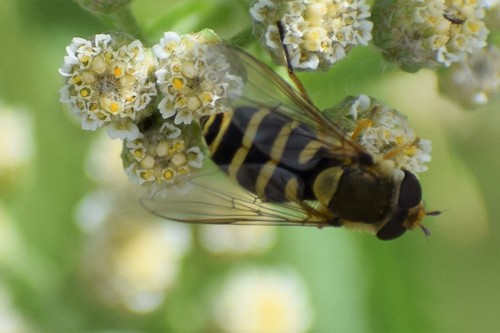
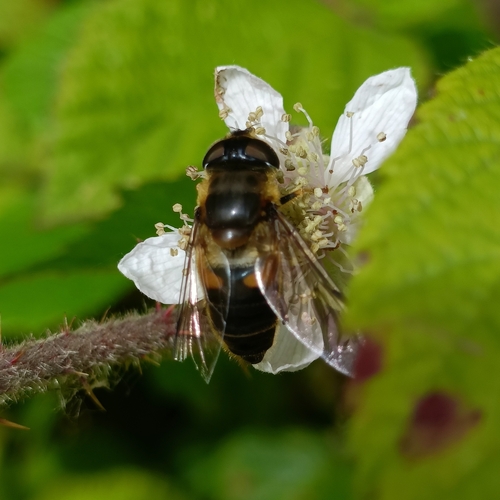
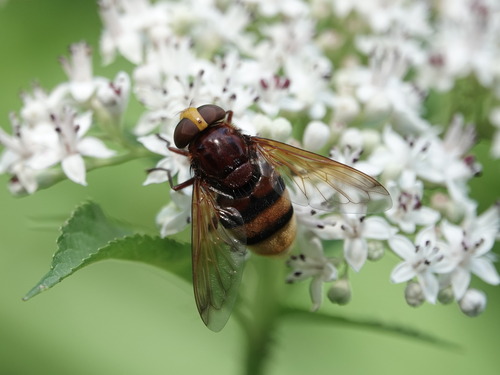
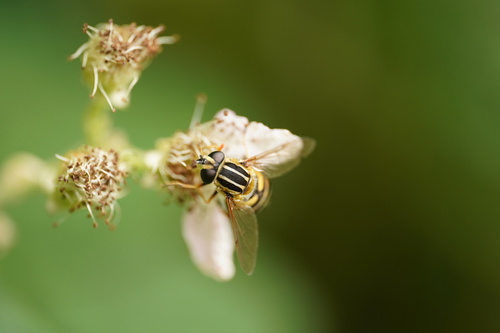
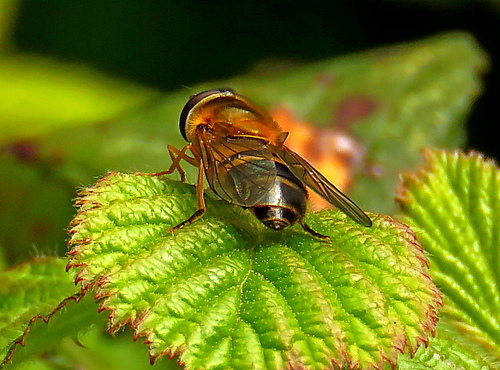
Syrphus torvus, the Hairy-eyed Flower Fly, is a common species of hoverfly found in the Holarctic. The adults feed on pollen and nectar, but the larvae feed on aphids. External images. For terminology see Speight key to genera and glossary. Eyes have numerous hairs, in male, long and dense, in female shorter. Femora 3 is black on basal 3/4. The male genitalia and the larva are illustrated by Dusek and Laska (1964).

See references for determination. Palearctic: Greenland and Fennoscandia southward to Iberia and the Mediterranean basin through Europe into Turkey and European Russia. Also from Urals eastward to Siberia and the Russian Far East to the Pacific coast (Kuril Isles) and Japan. Indomalaya Formosa, Northern India, Nepal, and Thailand.

Nearctic: from Alaska southward to New Mexico. Migratory. Large numbers of hoverflies of this species and of Metasyrphus sp. have been observed on Denali in the Rocky Mountains at altitudes of 5,000 metres (16,000 ft) at the head of the Kahiltna Glacier.

Habitat: Abies, Picea and Pinus forest and Betula, Fagus, Quercus forest and dwarf-shrub tundra. It is synanthropic in suburban gardens with mature... Wikipedia →
Global Distribution

Parks Where Found

# Park Country Daily sighting probability
1 Bavarian Forest National Park 🇩🇪 Germany
<5%
2 Wadden Sea National Park 🇩🇪 Germany
<5%

Cities Where Found

# City Country Daily sighting probability
1 Liverpool 🇬🇧 United Kingdom
~10%
2 Brussels 🇧🇪 Belgium
~10%
3 Birmingham 🇬🇧 United Kingdom
<5%
4 Manchester 🇬🇧 United Kingdom
<5%
5 Leeds 🇬🇧 United Kingdom
<5%
6 Copenhagen 🇩🇰 Denmark
<5%
7 Helsinki 🇫🇮 Finland
<5%
8 London 🇬🇧 United Kingdom
<5%
9 Vancouver 🇨🇦 Canada
<5%
10 Vienna 🇦🇹 Austria
<5%

Before you go

What are the chances of seeing a Hairy-Eyed Flower Fly in Brussels?

With luck

About 10% of wildlife watchers report a Hairy-Eyed Flower Fly sighting in Brussels on a given day, based on 15 verified sightings from GBIF citizen-science data. It is the 154th most-seen of the 337 insects we can rate there. Over three days the chance rises to about 20%, and over a week to about 40%, if each day is a fresh chance.

When is the best time to see a Hairy-Eyed Flower Fly in Brussels?

March–April and September–October

In those months about 10% of wildlife watchers report a Hairy-Eyed Flower Fly in Brussels on a given day, against under 5% in May–August and November–February, the lowest months.

What time of day is best to see a Hairy-Eyed Flower Fly?

Between 11 am and 2 pm

Across all the parks we cover, that three-hour window holds the most Hairy-Eyed Flower Fly sightings with a recorded time, and nearly all of them come between 6 am and 6 pm: it is a daytime animal.

Is Brussels the best place to see a Hairy-Eyed Flower Fly?

Among the best

Of the 15 cities where we can rate Hairy-Eyed Flower Fly sightings, Brussels ranks 2nd at about 10%, level with the leaders once rounded. The best odds are in Liverpool (United Kingdom, about 10%).

Where does the Hairy-Eyed Flower Fly sighting chance come from?

GBIF citizen-science records

It is estimated from how often the Hairy-Eyed Flower Fly is recorded against all the insects logged in Brussels (15 verified sightings), calibrated against known sighting rates. Figures are rounded to the nearest 10% because citizen-science data supports honest approximations, not decimals, and months with records from fewer than five people show "—". How it works.

← Back to Brussels