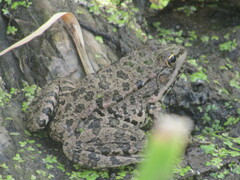
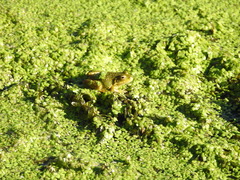
Marsh Frog

Marsh Frog

Pelophylax ridibundus

Silhouette: T137 · PhyloPic

LCLeast ConcernNTVUENCR
Daily sighting probability ~20% · Possible
at Budapest

In 3 days ~50% in a week ~80%

30 Verified sightings at Budapest
37 In all 3 parks From 2019 to 2026
June Best month
☀️ Diurnal When it's spotted

About the Marsh Frog

The marsh frog (Pelophylax ridibundus) is a species of water frog native to Europe and parts of western Asia. The first scientific description of the marsh frog was published in 1771 and written by Prussian zoologist Peter Simon Pallas, who gave it the scientific name Rana ridibunda after collecting specimens of it during an expedition through the Russian Empire. Pallas did not precisely specify the type locality (where he found the frogs), only noting it as "versus mare Caspium; Volgae et Iaico" (opposite to the Caspian Sea, Volga, and on the Yaik River). A more precise location of "Gurjew" on the north coast of the Caspian Sea (now the city of Atyrau in Kazakhstan) was given in a 1928 publication written by German herpetologists Robert Mertens and Lorenz Müller. However, a 1994 paper by herpetologists Alain Dubois and Annemarie Ohler noted that because Pallas never designated a holotype specimen, a neotype needs to be selected for the species. The restriction of the type locality done by Mertens and Müller is therefore invalid unless a specimen from Atyrau is designated as the neotype, which Dubois and Ohler suggest should be done... Wikipedia →

Sounds

Distress call1:15

Austria · 2026

© Benjamin Schmid · XC1173809 · CC BY-NC-SA 4.0

Uncertain0:08

Belgium · 2026

© Kelle Moreau · XC1161124 · CC BY-NC-SA 4.0

Advertisement call0:52

France · 2026

© Olivier SWIFT · XC1157527 · CC BY-NC-SA 4.0

Global Distribution

Parks Where Found

# Park Country Daily sighting probability
1 Plitvice Lakes National Park 🇭🇷 Croatia
~40%
2 Hortobágy National Park 🇭🇺 Hungary
~30%
3 Cévennes National Park 🇫🇷 France
~10%

Cities Where Found

# City Country Daily sighting probability
1 Dushanbe 🇹🇯 Tajikistan
~60%
2 Antalya 🇹🇷 Turkey
~50%
3 Jerusalem 🇮🇱 Israel
~40%
4 Sofia 🇧🇬 Bulgaria
~40%
5 Astana 🇰🇿 Kazakhstan
~40%
6 Yerevan 🇦🇲 Armenia
~40%
7 Ankara 🇹🇷 Turkey
~40%
8 Bishkek 🇰🇬 Kyrgyzstan
~40%
9 Almaty 🇰🇿 Kazakhstan
~30%
10 Tashkent 🇺🇿 Uzbekistan
~20%

Zoos & Centres Where Found

# Zoo / Centre Country
1 Paris Zoological Park 🇫🇷 France In captivity
2 Aquarium du palais de la Porte Dorée 🇫🇷 France In captivity
3 Zoo d'Amiens 🇫🇷 France In captivity
4 Knuthenborg Safaripark 🇩🇰 Denmark In captivity
5 Zoo de La Flèche 🇫🇷 France In captivity
6 Ljubljana Zoo 🇸🇮 Slovenia In captivity
7 Schönbrunn Zoo 🇦🇹 Austria In captivity
8 Alpenzoo Innsbruck 🇦🇹 Austria In captivity
9 Animal - Bird Collection 🇬🇷 Greece In captivity
10 The Fenn Bell Conservation Project 🇬🇧 United Kingdom In captivity
11 Lake Tisza Ecocentre 🇭🇺 Hungary In captivity

Before you go

What are the chances of seeing a Marsh Frog in Budapest?

Possible

About 20% of wildlife watchers report a Marsh Frog sighting in Budapest on a given day, based on 30 verified sightings from GBIF citizen-science data. It is the 2nd most-seen of the 5 amphibians we can rate there. Over three days the chance rises to about 50%, and over a week to about 80%, if each day is a fresh chance.

When is the best time to see a Marsh Frog in Budapest?

June and September

In those months about 30% of wildlife watchers report a Marsh Frog in Budapest on a given day, against under 5% in October to February, the lowest months.

What time of day is best to see a Marsh Frog?

Between 2 and 5 pm

Across all the parks we cover, that three-hour window holds the most Marsh Frog sightings with a recorded time, and about 9 in 10 of them come between 6 am and 6 pm: it is a daytime animal.

Is Budapest the best place to see a Marsh Frog?

14th of 32

Of the 32 cities where we can rate Marsh Frog sightings, Budapest ranks 14th at about 20%. The best odds are in Dushanbe (Tajikistan, about 60%), Antalya (Turkey, about 50%) and Jerusalem (Israel, about 40%).

Where does the Marsh Frog sighting chance come from?

GBIF citizen-science records

It is estimated from how often the Marsh Frog is recorded against all the amphibians logged in Budapest (30 verified sightings), calibrated against known sighting rates. Figures are rounded to the nearest 10% because citizen-science data supports honest approximations, not decimals, and months with records from fewer than five people show "—". How it works.

← Back to Budapest