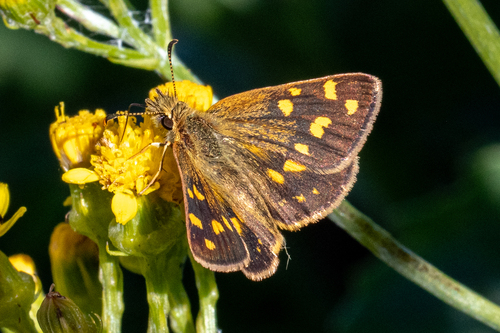
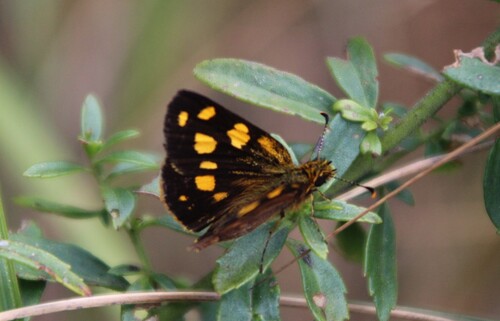
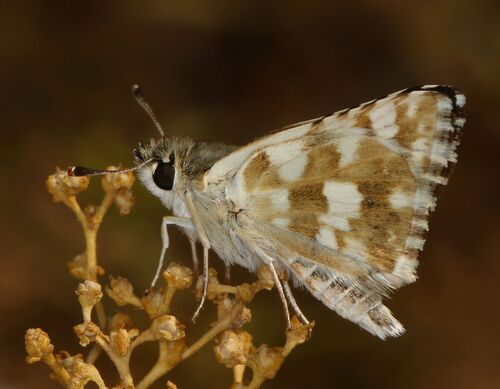
Pale Small-Branded Swift

Pale Small-Branded Swift

Pelopidas thrax

Daily sighting probability <5% · Rare
at Cape Town

In 3 days ~10% in a week ~20%

7 Verified sightings at Cape Town
28 In all 2 parks From 2019 to 2026
February Best month
☀️ Diurnal When it's spotted

About the Pale Small-Branded Swift

Pelopidas thrax, the pale small-branded swift, millet skipper or white branded swift, is a butterfly belonging to the family Hesperiidae. It is found in Greece, western and south-western Turkey, Israel, Lebanon, Syria, Iraq, Arabia, most of Africa even semi-arid countries as Burkina Faso, Kashmir (northern Pakistan) and the parts of the Far East. In Greece, it is only known from Samos, Chios, and Rhodes, where it is found at altitudes of sea level to 75 meters.

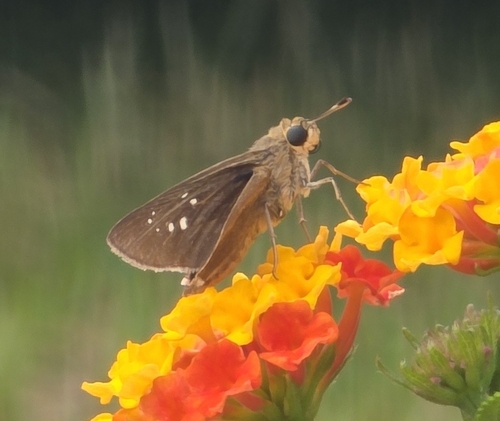
The ground colour of the fore and hind wings is brown. The upper side has a series of white spots of different sizes. Males have a narrow white scent scale patch on the upper surface of the forewings. The translucent spots are arranged differently from Gegenes nostrodamus and Gegenes pumilio.

The egg is yellowish at first and later becomes salmon-colored. It is flattened, approximately 0.9mm high and 1.5mm in diameter. The surface is covered with about 60 very fine elongated ribs, which take up about two-thirds of the height (calculated from the base). They intersect with horizontal lines. The larvae hatch after eight days.

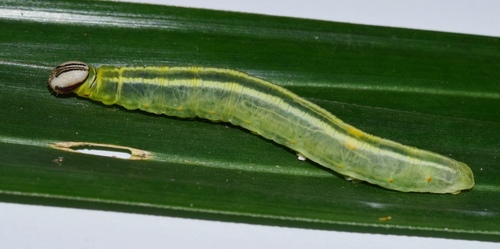
The caterpillar is up to 35 mm long (L6 stage). The body is light green with a darker... Wikipedia →
Global Distribution

Parks Where Found

# Park Country Daily sighting probability
1 iSimangaliso Wetland Park 🇿🇦 South Africa
~10%
2 Garden Route National Park 🇿🇦 South Africa
~10%

Cities Where Found

# City Country Daily sighting probability
1 Antalya 🇹🇷 Turkey
~20%
2 Tel Aviv 🇮🇱 Israel
~20%
3 Cape Town 🇿🇦 South Africa
<5%

Before you go

What are the chances of seeing a Pale Small-Branded Swift in Cape Town?

Rare

Under 5% of wildlife watchers report a Pale Small-Branded Swift sighting in Cape Town on a given day, based on 7 verified sightings from GBIF citizen-science data. It is the 264th most-seen of the 311 insects we can rate there. Over three days the chance rises to about 10%, and over a week to about 20%, if each day is a fresh chance.

When is the best time to see a Pale Small-Branded Swift in Cape Town?

February and November

In those months about 10% of wildlife watchers report a Pale Small-Branded Swift in Cape Town on a given day, against under 5% in March–October and December–January, the lowest months. Those are among Cape Town's driest months, with about 30 mm of rain a month against 140 mm in June.

What time of day is best to see a Pale Small-Branded Swift?

Between 9 am and noon

Across all the parks we cover, that three-hour window holds the most Pale Small-Branded Swift sightings with a recorded time, and nearly all of them come between 6 am and 6 pm: it is a daytime animal.

Is Cape Town the best place to see a Pale Small-Branded Swift?

3rd of 3

Of the 3 cities where we can rate Pale Small-Branded Swift sightings, Cape Town ranks 3rd at under 5%. The best odds are in Antalya (Turkey, about 20%) and Tel Aviv (Israel, about 20%).

Where does the Pale Small-Branded Swift sighting chance come from?

GBIF citizen-science records

It is estimated from how often the Pale Small-Branded Swift is recorded against all the insects logged in Cape Town (7 verified sightings), calibrated against known sighting rates. Figures are rounded to the nearest 10% because citizen-science data supports honest approximations, not decimals, and months with records from fewer than five people show "—". How it works.

← Back to Cape Town