House Bunting

House Bunting

Emberiza sahari

LCLeast ConcernNTVUENCR
Daily sighting probability ~50% · Likely
at Casablanca

In 3 days ~90% in a week >90%

54 Verified sightings at Casablanca
August Best month
☀️ Diurnal When it's spotted

About the House Bunting

The house bunting (Emberiza sahari) is a passerine bird in the bunting family Emberizidae. It is a resident breeder of dry country from northwestern Africa from Morocco south to Mali and east to Chad. In Morocco, the species has expanded from the Atlas Mountains northwards since the 1960s, and has recently reached Tangier and Tétouan on the southern shore of the Strait of Gibraltar. The house bunting bred in Europe for the first time in 2023, in Algeciras in southern Spain.

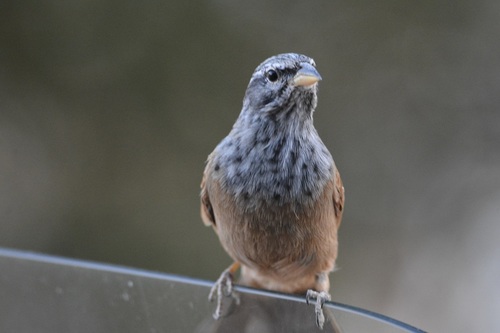
The house bunting breeds around human habitation, laying two to four eggs in a nest in a hole in a wall or building. Its natural food consists seeds, or when feeding young, insects. It is 14 cm long, similar in size to the striolated bunting and smaller than the rock bunting. The breeding male has a sandy orange-brown body and a grey head slightly dark-streaked but without the white supercilium that the striolated bunting has. The female's head has a brown tint to the grey, and more diffused streaking.

The house bunting has recently been split from the closely related striolated bunting, of which it used to be treated as a subspecies, Emberiza striolata sahari. The striolated bunting has stronger facial striping and a paler belly than the house bunting.

The incubation period of the clutch of three eggs is 12–14 days. The song, given from a perch, is similar to but weaker than that of the common chaffinch. In Morocco, the species is traditionally regarded as sacred, and has become very tame, freely entering and feeding inside houses, shops and mosques. Wikipedia →
Global Distribution

Parks Where Found

# Park Country Daily sighting probability

More parks will be added in future updates.

Cities Where Found

# City Country Daily sighting probability
1 Marrakesh 🇲🇦 Morocco
~90%
2 Fez 🇲🇦 Morocco
~60%
3 Tangier 🇲🇦 Morocco
~50%
4 Casablanca 🇲🇦 Morocco
~50%
5 Rabat 🇲🇦 Morocco
~20%

Before you go

What are the chances of seeing a House Bunting in Casablanca?

Likely

About 50% of wildlife watchers report a House Bunting sighting in Casablanca on a given day, based on 54 verified sightings from GBIF citizen-science data. It is the 9th most-seen of the 45 birds we can rate there. Over three days the chance rises to about 90%, and over a week to over 90%, if each day is a fresh chance.

When is the best time to see a House Bunting in Casablanca?

August

In that month about 70% of wildlife watchers report a House Bunting in Casablanca on a given day, against about 30% in September, the lowest month. That is one of Casablanca's driest months, with almost no rain against 100 mm in November. July has too few records to rate.

What time of day is best to see a House Bunting?

Between 8 and 11 am

Across all the parks we cover, that three-hour window holds the most House Bunting sightings with a recorded time, and about 9 in 10 of them come between 6 am and 6 pm: it is a daytime animal.

Is Casablanca the best place to see a House Bunting?

4th of 5

Of the 5 cities where we can rate House Bunting sightings, Casablanca ranks 4th at about 50%. The best odds are in Marrakesh (Morocco, about 90%), Fez (Morocco, about 60%) and Tangier (Morocco, about 50%).

Which relatives of the House Bunting live in Casablanca?

Same order: Passeriformes

The closest relatives of the House Bunting that you can see in Casablanca (order Passeriformes, Perching Birds) are Spotless Starling (about 90%), House Sparrow (about 80%) and Eurasian Blackbird (about 70%), with each one's daily chance of a sighting.

Where does the House Bunting sighting chance come from?

GBIF citizen-science records

It is estimated from how often the House Bunting is recorded against all the birds logged in Casablanca (54 verified sightings), calibrated against known sighting rates. Figures are rounded to the nearest 10% because citizen-science data supports honest approximations, not decimals, and months with records from fewer than five people show "—". How it works.

← Back to Casablanca