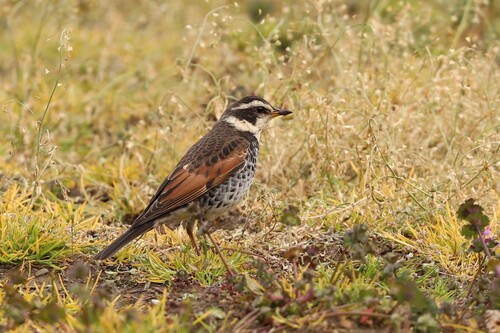
Japanese Thrush

Japanese Thrush

Turdus cardis

Silhouette: Sharon Wegner-Larsen · PhyloPic

LCLeast ConcernNTVUENCR
Daily sighting probability ~20% · Possible
at Changsha

In 3 days ~60% in a week ~90%

23 Verified sightings at Changsha
234 In all 2 parks From 2019 to 2026
December Best month
🌅 Crepuscular When it's spotted

About the Japanese Thrush

The Japanese thrush (Turdus cardis) is a species of bird in the thrush family Turdidae. The species is also known as the grey thrush or the Japanese grey thrush. The species was once split into two subspecies, with birds breeding in China being treated as the subspecies T. c. lateus,, but today differences are attributed to natural variation and the species is treated as being monotypic.

The Japanese thrush is migratory. It breeds in central China and Japan, arriving in Japan by April or May; it winters in coastal southern China (including Hainan) and northern Laos and Vietnam leaving its breeding grounds around October. It occasionally turns up as a passage migrant in Taiwan, and has been vagrant in Thailand. The species is usually found in forests and woodlands, either deciduous or mixed deciduous and coniferous in its breeding habitat, but also secondary forest and even gardens and parks.

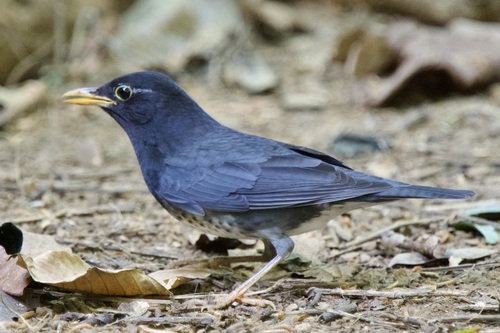
The Japanese thrush is a mid-sized thrush. The two sexes have different plumage (sexual dimorphism). The male has a black head, breast, back, wings and tail, and a white underside with black spots in the upper belly and flanks. The legs, bill and thin eye-ring are yellow. The female is brown above and has a white throat, breast and belly, washed with rusty orange on the flanks and black spots.

The Japanese thrush feeds on the ground, scratching through leaf-litter to find insects and earthworms. It will also take fruit. It lays 2-5 eggs in a nest made of twigs and moss, bound with mud and lined with hair and rootlets. The eggs are incubated for 12–13 days and the chick nestling period is 14 days. The species double broods (raising two broods a season), with the female laying a new clutch soon after the first brood fledges. Wikipedia →
Sounds

Song0:50

Japan · 2026

© Ding Li Yong · XC1139064 · CC BY-NC-ND 4.0

Alarm call1:10

China · 2024

© Bo Shunqi 薄顺奇 · XC963955 · CC BY-NC-SA 4.0

Call0:29

Taiwan · 2022

© Chi-Hsuan Shao · XC776093 · CC BY-NC-SA 4.0

Global Distribution

Parks Where Found

# Park Country Daily sighting probability
1 Cuc Phuong National Park 🇻🇳 Vietnam
~50%
2 Nikko National Park 🇯🇵 Japan
~10%

Cities Where Found

# City Country Daily sighting probability
1 Changsha 🇨🇳 China
~20%
2 Wuhan 🇨🇳 China
~20%
3 Hong Kong 🇨🇳 China
~10%
4 Nanchang 🇨🇳 China
~10%
5 Zhuhai [Macau] 🇨🇳 China
~10%
6 Xiamen City 🇨🇳 China
~10%
7 Chongqing 🇨🇳 China
~10%
8 Hanoi 🇻🇳 Vietnam
~10%
9 Gwangju 🇰🇷 South Korea
~10%
10 Hefei 🇨🇳 China
~10%

Zoos & Centres Where Found

# Zoo / Centre Country
1 Ueno Zoo 🇯🇵 Japan In captivity

Before you go

What are the chances of seeing a Japanese Thrush in Changsha?

Possible

About 20% of wildlife watchers report a Japanese Thrush sighting in Changsha on a given day, based on 23 verified sightings from GBIF citizen-science data. It is the 23rd most-seen of the 67 birds we can rate there. Over three days the chance rises to about 60%, and over a week to about 90%, if each day is a fresh chance.

When is the best time to see a Japanese Thrush in Changsha?

June–July and December

In those months about 30% of wildlife watchers report a Japanese Thrush in Changsha on a given day, against about 10% in October, the lowest month.

What time of day is best to see a Japanese Thrush?

Between 4 and 7 am

Across all the parks we cover, that three-hour window holds the most Japanese Thrush sightings with a recorded time, and about half of them come between 6 pm and 6 am: it is most active around dawn and dusk.

Is Changsha the best place to see a Japanese Thrush?

Yes

Of the 25 cities where we can rate Japanese Thrush sightings, Changsha has the highest daily chance: about 20%. Next come Wuhan (China, about 20%) and Hong Kong (China, about 10%).

Which relatives of the Japanese Thrush live in Changsha?

Same genus: Turdus

The closest relatives of the Japanese Thrush that you can see in Changsha (genus Turdus, Typical Thrushes) are Chinese Blackbird (about 80%), Grey-backed Thrush (about 20%) and Dusky Thrush (about 10%), with each one's daily chance of a sighting.

Where does the Japanese Thrush sighting chance come from?

GBIF citizen-science records

It is estimated from how often the Japanese Thrush is recorded against all the birds logged in Changsha (23 verified sightings), calibrated against known sighting rates. Figures are rounded to the nearest 10% because citizen-science data supports honest approximations, not decimals, and months with records from fewer than five people show "—". How it works.

← Back to Changsha