Naumann's Thrush

Naumann's Thrush

Turdus naumanni

Silhouette: Sharon Wegner-Larsen · PhyloPic

LCLeast ConcernNTVUENCR
Daily sighting probability ~10% · With luck
at Chengdu

In 3 days ~30% in a week ~60%

65 Verified sightings at Chengdu
5 In 1 park From 2019 to 2026
March Best month
☀️ Diurnal When it's spotted

About the Naumann's Thrush

Naumann's thrush (Turdus naumanni) is a species of the thrush family Turdidae which breeds eastwards from central Siberia to North Manchuria, Amurland and Sakhalin. It is closely related to the more northerly breeding dusky thrush T. eunomus; the two have often been regarded as conspecific.

This species breeds in open woodland areas; dusky thrush, as would be expected, is more tolerant of mountainous and tundra-edge habitats. This species is strongly migratory, wintering South Asia to Southeast Asia, principally in China, Korea and neighboring countries. It is a rare vagrant to western Europe.

It nests in trees, laying 3-5 eggs in an untidy but neatly lined nest. Migrating birds and wintering birds often form small flocks. It is omnivorous, eating a wide range of insects, especially mosquitoes, earthworms and berries.

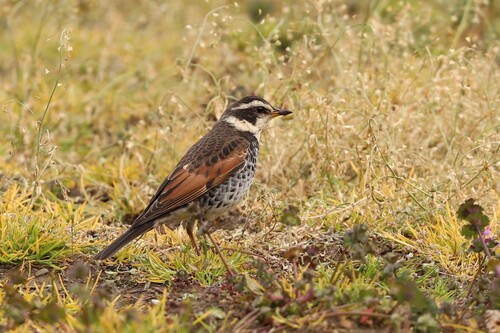
This is a medium-sized but stocky thrush, reminiscent in structure of a small fieldfare. The underwing is reddish brown, and there is a pale supercilium. Naumann's thrush has pale brown back and head. The face, breast, flank spots and rump are reddish, and the belly and undertail are white, whereas dusky thrush has a darker brown back and rump, and the face, breast, and flank spots rump are black. The belly and undertail are white.

The female is fairly similar to the male, but immatures have a weaker patterning. The song of Naumann's thrush may differ from the simple fluted or whistling redwing-like song of dusky thrush. The genus name comes from Latin Turdus, "thrush", and the species and English names commemorate the German naturalist Johann Andreas Naumann. Wikipedia →
Sounds

Call1:09

Mongolia · 2024

© Jochem Verweij · XC1010630 · CC BY-SA 4.0

Alarm call0:39

Mongolia · 2025

© Ding Li Yong · XC1002380 · CC BY-NC-ND 4.0

Song1:09

Russian Federation · 2018

© Ukolov Ilya · XC542134 · CC BY-NC-SA 4.0

Global Distribution

Parks Where Found

# Park Country Daily sighting probability
1 Gobi Gurvansaikhan National Park 🇲🇳 Mongolia
<5%

More parks will be added in future updates.

Cities Where Found

# City Country Daily sighting probability
1 Tianjin 🇨🇳 China
~30%
2 Beijing 🇨🇳 China
~20%
3 Seoul 🇰🇷 South Korea
~20%
4 Ningbo 🇨🇳 China
~20%
5 Chengdu 🇨🇳 China
~10%
6 Harbin 🇨🇳 China
~10%
7 Dalian 🇨🇳 China
~10%
8 Shijiazhuang 🇨🇳 China
~10%
9 Nanjing 🇨🇳 China
~10%
10 Xi'an 🇨🇳 China
~10%

Before you go

What are the chances of seeing a Naumann's Thrush in Chengdu?

With luck

About 10% of wildlife watchers report a Naumann's Thrush sighting in Chengdu on a given day, based on 65 verified sightings from GBIF citizen-science data. It is the 39th most-seen of the 156 birds we can rate there. Over three days the chance rises to about 30%, and over a week to about 60%, if each day is a fresh chance.

When is the best time to see a Naumann's Thrush in Chengdu?

March

In that month about 30% of wildlife watchers report a Naumann's Thrush in Chengdu on a given day, against under 5% in May–June and September–October, the lowest months. That is one of Chengdu's driest months, with about 40 mm of rain against 270 mm in August.

What time of day is best to see a Naumann's Thrush?

Between noon and 3 pm

Across all the parks we cover, that three-hour window holds the most Naumann's Thrush sightings with a recorded time, and about 9 in 10 of them come between 6 am and 6 pm: it is a daytime animal.

Is Chengdu the best place to see a Naumann's Thrush?

5th of 23

Of the 23 cities where we can rate Naumann's Thrush sightings, Chengdu ranks 5th at about 10%. The best odds are in Tianjin (China, about 30%), Beijing (China, about 20%) and Seoul (South Korea, about 20%).

Which relatives of the Naumann's Thrush live in Chengdu?

Same genus: Turdus

The closest relatives of the Naumann's Thrush that you can see in Chengdu (genus Turdus, Typical Thrushes) are Chinese Blackbird (about 80%) and Dusky Thrush (about 10%), with each one's daily chance of a sighting.

Where does the Naumann's Thrush sighting chance come from?

GBIF citizen-science records

It is estimated from how often the Naumann's Thrush is recorded against all the birds logged in Chengdu (65 verified sightings), calibrated against known sighting rates. Figures are rounded to the nearest 10% because citizen-science data supports honest approximations, not decimals, and months with records from fewer than five people show "—". How it works.

← Back to Chengdu