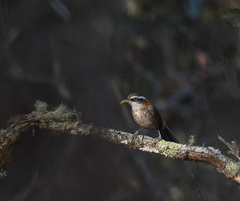
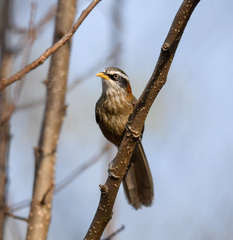

Streak-breasted Scimitar-Babbler

Streak-breasted Scimitar-Babbler

Pomatorhinus ruficollis

Silhouette: Sheatherius · PhyloPic

LCLeast ConcernNTVUENCR
Daily sighting probability <5% · Rare
at Chengdu

In 3 days ~10% in a week ~30%

24 Verified sightings at Chengdu
46 In all 2 parks From 2019 to 2026
June Best month
☀️ Diurnal When it's spotted

About the Streak-breasted Scimitar-Babbler

The streak-breasted scimitar babbler (Pomatorhinus ruficollis) is a species of bird in the family Timaliidae. It is found in Bangladesh, Bhutan, China, India, Laos, Myanmar, Nepal, and Vietnam. Its natural habitat is subtropical or tropical moist montane forest. The former Taiwan subspecies musicus is usually now considered a distinct species as the Taiwan scimitar babbler.

It forms mixed flocks with other species. Collar, N. J. & Robson, C. 2007. Family Timaliidae (Babblers) pp. 70 – 291 in; del Hoyo, J., Elliott, A. & Christie, D.A. eds. Handbook of the Birds of the World, Vol. 12. Picathartes to Tits and Chickadees. Lynx Edicions, Barcelona. Wikipedia →

Sounds

Call0:27

China · 2021

© 雪鼬 · XC949681 · CC BY-NC-SA 4.0

Song1:05

China · 2018

© Geoff Carey · XC879519 · CC BY-NC-SA 4.0

Alarm call0:29

China · 2021

© Ray Tsu 诸仁 · XC708062 · CC BY-NC-SA 4.0

Global Distribution

Parks Where Found

# Park Country Daily sighting probability
1 Langtang National Park 🇳🇵 Nepal
~10%
2 Royal Manas National Park 🇧🇹 Bhutan
<5%

Cities Where Found

# City Country Daily sighting probability
1 Chongqing 🇨🇳 China
~20%
2 Guiyang 🇨🇳 China
~20%
3 Changsha 🇨🇳 China
~20%
4 Hangzhou 🇨🇳 China
~10%
5 Fuzhou 🇨🇳 China
~10%
6 Chengdu 🇨🇳 China
<5%
7 Hong Kong 🇨🇳 China
<5%
8 Guangzhou 🇨🇳 China
<5%
9 Kathmandu 🇳🇵 Nepal
<5%
10 Tuen Mun 🇨🇳 China
<5%

Before you go

What are the chances of seeing a Streak-breasted Scimitar-Babbler in Chengdu?

Rare

Under 5% of wildlife watchers report a Streak-breasted Scimitar-Babbler sighting in Chengdu on a given day, based on 24 verified sightings from GBIF citizen-science data. It is the 72nd most-seen of the 156 birds we can rate there. Over three days the chance rises to about 10%, and over a week to about 30%, if each day is a fresh chance.

When is the best time to see a Streak-breasted Scimitar-Babbler in Chengdu?

June

In that month about 20% of wildlife watchers report a Streak-breasted Scimitar-Babbler in Chengdu on a given day, against under 5% in March–May, August–October and December–January, the lowest months. That is one of Chengdu's wettest months, with about 140 mm of rain against 10 mm in January.

What time of day is best to see a Streak-breasted Scimitar-Babbler?

Between 9 am and noon

Across all the parks we cover, that three-hour window holds the most Streak-breasted Scimitar-Babbler sightings with a recorded time, and about 9 in 10 of them come between 6 am and 6 pm: it is a daytime animal.

Is Chengdu the best place to see a Streak-breasted Scimitar-Babbler?

6th of 10

Of the 10 cities where we can rate Streak-breasted Scimitar-Babbler sightings, Chengdu ranks 6th at under 5%. The best odds are in Chongqing (China, about 20%), Guiyang (China, about 20%) and Changsha (China, about 20%).

Where does the Streak-breasted Scimitar-Babbler sighting chance come from?

GBIF citizen-science records

It is estimated from how often the Streak-breasted Scimitar-Babbler is recorded against all the birds logged in Chengdu (24 verified sightings), calibrated against known sighting rates. Figures are rounded to the nearest 10% because citizen-science data supports honest approximations, not decimals, and months with records from fewer than five people show "—". How it works.

← Back to Chengdu