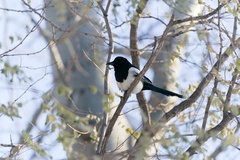
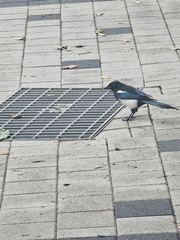
Oriental Magpie

Oriental Magpie

Pica serica

Silhouette: T. Michael Keesey · PhyloPic

Daily sighting probability ~10% · With luck
at Chongqing

In 3 days ~30% in a week ~60%

11 Verified sightings at Chongqing
July Best month
☀️ Diurnal When it's spotted

About the Oriental Magpie

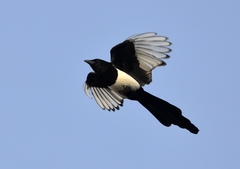
The Oriental magpie (Pica serica) is a species of magpie found from southeastern Russia to eastern China, Korea, Taiwan, and northern Indochina and Myanmar. It is also naturalised in Japan. Other names include Korean magpie, Chinese magpie and Asian magpie. The scientific name serica means "silky [texture]" or "Chinese"; this is the original spelling, though sometimes erroneously "corrected" to sericea.

Like the other magpies, the Oriental magpie is a member of the large radiation of mainly Holarctic corvids, which also includes the typical crows and ravens (Corvus), the nutcrackers (Nucifraga), and the Old World jays. The long tail might be plesiomorphic for this group, as it is also found in the tropical Asian magpies (Cissa and Urocissa) as well as in most of the very basal corvids, such as the treepies. The unique black-and-white pattern of the "monochrome" magpies is an autapomorphy.

The Oriental magpie was first described as a species, based on specimens collected in Amoy (now Xiamen) in southeastern China in 1844. Due to its similarity to the Eurasian magpie in plumage, it was reduced to a synonym of it by Richard Bowdler Sharpe in 1877, and then... Wikipedia →

Sounds

Call0:22

Taiwan · 2026

© Joan Theng · XC1156235 · CC BY-NC-SA 4.0

Uncertain0:14

South Korea · 2026

© Se-Jun Choi · XC1152740 · CC BY-NC-ND 4.0

Alarm call0:35

China · 2025

© Dave Guo · XC1015967 · CC BY-NC-SA 4.0

Global Distribution

Parks Where Found

# Park Country Daily sighting probability

More parks will be added in future updates.

Cities Where Found

# City Country Daily sighting probability
1 Shijiazhuang 🇨🇳 China
>90%
2 Gwangju 🇰🇷 South Korea
>90%
3 Seoul 🇰🇷 South Korea
~90%
4 Tianjin 🇨🇳 China
~90%
5 Beijing 🇨🇳 China
~90%
6 Daejeon 🇰🇷 South Korea
~90%
7 Suzhou 🇨🇳 China
~90%
8 Qingdao 🇨🇳 China
~90%
9 Busan 🇰🇷 South Korea
~90%
10 Lanzhou 🇨🇳 China
~80%

Zoos & Centres Where Found

# Zoo / Centre Country
1 Beijing Wildlife Park 🇨🇳 China In captivity
2 Shanghai Zoo 🇨🇳 China In captivity
3 Macau Zoo 🇲🇴 Macao SAR China In captivity

Before you go

What are the chances of seeing an Oriental Magpie in Chongqing?

With luck

About 10% of wildlife watchers report an Oriental Magpie sighting in Chongqing on a given day, based on 11 verified sightings from GBIF citizen-science data. It is the 38th most-seen of the 65 birds we can rate there. Over three days the chance rises to about 30%, and over a week to about 60%, if each day is a fresh chance.

When is the best time to see an Oriental Magpie in Chongqing?

April and July

In those months about 20% of wildlife watchers report an Oriental Magpie in Chongqing on a given day, against under 5% in October, the lowest month. September has too few records to rate.

What time of day is best to see an Oriental Magpie?

Between 2 and 5 pm

Across all the parks we cover, that three-hour window holds the most Oriental Magpie sightings with a recorded time, and nearly all of them come between 6 am and 6 pm: it is a daytime animal.

Is Chongqing the best place to see an Oriental Magpie?

40th of 47

Of the 47 cities where we can rate Oriental Magpie sightings, Chongqing ranks 40th at about 10%. The best odds are in Shijiazhuang (China, over 90%), Gwangju (South Korea, over 90%) and Seoul (South Korea, about 90%).

Which relatives of the Oriental Magpie live in Chongqing?

Same family: Corvidae

The closest relatives of the Oriental Magpie that you can see in Chongqing (family Corvidae, Crows, Jays, and Magpies) are Red-billed Blue Magpie (about 50%) and Azure-winged Magpie (about 10%), with each one's daily chance of a sighting.

Where does the Oriental Magpie sighting chance come from?

GBIF citizen-science records

It is estimated from how often the Oriental Magpie is recorded against all the birds logged in Chongqing (11 verified sightings), calibrated against known sighting rates. Figures are rounded to the nearest 10% because citizen-science data supports honest approximations, not decimals, and months with records from fewer than five people show "—". How it works.

← Back to Chongqing