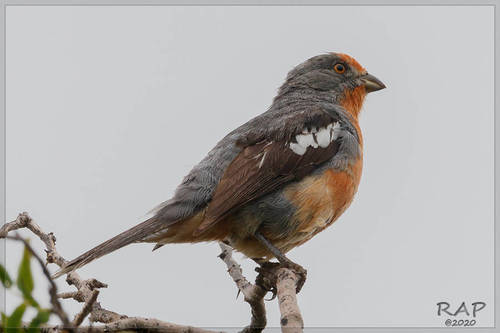
Bolivian Blackbird

Bolivian Blackbird

Agelaioides oreopsar

Silhouette: Sheatherius · PhyloPic

Daily sighting probability <5% · Rare
at Cochabamba

In 3 days ~10% in a week ~20%

7 Verified sightings at Cochabamba
March Best month
☀️ Diurnal When it's spotted

About the Bolivian Blackbird

The Bolivian blackbird (Oreopsar bolivianus) is a species of bird in the family Icteridae, the oropendolas, New World orioles, and New World blackbirds. It is endemic to Bolivia. The Bolivian blackbird was formally described in 1939 with its current binomial Oreopsar bolivianus. A 2001 publication suggested that its genus be merged into Agelaioides. Doing so would have required that its binomial be Agelaioides oreopsar because Agelaioides bolivianus applied at the time to another species. The proposal was not accepted by major taxonomic systems. However, strong evidence suggests that its closest relative is the greyish baywing (Agelaioides badius).

The Bolivian blackbird is the only member of its genus and has no subspecies. The Bolivian blackbird is about 23 cm (9 in) long. Males weigh an average of 73.5 g (2.6 oz) and females 66.2 g (2.3 oz). The species' bill has a decurved culmen. Adults of both sexes have the same almost entirely black plumage with little iridescence. Their flight feathers are sepia-brown which readily shows in flight. They have a brown iris, a gray bill, and dusky gray legs and feet. Juveniles are similar to adults... Wikipedia →

Global Distribution

Parks Where Found

# Park Country Daily sighting probability

More parks will be added in future updates.

Cities Where Found

# City Country Daily sighting probability
1 Cochabamba 🇧🇴 Bolivia
<5%

Before you go

What are the chances of seeing a Bolivian Blackbird in Cochabamba?

Rare

Under 5% of wildlife watchers report a Bolivian Blackbird sighting in Cochabamba on a given day, based on 7 verified sightings from GBIF citizen-science data. It is the 96th most-seen of the 112 birds we can rate there. Over three days the chance rises to about 10%, and over a week to about 20%, if each day is a fresh chance.

When is the best time to see a Bolivian Blackbird in Cochabamba?

February–March and August

In those months about 10% of wildlife watchers report a Bolivian Blackbird in Cochabamba on a given day, against under 5% in April–July and September–January, the lowest months.

What time of day is best to see a Bolivian Blackbird?

Between 7 and 10 am

Across all the parks we cover, that three-hour window holds the most Bolivian Blackbird sightings with a recorded time, and about 8 in 10 of them come between 6 am and 6 pm: it is a daytime animal.

Where else can you see a Bolivian Blackbird?

Only Cochabamba, in our data

Cochabamba is the only city on Wallace's Line with enough records to rate Bolivian Blackbird sightings: under 5% of wildlife watchers there report one on a given day.

Where does the Bolivian Blackbird sighting chance come from?

GBIF citizen-science records

It is estimated from how often the Bolivian Blackbird is recorded against all the birds logged in Cochabamba (7 verified sightings), calibrated against known sighting rates. Figures are rounded to the nearest 10% because citizen-science data supports honest approximations, not decimals, and months with records from fewer than five people show "—". How it works.


← Back to Cochabamba