Yellow-winged Blackbird

Yellow-winged Blackbird

Agelasticus thilius

Silhouette: Sheatherius · PhyloPic

LCLeast ConcernNTVUENCR
Daily sighting probability ~10% · With luck
at Cochabamba

In 3 days ~30% in a week ~60%

32 Verified sightings at Cochabamba
286 In all 3 parks From 2019 to 2026
May Best month
☀️ Diurnal When it's spotted

About the Yellow-winged Blackbird

The yellow-winged blackbird (Agelasticus thilius) is a species of bird in the family Icteridae, the oropendolas, New World orioles, and New World blackbirds. It is found in Argentina, Bolivia, Brazil, Chile, Paraguay, Peru, and Uruguay.

The yellow-winged blackbird was formally described in 1782 with the binomial Turdus Thilius [sic]. Genus Agelasticus had been erected in 1851 and in 1855 Turdus thilius was designated as its type species and renamed Agelasticus thilius. However, A. thilius was later assigned at different times to genera Agelaius and Chrysomus. By the 1990s those two genera were beginning to be recognized as polyphyletic, and early in the twenty-first century Agelasticus was resurrected for the yellow-winged blackbird and two other species.

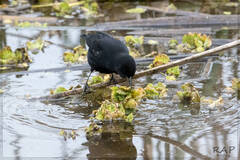
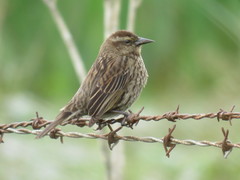
Male yellow-winged blackbirds average 17.9 cm (7.0 in) long. Males weigh an average of 33.5 g (1.2 oz) and females average about 29 g (1.0 oz). The species is sexually dimorphic. Adult males of the nominate subspecies are almost... Wikipedia →

Sounds

Recording0:21

Uruguay · 2024

© Guillermo Menéndez (gmmv80) · XC923447 · CC BY-NC-SA 4.0

Song0:05

Brazil · 2021

© JAYRSON ARAUJO DE OLIVEIRA · XC686859 · CC BY-NC-SA 4.0

Call0:04

Chile · 2011

© Cristian Pinto · XC571043 · CC BY-NC-SA 4.0

Global Distribution

Parks Where Found

# Park Country Daily sighting probability
1 Torres del Paine National Park 🇨🇱 Chile
~10%
2 Iberá National Park 🇦🇷 Argentina
~10%
3 Nahuel Huapi National Park 🇦🇷 Argentina
<5%

Cities Where Found

# City Country Daily sighting probability
1 Santiago 🇨🇱 Chile
~10%
2 Cochabamba 🇧🇴 Bolivia
~10%
3 Buenos Aires 🇦🇷 Argentina
~10%
4 Cordoba 🇦🇷 Argentina
<5%
5 Montevideo 🇺🇾 Uruguay
<5%

Before you go

What are the chances of seeing a Yellow-winged Blackbird in Cochabamba?

With luck

About 10% of wildlife watchers report a Yellow-winged Blackbird sighting in Cochabamba on a given day, based on 32 verified sightings from GBIF citizen-science data. It is the 55th most-seen of the 112 birds we can rate there. Over three days the chance rises to about 30%, and over a week to about 60%, if each day is a fresh chance.

When is the best time to see a Yellow-winged Blackbird in Cochabamba?

May

In that month about 30% of wildlife watchers report a Yellow-winged Blackbird in Cochabamba on a given day, against under 5% in February–March and June, the lowest months. That is one of Cochabamba's driest months, with about 5 mm of rain against 100 mm in January.

What time of day is best to see a Yellow-winged Blackbird?

Between 10 am and 1 pm

Across all the parks we cover, that three-hour window holds the most Yellow-winged Blackbird sightings with a recorded time, and about 9 in 10 of them come between 6 am and 6 pm: it is a daytime animal.

Is Cochabamba the best place to see a Yellow-winged Blackbird?

Among the best

Of the 5 cities where we can rate Yellow-winged Blackbird sightings, Cochabamba ranks 2nd at about 10%, level with the leaders once rounded. The best odds are in Santiago (Chile, about 10%).

Which relatives of the Yellow-winged Blackbird live in Cochabamba?

Same family: Icteridae

The closest relatives of the Yellow-winged Blackbird that you can see in Cochabamba (family Icteridae, New World Blackbirds and Orioles) are Grayish Baywing (about 70%) and Shiny Cowbird (about 20%), with each one's daily chance of a sighting.

Where does the Yellow-winged Blackbird sighting chance come from?

GBIF citizen-science records

It is estimated from how often the Yellow-winged Blackbird is recorded against all the birds logged in Cochabamba (32 verified sightings), calibrated against known sighting rates. Figures are rounded to the nearest 10% because citizen-science data supports honest approximations, not decimals, and months with records from fewer than five people show "—". How it works.

← Back to Cochabamba