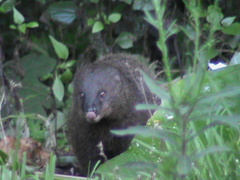
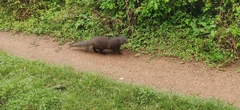
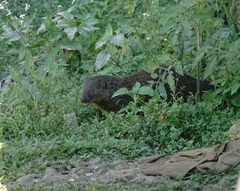
Indian Brown Mongoose

Indian Brown Mongoose

Herpestes fuscus

Silhouette: Margot Michaud · PhyloPic

Daily sighting probability ~10% · With luck
at Colombo [Sri Jayawardenepura Kotte]

In 3 days ~30% in a week ~60%

10 Verified sightings at Colombo [Sri Jayawardenepura Kotte]
12 In 1 park From 2019 to 2026
February Best month
☀️ Diurnal When it's spotted

About the Indian Brown Mongoose

The Indian brown mongoose or brown mongoose (Urva fusca) is a mongoose species native to the Western Ghats in India and the western coast in Sri Lanka and introduced to Fiji. It is listed as least concern on the IUCN Red List.

The Indian brown mongoose appears large compared to the other mongoose species in southern Western Ghats. This species has a dark brown body and its legs are noticeably in black colour. Head to body length is 33–48 cm. Tail is about 20–34 cm which is two-thirds of its body length and more furry than that of the small Indian mongoose. A pointed tail and fur beneath the hindleg help to distinguish this species from others. Males are larger and heavier than females with a weight of 2.7 kg. Young are much darker in color with yellowish eyes.

In South India, the Indian brown mongoose lives at an elevation range of 700–1,300 m (2,300–4,300 ft) from Virajpet in south Coorg and Ooty in the Nilgiri Hills, Tiger Shola in the Palni Hills, High Wavy Mountains in Madurai, Kalakad-Mundanthurai in Agasthyamalai Hills, Valparai plateau in the Anamalai Hills, and Peeramedu in Kerala. In Sri Lanka, the species is confined to... Wikipedia →

Global Distribution

Parks Where Found

# Park Country Daily sighting probability
1 Horton Plains National Park 🇱🇰 Sri Lanka
~50%

More parks will be added in future updates.

Cities Where Found

# City Country Daily sighting probability
1 Colombo [Sri Jayawardenepura Kotte] 🇱🇰 Sri Lanka
~10%

Before you go

What are the chances of seeing an Indian Brown Mongoose in Colombo [Sri Jayawardenepura Kotte]?

With luck

About 10% of wildlife watchers report an Indian Brown Mongoose sighting in Colombo [Sri Jayawardenepura Kotte] on a given day, based on 10 verified sightings from GBIF citizen-science data. It is the 4th most-seen of the 6 mammals we can rate there. Over three days the chance rises to about 30%, and over a week to about 60%, if each day is a fresh chance.

When is the best time to see an Indian Brown Mongoose in Colombo [Sri Jayawardenepura Kotte]?

February

In that month about 30% of wildlife watchers report an Indian Brown Mongoose in Colombo [Sri Jayawardenepura Kotte] on a given day, against under 5% in January, March–June, September and November, the lowest months. That is one of Colombo [Sri Jayawardenepura Kotte]'s driest months, with about 70 mm of rain against 310 mm in November.

What time of day is best to see an Indian Brown Mongoose?

Between 5 and 8 am

Across all the parks we cover, that three-hour window holds the most Indian Brown Mongoose sightings with a recorded time, and about 7 in 10 of them come between 6 am and 6 pm: it is a daytime animal.

Where else can you see an Indian Brown Mongoose?

Only Colombo [Sri Jayawardenepura Kotte], in our data

Colombo [Sri Jayawardenepura Kotte] is the only city on Wallace's Line with enough records to rate Indian Brown Mongoose sightings: about 10% of wildlife watchers there report one on a given day.

Where does the Indian Brown Mongoose sighting chance come from?

GBIF citizen-science records

It is estimated from how often the Indian Brown Mongoose is recorded against all the mammals logged in Colombo [Sri Jayawardenepura Kotte] (10 verified sightings), calibrated against known sighting rates. Figures are rounded to the nearest 10% because citizen-science data supports honest approximations, not decimals, and months with records from fewer than five people show "—". How it works.

← Back to Colombo [Sri Jayawardenepura Kotte]