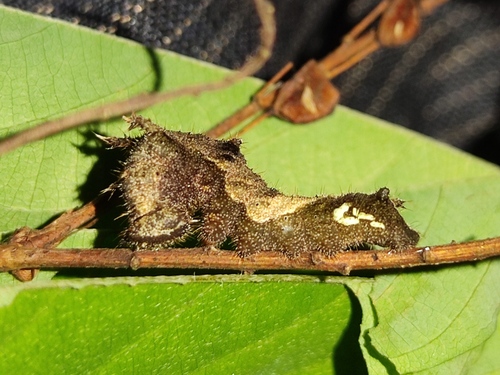
About the Indian Lily Moth
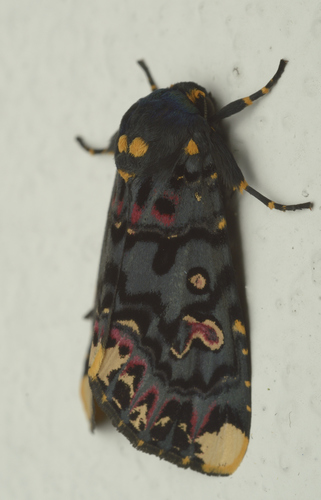
Polytela gloriosae, the Indian lily moth or lily caterpillar, is a moth of the family Noctuidae. The species was first described by Johan Christian Fabricius in 1781. It is found in Sri Lanka, India and probably in Indonesia.
The wingspan of the male is 29 mm. Its eyes are hairy and its proboscis is fully developed. Palpi porrect (extending forward) and roughly scaled. Head and thorax are blue black. Antennae orange. Three orange specks are found on the metathorax. Abdomen blackish with orange terminal segments. Forewings blue black. There is an orange speck at the base. Two pink and black lunules run towards the inner margin. Orbicular is yellow with a ring mark. Reniform yellowish. Large orange blotches are found at the apex and outer angle. Hindwings fuscous.
The caterpillar is smooth and purple black. Series of white spots on dorsal, lateral, and sublateral areas. Purplish lateral blotches on thoracic somites. Head and legs are reddish. Early instars are more reddish brown. Body colour turns darker as the caterpillar reaches later instars. Eggs are small spherical and yellow.
The female lays 80 to 90 eggs in 2 to 4 clusters. Eggs are hatched within... Wikipedia →