
Araucaria Tit-Spinetail

Araucaria Tit-Spinetail

Leptasthenura setaria

Silhouette: Sheatherius · PhyloPic

LCLeast ConcernNTVUENCR
Daily sighting probability ~20% · Possible
at Curitiba

In 3 days ~50% in a week ~80%

333 Verified sightings at Curitiba
310 In 1 park From 2019 to 2026
March Best month
☀️ Diurnal When it's spotted

About the Araucaria Tit-Spinetail

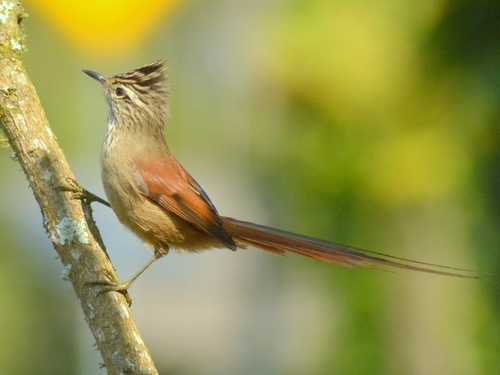
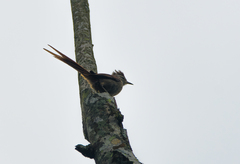
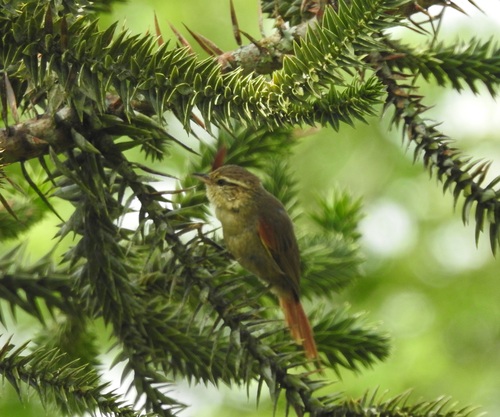
The Araucaria tit-spinetail (Leptasthenura setaria) is a Near Threatened species of bird in the Furnariinae subfamily of the ovenbird family Furnariidae. It is found in Argentina and Brazil. For a period in the early twentieth century the Araucaria tit-spinetail was placed by itself in genus Dendrophylax. Research published in 2011 conclusively placed it in Leptasthenura.

The Araucaria tit-spinetail's English name comes from the Araucaria angustifolia ("Brazilian pine"), on which is the bird is totally dependent. The Araucaria tit-spinetail is monotypic. The Araucaria tit-spinetail is 17 to 19 cm (6.7 to 7.5 in) long and weighs about 11 g (0.39 oz). It is a small-bodied, long-tailed furnariid with a short crest and a longish (for the genus) slightly decurved bill. The sexes have the same plumage. Adults have a thin white supercilium on an otherwise black and white striped face. Their crown and crest are blackish with narrow paler streaks. Their upperparts are reddish brown with faint pale streaks on the upper back. Their wings are mostly rufous with wide rufous bases on the otherwise blackish flight feathers. Their tail is mostly reddish... Wikipedia →

Sounds

Song0:17

Brazil · 2025

© JAYRSON ARAUJO DE OLIVEIRA · XC1053011 · CC BY-NC-SA 4.0

Duet0:27

Brazil · 2002

© Jeremy Minns · XC80567 · CC BY-NC-ND 2.5

Song0:24

Brazil · 2012

© Ricardo Gagliardi · XC474057 · CC BY-NC-SA 4.0

Global Distribution

Parks Where Found

# Park Country Daily sighting probability
1 Itatiaia National Park 🇧🇷 Brazil
~20%

More parks will be added in future updates.

Cities Where Found

# City Country Daily sighting probability
1 Curitiba 🇧🇷 Brazil
~20%

Before you go

What are the chances of seeing an Araucaria Tit-Spinetail in Curitiba?

Possible

About 20% of wildlife watchers report an Araucaria Tit-Spinetail sighting in Curitiba on a given day, based on 333 verified sightings from GBIF citizen-science data. It is the 39th most-seen of the 247 birds we can rate there. Over three days the chance rises to about 50%, and over a week to about 80%, if each day is a fresh chance.

When is the best time to see an Araucaria Tit-Spinetail in Curitiba?

January, March–April, June–July and September

In those months about 30% of wildlife watchers report an Araucaria Tit-Spinetail in Curitiba on a given day, against about 10% in November, the lowest month.

What time of day is best to see an Araucaria Tit-Spinetail?

Between 8 and 11 am

Across all the parks we cover, that three-hour window holds the most Araucaria Tit-Spinetail sightings with a recorded time, and about 9 in 10 of them come between 6 am and 6 pm: it is a daytime animal.

Where else can you see an Araucaria Tit-Spinetail?

Only Curitiba, in our data

Curitiba is the only city on Wallace's Line with enough records to rate Araucaria Tit-Spinetail sightings: about 20% of wildlife watchers there report one on a given day.

Which relatives of the Araucaria Tit-Spinetail live in Curitiba?

Same family: Furnariidae

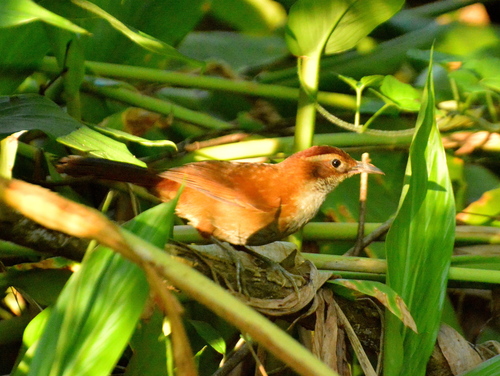
The closest relatives of the Araucaria Tit-Spinetail that you can see in Curitiba (family Furnariidae, Ovenbirds and Woodcreepers) are Rufous Hornero (about 90%), Olive Spinetail (about 30%) and Spix's Spinetail (about 20%), with each one's daily chance of a sighting.

Where does the Araucaria Tit-Spinetail sighting chance come from?

GBIF citizen-science records

It is estimated from how often the Araucaria Tit-Spinetail is recorded against all the birds logged in Curitiba (333 verified sightings), calibrated against known sighting rates. Figures are rounded to the nearest 10% because citizen-science data supports honest approximations, not decimals, and months with records from fewer than five people show "—". How it works.

← Back to Curitiba