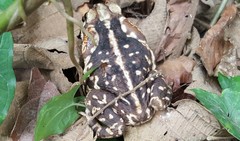
Yellow Cururu Toad

Yellow Cururu Toad

Rhinella icterica

Silhouette: Augusto Nunes Carvalho · PhyloPic

LCLeast ConcernNTVUENCR
Daily sighting probability ~40% · Likely
at Curitiba

In 3 days ~80% in a week >90%

93 Verified sightings at Curitiba
54 In all 2 parks From 2019 to 2026
September Best month
🌙 Nocturnal When it's spotted

About the Yellow Cururu Toad

Rhinella icterica (common name: yellow cururu toad) is a species of toad in the family Bufonidae that is found in northeastern Argentina (Misiones Province), southern Brazil, and eastern Paraguay. "Cururu" is its indigenous name and refers to the male advertisement call that is a melodious tremolo. "Cururu toad", without the specifier "yellow", is a common name used for a few other closely related species.

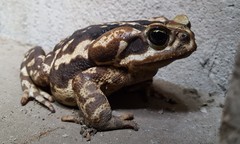
Rhinella icterica is relatively large, stout-bodied toads. Males measure 100–166 mm (3.9–6.5 in) and females 135–190 mm (5.3–7.5 in) in snout–vent length. The parotoid glands are strong, as are the cephalic crests. The dorsum is yellowish in females and juveniles, with a light midline stripe and a regular pattern of black blotches; in the males the colouration is often a bright greenish yellow, with only a few black blotches. The belly is white and marbled with brown. The skin is scattered with blunt, thorny warts, especially in the males. Rhinella icterica is the most common toad species found in southeastern Brazil and preys on the yellow scorpion (Tityus serrulatus). It has been observed that Rhinella icterica possess the ability to eat scorpions without adverse... Wikipedia →

Sounds

Recording0:55

Brazil · 2014

© Ricardo José Mitidieri · XC934480 · CC BY-NC-SA 4.0

Recording0:12

Brazil · 2017

© amandapmarcon · iNaturalist · CC BY-NC 4.0

Recording0:05

Brazil · 2025

© Manequinho Correia · iNaturalist · CC BY-NC 4.0

Global Distribution

Parks Where Found

# Park Country Daily sighting probability
1 Serra dos Órgãos National Park 🇧🇷 Brazil
~40%
2 Itatiaia National Park 🇧🇷 Brazil
~40%

Cities Where Found

# City Country Daily sighting probability
1 Curitiba 🇧🇷 Brazil
~40%
2 São Paulo 🇧🇷 Brazil
~10%
3 Campinas 🇧🇷 Brazil
~10%

Zoos & Centres Where Found

# Zoo / Centre Country
1 São Paulo Zoo 🇧🇷 Brazil In captivity
2 Rio de Janeiro Zoological Garden 🇧🇷 Brazil In captivity

Before you go

What are the chances of seeing a Yellow Cururu Toad in Curitiba?

Likely

About 40% of wildlife watchers report a Yellow Cururu Toad sighting in Curitiba on a given day, based on 93 verified sightings from GBIF citizen-science data. Over three days the chance rises to about 80%, and over a week to over 90%, if each day is a fresh chance.

When is the best time to see a Yellow Cururu Toad in Curitiba?

September

In that month about 60% of wildlife watchers report a Yellow Cururu Toad in Curitiba on a given day, against about 30% in January to May, the lowest months.

What time of day is best to see a Yellow Cururu Toad?

Between 6 and 9 pm

Across all the parks we cover, that three-hour window holds the most Yellow Cururu Toad sightings with a recorded time, and about 7 in 10 of them come between 6 pm and 6 am: it is mostly seen at night.

Is Curitiba the best place to see a Yellow Cururu Toad?

Yes

Of the 3 cities where we can rate Yellow Cururu Toad sightings, Curitiba has the highest daily chance: about 40%. Next come São Paulo (Brazil, about 10%) and Campinas (Brazil, about 10%).

Which relatives of the Yellow Cururu Toad live in Curitiba?

Same order: Anura

The closest relatives of the Yellow Cururu Toad that you can see in Curitiba (order Anura, Frogs and Toads) are Bischoff's Tree Frog (about 20%), Cuvier’s Foam Frog (about 10%) and Boie's Frog (about 10%), with each one's daily chance of a sighting.

Where does the Yellow Cururu Toad sighting chance come from?

GBIF citizen-science records

It is estimated from how often the Yellow Cururu Toad is recorded against all the amphibians logged in Curitiba (93 verified sightings), calibrated against known sighting rates. Figures are rounded to the nearest 10% because citizen-science data supports honest approximations, not decimals, and months with records from fewer than five people show "—". How it works.

← Back to Curitiba