Black-spotted Frog

Black-spotted Frog

Pelophylax nigromaculatus

Silhouette: Beth Reinke · PhyloPic

LCLeast ConcernNTVUENCR
Daily sighting probability ~50% · Likely
at Daegu

In 3 days ~90% in a week >90%

30 Verified sightings at Daegu
June Best month
☀️🌙 Day & Night When it's spotted

About the Black-spotted Frog

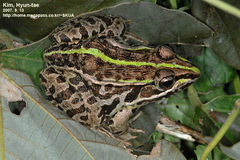
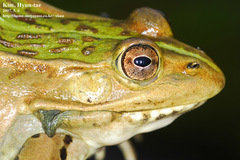
Pelophylax nigromaculatus (formerly Rana nigromaculata), is a species of true frog found in East Asia, first described in 1861. This widespread and common frog has many common names, including dark-spotted frog, black-spotted pond frog, and black-spotted frog.

It occurs across much of mainland eastern-northeastern China, the Amur River valley in Russia, the Korean Peninsula (including Ulleungdo Island), and most of Japan, with exceptions of Hokkaidō and the Ryukyu Islands. It has been considered the most-common of the true frogs on the Korean Peninsula, and has been hunted for food there for centuries, and, in modern times, used as an experimental animal. There are also introduced populations in Turkmenistan, Oahu, and Saipan.

The dark-spotted frog is a relatively low-altitude species, not being found above 2200 m. It ranges across a variety of habitats, from deserts and bushland to meadows and forests, and is typically found in or near stagnant or slow-moving water. Although relatively tolerant of human interference, it is increasingly threatened by hunting and water pollution.

Adult males measure about 62 mm (2.4 in) and females 74... Wikipedia →

Sounds

Advertisement call0:27

China · 2024

© Dave GUO · XC962553 · CC BY-NC-SA 4.0

Recording0:07

China · 2025

© Dallin Kohler · iNaturalist · CC BY-NC 4.0

Recording0:17

China · 2024

© Amaël Borzée · iNaturalist · CC BY-NC 4.0

Global Distribution

Parks Where Found

# Park Country Daily sighting probability

More parks will be added in future updates.

Cities Where Found

# City Country Daily sighting probability
1 Daegu 🇰🇷 South Korea
~50%
2 Tianjin 🇨🇳 China
~40%
3 Nagoya 🇯🇵 Japan
~20%
4 Chengdu 🇨🇳 China
~20%
5 Qingdao 🇨🇳 China
~20%
6 Beijing 🇨🇳 China
~20%
7 Nanjing 🇨🇳 China
~20%
8 Seoul 🇰🇷 South Korea
~20%
9 Ningbo 🇨🇳 China
~20%
10 Hangzhou 🇨🇳 China
~20%

Zoos & Centres Where Found

# Zoo / Centre Country
1 Animals Asia 🇨🇳 China In captivity
2 Cube Oceanarium 🇨🇳 China In captivity

Before you go

What are the chances of seeing a Black-spotted Frog in Daegu?

Likely

About 50% of wildlife watchers report a Black-spotted Frog sighting in Daegu on a given day, based on 30 verified sightings from GBIF citizen-science data. Over three days the chance rises to about 90%, and over a week to over 90%, if each day is a fresh chance.

When is the best time to see a Black-spotted Frog in Daegu?

June

In that month about 80% of wildlife watchers report a Black-spotted Frog in Daegu on a given day, against about 10% in February–March and October, the lowest months. December has too few records to rate.

What time of day is best to see a Black-spotted Frog?

Between 9 am and noon

Across all the parks we cover, that three-hour window holds the most Black-spotted Frog sightings with a recorded time, and about 7 in 10 of them come between 6 am and 6 pm: it is seen both by day and at night.

Is Daegu the best place to see a Black-spotted Frog?

Yes

Of the 17 cities where we can rate Black-spotted Frog sightings, Daegu has the highest daily chance: about 50%. Next come Tianjin (China, about 40%) and Nagoya (Japan, about 20%).

Which relatives of the Black-spotted Frog live in Daegu?

Same order: Anura

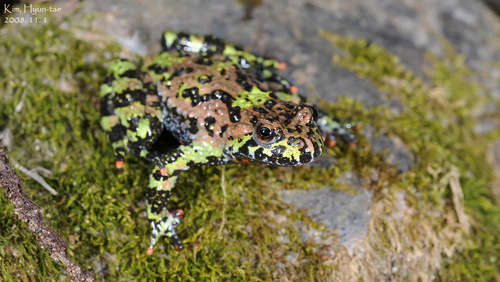
The closest relatives of the Black-spotted Frog that you can see in Daegu (order Anura, Frogs and Toads) are Japanese Tree Frog (about 40%) and Oriental Fire-bellied Toad (about 30%), with each one's daily chance of a sighting.

Where does the Black-spotted Frog sighting chance come from?

GBIF citizen-science records

It is estimated from how often the Black-spotted Frog is recorded against all the amphibians logged in Daegu (30 verified sightings), calibrated against known sighting rates. Figures are rounded to the nearest 10% because citizen-science data supports honest approximations, not decimals, and months with records from fewer than five people show "—". How it works.

← Back to Daegu