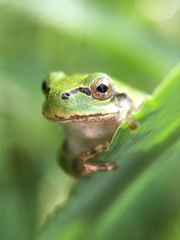
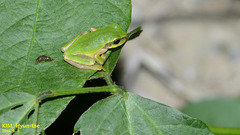
Japanese Tree Frog

Japanese Tree Frog

Dryophytes japonicus

LCLeast ConcernNTVUENCR
Daily sighting probability ~40% · Likely
at Daegu

In 3 days ~80% in a week >90%

22 Verified sightings at Daegu
June Best month

About the Japanese Tree Frog

Dryophytes japonicus, with frequently used synonym Hyla japonica, commonly known as the Japanese tree frog, is a species of anuran native to Japan, China, and Korea. It is unique in its ability to withstand extreme cold, with some individuals showing cold resistance at temperatures as low as −30 °C for up to 120 days. Japanese tree frogs are not currently facing any notable risk of extinction and are classified by the IUCN as a species of "least concern". Notably, it has been sent to space in a study that explored the effect of microgravity on Japanese tree frogs. Some consider that Dryophytes japonicus is synonymous with Hyla japonica. However, a 2025 study treated that this species as Dryophytes japonicus again, and separated northern species as Dryophytes leopardus.

The Japanese tree frog lives in a variety of habitats such as wetlands, forests, rivers, and mountains. They are generally located near vegetation near water sources and forests. They are carnivores that prey on insects and spiders. Their average clutch size is around 340–1,500 eggs, and their lifespan is usually around six years. There is an estimated 100 million of these frogs in Japan, but the accuracy is limited due to difficulty in counting. Wikipedia →

Sounds

Advertisement call0:57

Russian Federation · 2015

© Albert Lastukhin · XC892275 · CC BY-NC-ND 4.0

Recording0:11

South Korea · 2024

© Paul B. · iNaturalist · CC BY-NC 4.0

Recording0:19

China · 2024

© Amaël Borzée · iNaturalist · CC BY-NC 4.0

Global Distribution

Parks Where Found

# Park Country Daily sighting probability

More parks will be added in future updates.

Cities Where Found

# City Country Daily sighting probability
1 Daegu 🇰🇷 South Korea
~40%
2 Seoul 🇰🇷 South Korea
~20%

Zoos & Centres Where Found

# Zoo / Centre Country
1 Uminonakamichi Seaside Park 🇯🇵 Japan In captivity
2 Asahiyama Zoo 🇯🇵 Japan In captivity
3 Ueno Zoological Gardens (West Garden) 🇯🇵 Japan In captivity

Before you go

What are the chances of seeing a Japanese Tree Frog in Daegu?

Likely

About 40% of wildlife watchers report a Japanese Tree Frog sighting in Daegu on a given day, based on 22 verified sightings from GBIF citizen-science data. Over three days the chance rises to about 80%, and over a week to over 90%, if each day is a fresh chance.

When is the best time to see a Japanese Tree Frog in Daegu?

June

In that month about 70% of wildlife watchers report a Japanese Tree Frog in Daegu on a given day, against about 10% in February–March and September, the lowest months. December has too few records to rate.

Is Daegu the best place to see a Japanese Tree Frog?

Yes

Of the 2 cities where we can rate Japanese Tree Frog sightings, Daegu has the highest daily chance: about 40%. Next come Seoul (South Korea, about 20%).

Which relatives of the Japanese Tree Frog live in Daegu?

Same order: Anura

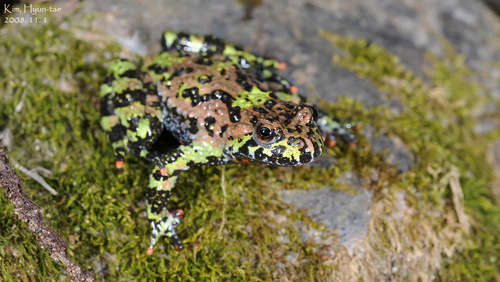
The closest relatives of the Japanese Tree Frog that you can see in Daegu (order Anura, Frogs and Toads) are Black-spotted Frog (about 50%) and Oriental Fire-bellied Toad (about 30%), with each one's daily chance of a sighting.

Where does the Japanese Tree Frog sighting chance come from?

GBIF citizen-science records

It is estimated from how often the Japanese Tree Frog is recorded against all the amphibians logged in Daegu (22 verified sightings), calibrated against known sighting rates. Figures are rounded to the nearest 10% because citizen-science data supports honest approximations, not decimals, and months with records from fewer than five people show "—". How it works.

← Back to Daegu