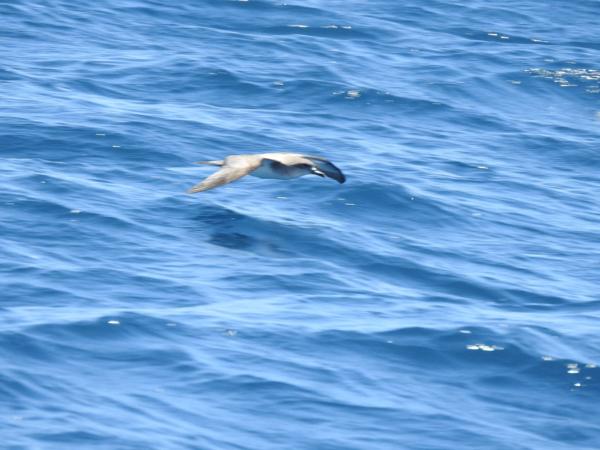
Great Shearwater

Great Shearwater

Puffinus gravis

Silhouette: Juan Carlos Jerí · PhyloPic

LCLeast ConcernNTVUENCR
Daily sighting probability ~10% · With luck
at Dakar

In 3 days ~20% in a week ~50%

24 Verified sightings at Dakar
208 In all 4 parks From 2019 to 2026
November Best month
☀️ Diurnal When it's spotted

About the Great Shearwater

The great shearwater (Ardenna gravis) is a large shearwater in the seabird family Procellariidae. It breeds colonially on rocky islands in the South Atlantic. Outside the breeding season it ranges widely in the Atlantic.

The great shearwater was formally described in 1818 by the Irish naturalist Bernard O'Reilly and given the binomial name Procellaria gravis. The great shearwater is now placed in the genus Ardenna that was introduced in 1853 by Ludwig Reichenbach. The genus name Ardenna was used to refer to a seabird by Italian naturalist Ulisse Aldrovandi in 1603. The specific epithet gravis is Latin meaning "heavy" or "weighty". The species is monotypic: no subspecies are recognised.

This shearwater is 43–51 cm (16.9–20.1 in) in length with a 105–122 cm (3.5–4.0 ft) wingspan. It is identifiable by its size, dark upper parts, and white under parts, with the exception of a brown belly patch and dark shoulder markings. It has a black cap, black bill, and a white "horseshoe" on the base of the tail. The stiff flight, like a large Manx shearwater, is also distinctive. The only other large shearwaters in its range are the Cory's Shearwater and the all-dark... Wikipedia →

Sounds

Recording0:08

Bermuda · 2022

© Luke Foster · iNaturalist · CC BY-NC 4.0

Recording0:34

United States · 2020

© Birder20714 · iNaturalist · CC BY-NC 4.0

Global Distribution

Parks Where Found

# Park Country Daily sighting probability
1 Península Valdés 🇦🇷 Argentina
<5%
2 Acadia National Park 🇺🇸 United States
<5%
3 Table Mountain National Park 🇿🇦 South Africa
<5%
4 Merritt Island National Wildlife Refuge 🇺🇸 United States
<5%

Cities Where Found

# City Country Daily sighting probability
1 Dakar 🇸🇳 Senegal
~10%
2 Miami 🇺🇸 United States
<5%

Before you go

What are the chances of seeing a Great Shearwater in Dakar?

With luck

About 10% of wildlife watchers report a Great Shearwater sighting in Dakar on a given day, based on 24 verified sightings from GBIF citizen-science data. It is the 94th most-seen of the 152 birds we can rate there. Over three days the chance rises to about 20%, and over a week to about 50%, if each day is a fresh chance.

When is the best time to see a Great Shearwater in Dakar?

November and December

In those months about 20% of wildlife watchers report a Great Shearwater in Dakar on a given day, against under 5% in January–August and October, the lowest months. Those are among Dakar's driest months, with about 10 mm of rain a month against 190 mm in August.

What time of day is best to see a Great Shearwater?

Between 9 am and noon

Across all the parks we cover, that three-hour window holds the most Great Shearwater sightings with a recorded time, and about 9 in 10 of them come between 6 am and 6 pm: it is a daytime animal.

Is Dakar the best place to see a Great Shearwater?

Yes

Of the 2 cities where we can rate Great Shearwater sightings, Dakar has the highest daily chance: about 10%. Next come Miami (United States, under 5%).

Which relatives of the Great Shearwater live in Dakar?

Same genus: Puffinus

The closest relatives of the Great Shearwater that you can see in Dakar (genus Puffinus, Small Shearwaters) are Sooty Shearwater (about 30%) and Manx Shearwater (about 20%), with each one's daily chance of a sighting.

Where does the Great Shearwater sighting chance come from?

GBIF citizen-science records

It is estimated from how often the Great Shearwater is recorded against all the birds logged in Dakar (24 verified sightings), calibrated against known sighting rates. Figures are rounded to the nearest 10% because citizen-science data supports honest approximations, not decimals, and months with records from fewer than five people show "—". How it works.


← Back to Dakar