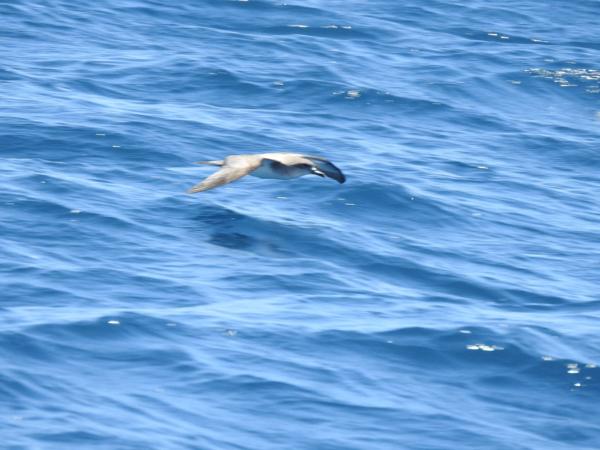
Bulwer's Petrel

Bulwer's Petrel

Bulweria bulwerii

Silhouette: Sheatherius · PhyloPic

LCLeast ConcernNTVUENCR
Daily sighting probability <5% · Rare
at Dakar

In 3 days ~10% in a week ~20%

8 Verified sightings at Dakar
60 In all 2 parks From 2019 to 2026
October Best month
☀️ Diurnal When it's spotted

About the Bulwer's Petrel

Bulwer's petrel (Bulweria bulwerii) is a small petrel in the family Procellariidae that is found in tropical and subtropical regions of the Atlantic, Indian and Pacific Oceans. It is named after the English naturalist James Bulwer.

Bulwer's petrel was formally described in 1828 by the naturalists Jardine and Selby who coined the binomial name Procellaria bulwerii. The specific epithet was chosen to acknowledge the artist and naturalist James Bulwer who had collected the type specimen on the island of Madeira. Bulwer's petrel is now placed in the genus Bulweria that was introduced in 1843 by the French naturalist Charles Lucien Bonaparte. The species is monotypic: no subspecies are recognised.

This very long-winged petrel is 25–29 cm (9.8–11.4 in) in length with a 78–90 cm (31–35 in) wingspan. It has mainly brown plumage and a long pointed tail. It has a buoyant twisting flight as it picks planktonic food items from the ocean surface.

The species has a wide distribution through tropical and subtropical regions of the Atlantic, Indian and Pacific oceans, it is a year-round resident in Cabo Verde, China, French Guiana, Indonesia... Wikipedia →

Sounds

Song0:27

Spain · 2020

© Marcel Gil Velasco · XC619771 · CC BY-NC-SA 4.0

Call0:24

Portugal · 2005

© Steve Gantlett · XC18554 · CC BY-NC-ND 2.5

Song0:53

Portugal · 2005

© James Bradley · XC295062 · CC BY-NC-SA 4.0

Global Distribution

Parks Where Found

# Park Country Daily sighting probability
1 Komodo National Park 🇮🇩 Indonesia
~10%
2 Raja Ampat 🇮🇩 Indonesia
<5%

Cities Where Found

# City Country Daily sighting probability
1 Dakar 🇸🇳 Senegal
<5%

Before you go

What are the chances of seeing a Bulwer's Petrel in Dakar?

Rare

Under 5% of wildlife watchers report a Bulwer's Petrel sighting in Dakar on a given day, based on 8 verified sightings from GBIF citizen-science data. It is the 132nd most-seen of the 152 birds we can rate there. Over three days the chance rises to about 10%, and over a week to about 20%, if each day is a fresh chance.

When is the best time to see a Bulwer's Petrel in Dakar?

October

In that month about 20% of wildlife watchers report a Bulwer's Petrel in Dakar on a given day, against under 5% in November to September, the lowest months.

What time of day is best to see a Bulwer's Petrel?

Between 9 am and noon

Across all the parks we cover, that three-hour window holds the most Bulwer's Petrel sightings with a recorded time, and about 8 in 10 of them come between 6 am and 6 pm: it is a daytime animal.

Where else can you see a Bulwer's Petrel?

Only Dakar, in our data

Dakar is the only city on Wallace's Line with enough records to rate Bulwer's Petrel sightings: under 5% of wildlife watchers there report one on a given day.

Which relatives of the Bulwer's Petrel live in Dakar?

Same family: Procellariidae

The closest relatives of the Bulwer's Petrel that you can see in Dakar (family Procellariidae, Shearwaters and Petrels) are Sooty Shearwater (about 30%), Manx Shearwater (about 20%) and Great Shearwater (about 10%), with each one's daily chance of a sighting.

Where does the Bulwer's Petrel sighting chance come from?

GBIF citizen-science records

It is estimated from how often the Bulwer's Petrel is recorded against all the birds logged in Dakar (8 verified sightings), calibrated against known sighting rates. Figures are rounded to the nearest 10% because citizen-science data supports honest approximations, not decimals, and months with records from fewer than five people show "—". How it works.

← Back to Dakar