About the Catalpa Sphinx
Ceratomia catalpae, the catalpa sphinx, is a hawk moth of the family Sphingidae. The species was first described by Jean Baptiste Boisduval in 1875. Other common names are the Catawba worm, or Catalpa sphinx. Ceratomia catalpae is a native of southeastern North America and can be located on catalpa trees that grow within this region. It can be found from Maine, west to Iowa, and south to the Gulf States.
From oviposition of the eggs to pupation, about four weeks will pass. Where multiple broods occur, pupae will eclose in two weeks, or when conditions are suitable. Adult C. catalpae do not reflect the wonderful colors of their larvae. They are a dull brown color lacking the show-off appearance of its larval stages.
Translucent, milky-white, green, or yellowish eggs are oval, being about 0.5 mm in diameter. Eggs are deposited in masses of 100-1000 eggs on the undersurface of leaves, while smaller masses are deposited onto branches on the catalpa tree. Eggs incubate and hatch five to seven days after oviposition.
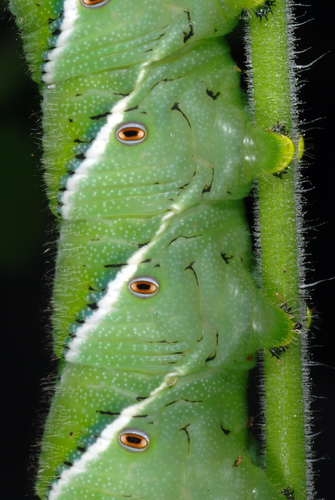
The larval stage of C. catalpae is known as the catalpa, catawba worm, and toppy worm. When first hatching, the larvae are... Wikipedia →