Eastern Green Mamba

Eastern Green Mamba

Dendroaspis angusticeps

Silhouette: SeismicShrimp · PhyloPic

LCLeast ConcernNTVUENCR
Daily sighting probability ~10% · With luck
at Durban

In 3 days ~20% in a week ~40%

14 Verified sightings at Durban
6 In 1 park From 2019 to 2026
March Best month
☀️ Diurnal When it's spotted

About the Eastern Green Mamba

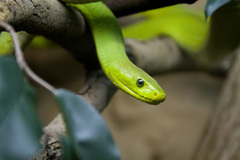
The eastern green mamba (Dendroaspis angusticeps) is a highly venomous snake species of the mamba genus Dendroaspis native to the coastal regions of southern East Africa. Described by Scottish surgeon and zoologist Andrew Smith in 1849, it has a slender build with a bright green back and green-yellow ventral scales. Adult females average around 2 metres (6 ft 7 in) in length, and males are slightly smaller.

In spite of common urban legends and misconceptions labeling the eastern green mamba an aggressive, fast-moving "people-chaser", it is in fact a shy and elusive species that remains hidden in the trees, and is rarely seen. This seclusion is usually attributed to its arboreal habitat and green colouration, which acts as effective camouflage in its natural environment. Even with its deadly venom, the green mamba has to protect itself from predators, including birds of prey and other snakes, such as cobras. It has been observed engaging in ambush predation, a trait seen among many Viperidae species, contrary to the active hunting style typical of other Elapidae snakes. It preys on arboreal and winged animals, such as birds and their chicks and eggs, bats, and arboreal rodents such as mice, rats, and gerbils.

Eastern green mamba venom consists of both neurotoxins and cardiotoxins. Symptoms of envenomation include swelling of the immediate bite-wound area, dizziness, vertigo and nausea, accompanied by dehydration, labored breathing and difficult swallowing. This eventually will develop into arrhythmia and convulsions—all progressing to respiratory paralysis, which results in a fatal lack of oxygen to the brain. Bites that are severe if not immediately treated on-site can quickly prove deadly. Wikipedia →

Global Distribution

Parks Where Found

# Park Country Daily sighting probability
1 iSimangaliso Wetland Park 🇿🇦 South Africa
~10%

More parks will be added in future updates.

Cities Where Found

# City Country Daily sighting probability
1 Durban 🇿🇦 South Africa
~10%

Zoos & Centres Where Found

# Zoo / Centre Country
1 Cabarceno Natural Park 🇪🇸 Spain In captivity
2 Dvůr Králové Zoo 🇨🇿 Czechia In captivity
3 Zoo Pilsen 🇨🇿 Czechia In captivity
4 Columbus Zoo and Aquarium 🇺🇸 United States In captivity
5 Sedgwick County Zoo 🇺🇸 United States In captivity
6 Dallas Zoo 🇺🇸 United States In captivity
7 National Zoological Garden of South Africa 🇿🇦 South Africa In captivity
8 Toledo Zoo 🇺🇸 United States In captivity
9 ABQ BioPark Zoo 🇺🇸 United States In captivity
10 San Antonio Zoo 🇺🇸 United States In captivity
11 Tierpark Hagenbeck 🇩🇪 Germany In captivity
12 Cameron Park Zoo 🇺🇸 United States In captivity
13 Crocworld Conservation Centre 🇿🇦 South Africa In captivity
14 Zagreb Zoo 🇭🇷 Croatia In captivity
15 Alligator Adventure 🇺🇸 United States In captivity
16 Reptile Gardens 🇺🇸 United States In captivity
17 Bois du Petit-Château 🇨🇭 Switzerland In captivity
18 Hartbeespoort Dam Snake and Animal Park 🇿🇦 South Africa In captivity
19 Riverbend Crocodile Farm 🇿🇦 South Africa In captivity
20 Two Oceans Aquarium 🇿🇦 South Africa In captivity
21 Reptiland 🇫🇷 France In captivity
22 National Reptile Zoo 🇮🇪 Ireland In captivity
23 Reptilia 🇨🇦 Canada In captivity
24 Reptilienzoo Nockalm 🇦🇹 Austria In captivity

Before you go

What are the chances of seeing an Eastern Green Mamba in Durban?

With luck

About 10% of wildlife watchers report an Eastern Green Mamba sighting in Durban on a given day, based on 14 verified sightings from GBIF citizen-science data. It is the 19th most-seen of the 27 reptiles we can rate there. Over three days the chance rises to about 20%, and over a week to about 40%, if each day is a fresh chance.

When is the best time to see an Eastern Green Mamba in Durban?

March

In that month about 20% of wildlife watchers report an Eastern Green Mamba in Durban on a given day, against under 5% in July–October and December–January, the lowest months.

What time of day is best to see an Eastern Green Mamba?

Between 10 am and 1 pm

Across all the parks we cover, that three-hour window holds the most Eastern Green Mamba sightings with a recorded time, and about 9 in 10 of them come between 6 am and 6 pm: it is a daytime animal.

Where else can you see an Eastern Green Mamba?

Only Durban, in our data

Durban is the only city on Wallace's Line with enough records to rate Eastern Green Mamba sightings: about 10% of wildlife watchers there report one on a given day.

Where does the Eastern Green Mamba sighting chance come from?

GBIF citizen-science records

It is estimated from how often the Eastern Green Mamba is recorded against all the reptiles logged in Durban (14 verified sightings), calibrated against known sighting rates. Figures are rounded to the nearest 10% because citizen-science data supports honest approximations, not decimals, and months with records from fewer than five people show "—". How it works.

← Back to Durban