Mangrove Kingfisher

Mangrove Kingfisher

Halcyon senegaloides

Silhouette: Andy Wilson · PhyloPic

LCLeast ConcernNTVUENCR
Daily sighting probability <5% · Rare
at Durban

In 3 days <5% in a week ~10%

8 Verified sightings at Durban
33 In 1 park From 2019 to 2026
July Best month
☀️ Diurnal When it's spotted

About the Mangrove Kingfisher

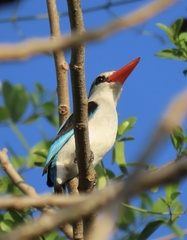
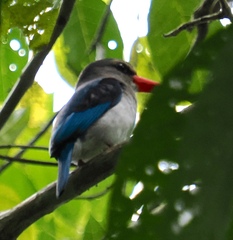
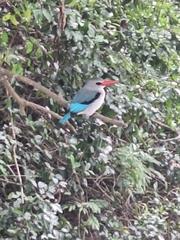
The mangrove kingfisher (Halcyon senegaloides) is a kingfisher in the genus Halcyon. It is similar in appearance to the woodland kingfisher. It is found along the eastern coastline of Sub-Saharan Africa, living in woodland, along rivers, and in estuaries and mangrove. The International Union for Conservation of Nature (IUCN) has assessed it as being of least concern.

This species was described by Andrew Smith in 1834, using a specimen collected around Port Natal (now Durban). It is a close relative of the woodland kingfisher (Halcyon senegalensis). The mangrove kingfisher is a monotypic species. Northern populations are sometimes separated as subspecies ranivorus, but the differences do not appear to be large enough.

The mangrove kingfisher is about 22 cm (8.7 in) long. The male and female are alike. The head is dark grey-brown, with black lores and a narrow white line above the eye, and the cheeks and sides of the neck are brown-grey. The grey breast and flanks are vermiculated (having dense, irregular lines). There is a black patch under the wing. The rest of the plumage is similar to the woodland kingfisher, having black and blue covert and flight... Wikipedia →

Sounds

Song0:27

Tanzania · 2022

© isaac kilusu · XC755902 · CC BY-NC-SA 4.0

Recording0:47

Tanzania · 2020

© Lien Rag · XC550678 · CC BY-NC-SA 4.0

Call0:59

Kenya · 2016

© Simon Carter · XC309980 · CC BY-NC-SA 4.0

Global Distribution

Parks Where Found

# Park Country Daily sighting probability
1 iSimangaliso Wetland Park 🇿🇦 South Africa
<5%

More parks will be added in future updates.

Cities Where Found

# City Country Daily sighting probability
1 Zanzibar City 🇹🇿 Tanzania
~20%
2 Mombasa 🇰🇪 Kenya
~10%
3 Durban 🇿🇦 South Africa
<5%

Before you go

What are the chances of seeing a Mangrove Kingfisher in Durban?

Rare

Under 5% of wildlife watchers report a Mangrove Kingfisher sighting in Durban on a given day, based on 8 verified sightings from GBIF citizen-science data. It is the 186th most-seen of the 219 birds we can rate there. Over three days the chance rises to under 5%, and over a week to about 10%, if each day is a fresh chance.

When is the best time to see a Mangrove Kingfisher in Durban?

Any time of year

In every month with enough records, under 5% of wildlife watchers report a Mangrove Kingfisher in Durban on a given day, so our monthly data shows no clear season.

What time of day is best to see a Mangrove Kingfisher?

Between 8 and 11 am

Across all the parks we cover, that three-hour window holds the most Mangrove Kingfisher sightings with a recorded time, and about 9 in 10 of them come between 6 am and 6 pm: it is a daytime animal.

Is Durban the best place to see a Mangrove Kingfisher?

3rd of 3

Of the 3 cities where we can rate Mangrove Kingfisher sightings, Durban ranks 3rd at under 5%. The best odds are in Zanzibar City (Tanzania, about 20%) and Mombasa (Kenya, about 10%).

Where does the Mangrove Kingfisher sighting chance come from?

GBIF citizen-science records

It is estimated from how often the Mangrove Kingfisher is recorded against all the birds logged in Durban (8 verified sightings), calibrated against known sighting rates. Figures are rounded to the nearest 10% because citizen-science data supports honest approximations, not decimals, and months with records from fewer than five people show "—". How it works.

← Back to Durban