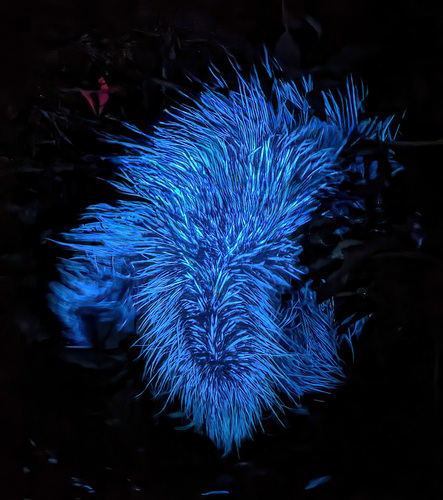
Richardson's Ground Squirrel

Richardson's Ground Squirrel

Urocitellus richardsonii

Silhouette: Andy Wilson · PhyloPic

LCLeast ConcernNTVUENCR
Daily sighting probability ~10% · With luck
at Edmonton

In 3 days ~30% in a week ~50%

68 Verified sightings at Edmonton
July Best month
☀️ Diurnal When it's spotted

About the Richardson's Ground Squirrel

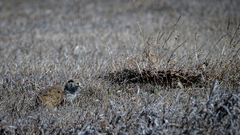
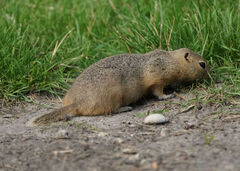
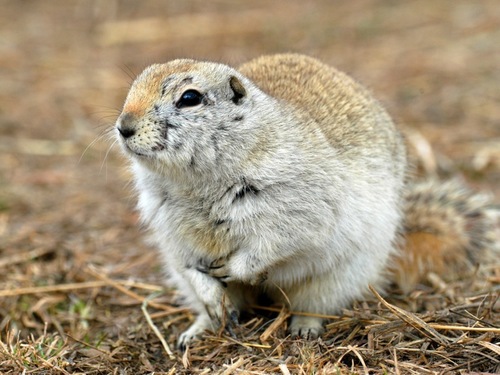
Richardson's ground squirrel (Urocitellus richardsonii), also known as the dakrat or flickertail, is a North American ground squirrel in the genus Urocitellus. Like a number of other ground squirrels, they are sometimes called prairie dogs or gophers, though the latter name belongs more strictly to the pocket gophers of family Geomyidae, and the former to members of the genus Cynomys.

This squirrel was named after the Scottish naturalist Sir John Richardson. North Dakota is nicknamed the Flickertail state after the squirrel. The nickname Dakrat is derived from "Dakota Rat" and is a commonly used name around Minot, North Dakota and on Minot Air Force Base.

Native to the short grass prairies, Richardson's ground squirrel is found mainly in the northern states of the United States, such as North Dakota and Montana, and in western Canada, including central and southern Alberta, southern Saskatchewan, and southern Manitoba. The range of this animal expanded as forests were cleared to create farmland. They are not simply restricted to prairie; sometimes they adapt to suburban environments, causing them to be seen as pests because of the burrows they dig. It is... Wikipedia →
Sounds

Recording0:16

Canada · 2026

© morkenne · iNaturalist · CC BY-NC 4.0

Recording0:11

Canada · 2025

© Maianthemum · iNaturalist · CC BY-NC 4.0

Recording0:11

Canada · 2024

© nafisachalchal · iNaturalist · CC BY-NC 4.0

Global Distribution

Parks Where Found

# Park Country Daily sighting probability

More parks will be added in future updates.

Cities Where Found

# City Country Daily sighting probability
1 Calgary 🇨🇦 Canada
~30%
2 Edmonton 🇨🇦 Canada
~10%

Zoos & Centres Where Found

# Zoo / Centre Country
1 Green World Ecological Farm 🇹🇼 Taiwan In captivity
2 Gunma Safari Park 🇯🇵 Japan In captivity

Before you go

What are the chances of seeing a Richardson's Ground Squirrel in Edmonton?

With luck

About 10% of wildlife watchers report a Richardson's Ground Squirrel sighting in Edmonton on a given day, based on 68 verified sightings from GBIF citizen-science data. It is the 10th most-seen of the 20 mammals we can rate there. Over three days the chance rises to about 30%, and over a week to about 50%, if each day is a fresh chance.

When is the best time to see a Richardson's Ground Squirrel in Edmonton?

June and July

In those months about 20% of wildlife watchers report a Richardson's Ground Squirrel in Edmonton on a given day, against under 5% in October to February, the lowest months. Those are among Edmonton's wettest months, with about 90 mm of rain a month against 20 mm in February.

What time of day is best to see a Richardson's Ground Squirrel?

Between 11 am and 2 pm

Across all the parks we cover, that three-hour window holds the most Richardson's Ground Squirrel sightings with a recorded time, and about 8 in 10 of them come between 6 am and 6 pm: it is a daytime animal.

Is Edmonton the best place to see a Richardson's Ground Squirrel?

2nd of 2

Of the 2 cities where we can rate Richardson's Ground Squirrel sightings, Edmonton ranks 2nd at about 10%. The best odds are in Calgary (Canada, about 30%).

Which relatives of the Richardson's Ground Squirrel live in Edmonton?

Same family: Sciuridae

The closest relatives of the Richardson's Ground Squirrel that you can see in Edmonton (family Sciuridae, Squirrels) are American Red Squirrel (about 50%) and Least Chipmunk (about 30%), with each one's daily chance of a sighting.

Where does the Richardson's Ground Squirrel sighting chance come from?

GBIF citizen-science records

It is estimated from how often the Richardson's Ground Squirrel is recorded against all the mammals logged in Edmonton (68 verified sightings), calibrated against known sighting rates. Figures are rounded to the nearest 10% because citizen-science data supports honest approximations, not decimals, and months with records from fewer than five people show "—". How it works.

← Back to Edmonton