White-tailed Jackrabbit

White-tailed Jackrabbit

Lepus townsendii

Silhouette: Jan A. Venter, Herbert H. T. Prins, David A. Balfour & Rob Slotow (vectorized by T. Michael Keesey) · PhyloPic

LCLeast ConcernNTVUENCR
Daily sighting probability ~40% · Likely
at Edmonton

In 3 days ~80% in a week >90%

676 Verified sightings at Edmonton
53 In all 3 parks From 2019 to 2026
August Best month
🌅 Crepuscular When it's spotted

About the White-tailed Jackrabbit

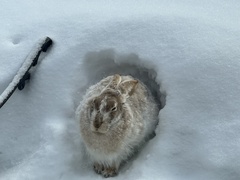
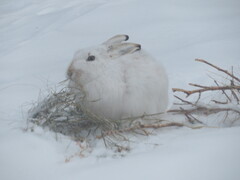
The white-tailed jackrabbit (Lepus townsendii), also known as the prairie hare and the white jack, is a species of hare found in western North America. Like all hares and rabbits, it is a member of the family Leporidae of order Lagomorpha. It is a solitary individual except where several males court a female in the breeding season. Litters of four to five young are born in a form, a shallow depression in the ground, hidden among vegetation. This jackrabbit has two described subspecies: L. townsendii townsendii occurring west of the Rocky Mountains and L. townsendii campanius occurring east of the Rocky Mountains.

The white-tailed jackrabbit is a large species of hare and is the largest species called "jackrabbit". This jackrabbit has an adult length of 22 to 26 inches (56 to 65 centimeters), including a tail measuring 2.6 to 4.0 in (6.6 to 10.2 cm), and a weight between 5.5 and 9.5 pounds (2.5 and 4.3 kilograms). From winter to spring, weight tends to increase in females due to pregnancy, but decrease in males due to the stresses of reproductive competition. Thus, females in Iowa went from averaging 7.9 lb (3,600 g) in winter to 8.4 lb (3,800 g) in spring and males... Wikipedia →


Global Distribution

Parks Where Found

# Park Country Daily sighting probability
1 Sequoia and Kings Canyon National Parks 🇺🇸 United States
~10%
2 Yosemite National Park 🇺🇸 United States
~10%
3 Yellowstone National Park 🇺🇸 United States
~10%

Cities Where Found

# City Country Daily sighting probability
1 Calgary 🇨🇦 Canada
~40%
2 Edmonton 🇨🇦 Canada
~40%

Before you go

What are the chances of seeing a White-tailed Jackrabbit in Edmonton?

Likely

About 40% of wildlife watchers report a White-tailed Jackrabbit sighting in Edmonton on a given day, based on 676 verified sightings from GBIF citizen-science data. It is the 2nd most-seen of the 20 mammals we can rate there. Over three days the chance rises to about 80%, and over a week to over 90%, if each day is a fresh chance.

When is the best time to see a White-tailed Jackrabbit in Edmonton?

June to April

In those months about 40% of wildlife watchers report a White-tailed Jackrabbit in Edmonton on a given day, against about 30% in May, the lowest month.

What time of day is best to see a White-tailed Jackrabbit?

Between 6 and 9 pm

Across all the parks we cover, that three-hour window holds the most White-tailed Jackrabbit sightings with a recorded time, and about 6 in 10 of them come between 6 am and 6 pm: it is most active around dawn and dusk.

Is Edmonton the best place to see a White-tailed Jackrabbit?

Among the best

Of the 2 cities where we can rate White-tailed Jackrabbit sightings, Edmonton ranks 2nd at about 40%, level with the leaders once rounded. The best odds are in Calgary (Canada, about 40%).

Where does the White-tailed Jackrabbit sighting chance come from?

GBIF citizen-science records

It is estimated from how often the White-tailed Jackrabbit is recorded against all the mammals logged in Edmonton (676 verified sightings), calibrated against known sighting rates. Figures are rounded to the nearest 10% because citizen-science data supports honest approximations, not decimals, and months with records from fewer than five people show "—". How it works.

← Back to Edmonton