About the Banded Krait
The banded krait (Bungarus fasciatus) is a venomous species of elapid endemic to Asia, from Indian subcontinent through Southeast Asia to Southern China. With a maximum length exceeding 2 m (6 ft 7 in), it is the longest krait with a distinguishable gold and black pattern. While this species is generally considered timid and docile, resembling other members of the genus, its venom is highly neurotoxic which is lethal to humans. Although toxicity of the banded krait based upon murine LD50 experiments is lower than that of many other kraits, its venom yield is the highest due to its size.
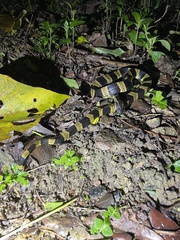
The banded krait is easily identified by its alternate black and yellow crossbands all of which encircle the body. The head is broad and depressed and it is not distinct from the neck. The eyes are black. It has arrowhead-like yellow markings on its otherwise black head and has yellow lips, lores, chin, and throat. The tail is relatively small, about one-tenth the length of the snake.
The longest banded krait measured was 2.25 m (7 ft 5 in) long, but normally the length encountered is 1.8 m (5 ft 11 in). Scalation: 15 dorsal scale rows at midbody; sub-caudal scutes undivided throughout... Wikipedia →