
Ecuadorian Thrush

Ecuadorian Thrush

Turdus maculirostris

Silhouette: Sharon Wegner-Larsen · PhyloPic

LCLeast ConcernNTVUENCR
Daily sighting probability ~40% · Likely
at Guayaquil

In 3 days ~80% in a week >90%

329 Verified sightings at Guayaquil
181 In 1 park From 2019 to 2026
March Best month
☀️ Diurnal When it's spotted

About the Ecuadorian Thrush

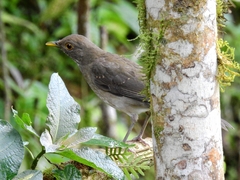
The Ecuadorian thrush (Turdus maculirostris) is a species of bird in the family Turdidae. It is found in Ecuador and Peru. The Ecuadorian thrush was originally described in 1884 as a subspecies of the black-billed thrush (Turdus ignobilis). It was later reassigned as a subspecies of the spectacled thrush (T. nudigenis) but in the early 2000s was recognized as a full species. The Ecuadorian thrush is monotypic.

The Ecuadorian thrush is 21.5 to 23 cm (8.5 to 9.1 in) long and weighs 62 to 76 g (2.2 to 2.7 oz). The sexes have the same plumage. Adults have an olive-brown head with a faint yellow eye-ring. Their upperparts, wings, and tail are olive-brown. Their throat is white with dark streaks. Their breast and flanks are a paler olive-brown than their upperparts and their belly and vent are whitish. They have a dark iris, a dusky yellow bill, and olive-brownish legs and feet. Juveniles have thin buff streaks on their upperparts, wing bars of orangey spots, and dark brown mottling on their breast and flanks.

The Ecuadorian thrush is found in western Ecuador from just south of the Colombian border south through... Wikipedia →

Sounds

Song0:35

Ecuador · 2026

© Paul Molina Abril · XC1182843 · CC BY-NC-SA 4.0

Alarm call0:54

Ecuador · 2018

© Manuel Sánchez-Nivicela · XC1161685 · CC BY-NC-ND 4.0

Call0:36

Ecuador · 2017

© Bobby Wilcox · XC407443 · CC BY-NC-SA 4.0

Global Distribution

Parks Where Found

# Park Country Daily sighting probability
1 Machalilla National Park 🇪🇨 Ecuador
~20%

More parks will be added in future updates.

Cities Where Found

# City Country Daily sighting probability
1 Guayaquil 🇪🇨 Ecuador
~40%

Before you go

What are the chances of seeing an Ecuadorian Thrush in Guayaquil?

Likely

About 40% of wildlife watchers report an Ecuadorian Thrush sighting in Guayaquil on a given day, based on 329 verified sightings from GBIF citizen-science data. It is the 20th most-seen of the 167 birds we can rate there. Over three days the chance rises to about 80%, and over a week to over 90%, if each day is a fresh chance.

When is the best time to see an Ecuadorian Thrush in Guayaquil?

March and December

In those months about 50% of wildlife watchers report an Ecuadorian Thrush in Guayaquil on a given day, against about 20% in June and July, the lowest months. Those are among Guayaquil's wettest months, with about 120 mm of rain a month against almost none in September.

What time of day is best to see an Ecuadorian Thrush?

Between 2 and 5 pm

Across all the parks we cover, that three-hour window holds the most Ecuadorian Thrush sightings with a recorded time, and about 9 in 10 of them come between 6 am and 6 pm: it is a daytime animal.

Where else can you see an Ecuadorian Thrush?

Only Guayaquil, in our data

Guayaquil is the only city on Wallace's Line with enough records to rate Ecuadorian Thrush sightings: about 40% of wildlife watchers there report one on a given day.

Which relatives of the Ecuadorian Thrush live in Guayaquil?

Same order: Passeriformes

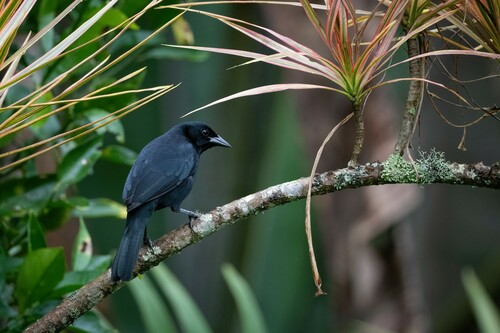
The closest relatives of the Ecuadorian Thrush that you can see in Guayaquil (order Passeriformes, Perching Birds) are Blue-gray Tanager (about 90%), Tropical Kingbird (about 80%) and Scrub Blackbird (about 70%), with each one's daily chance of a sighting.

Where does the Ecuadorian Thrush sighting chance come from?

GBIF citizen-science records

It is estimated from how often the Ecuadorian Thrush is recorded against all the birds logged in Guayaquil (329 verified sightings), calibrated against known sighting rates. Figures are rounded to the nearest 10% because citizen-science data supports honest approximations, not decimals, and months with records from fewer than five people show "—". How it works.

← Back to Guayaquil