Japanese Skink

Japanese Skink

Plestiodon japonicus

LCLeast ConcernNTVUENCR Endemic
Daily sighting probability ~40% · Likely
at Hiroshima

In 3 days ~80% in a week >90%

13 Verified sightings at Hiroshima
July Best month

About the Japanese Skink

Plestiodon japonicus is a species of lizard which is endemic to Japan. The IUCN lists the species as least concern. The species was first described in 1864 by the German naturalist Wilhelm Peters as Eumeces (Pleistodon) quinquelineatus var. Japonicus. It was placed into the genus Plestiodon in 2008. The genus Eumeces now contains African and Middle-Eastern skinks.

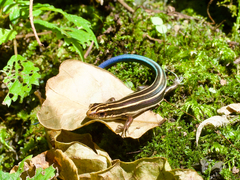
A similar species is Plestiodon latiscutatus which is distributed o the Izu Peninsula and the Izu Islands. Plestiodon japonicus has a total length of 15 to 24 cm with a snout-vent length of 6 to 9.6 cm. Juveniles have shiny blue tails and black bodies with five golden stripes. The adults are brown. While the females still retain stripes, they can disappear on the males. During the mating season the head of the males has a red color.

The mating season occurs from April to May. The females lay clutches of 6 to 15 eggs. They stay and care for them until they hatch. The species has the largest distribution of any skink species in Japan. It occurs in Western Honshu, Shikoku, Kyushu and surrounding islands. Wikipedia →

Global Distribution

Parks Where Found

# Park Country Daily sighting probability

More parks will be added in future updates.

Cities Where Found

# City Country Daily sighting probability
1 Osaka 🇯🇵 Japan
~40%
2 Hiroshima 🇯🇵 Japan
~40%
3 Fukuoka 🇯🇵 Japan
~30%

Zoos & Centres Where Found

# Zoo / Centre Country
1 Marine World Uminonakamichi 🇯🇵 Japan In captivity

Closest Relatives at Hiroshima

No species of the same family or order lives in Hiroshima, so these are its closest relatives here: other reptiles.

Before you go

What are the chances of seeing a Japanese Skink in Hiroshima?

Likely

About 40% of wildlife watchers report a Japanese Skink sighting in Hiroshima on a given day, based on 13 verified sightings from GBIF citizen-science data. Over three days the chance rises to about 80%, and over a week to over 90%, if each day is a fresh chance.

When is the best time to see a Japanese Skink in Hiroshima?

July

In that month about 70% of wildlife watchers report a Japanese Skink in Hiroshima on a given day, against about 10% in November to April, the lowest months. That is one of Hiroshima's wettest months, with about 260 mm of rain against 65 mm in January.

Is Hiroshima the best place to see a Japanese Skink?

Among the best

Of the 3 cities where we can rate Japanese Skink sightings, Hiroshima ranks 2nd at about 40%, level with the leaders once rounded. The best odds are in Osaka (Japan, about 40%).

Where does the Japanese Skink sighting chance come from?

GBIF citizen-science records

It is estimated from how often the Japanese Skink is recorded against all the reptiles logged in Hiroshima (13 verified sightings), calibrated against known sighting rates. Figures are rounded to the nearest 10% because citizen-science data supports honest approximations, not decimals, and months with records from fewer than five people show "—". How it works.

← Back to Hiroshima
