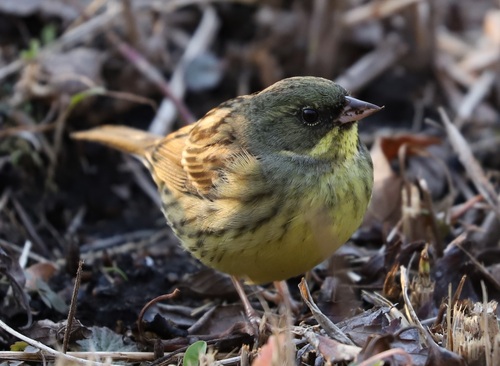
Rustic Bunting

Rustic Bunting

Emberiza rustica

Silhouette: L. Shyamal · PhyloPic

LCNTNear ThreatenedVUENCR
Daily sighting probability ~20% · Possible
at Jinhua

In 3 days ~40% in a week ~70%

10 Verified sightings at Jinhua
22 In 1 park From 2019 to 2026
December Best month

About the Rustic Bunting

The rustic bunting (Emberiza rustica) is a passerine bird in the bunting family Emberizidae, a group now separated by most modern authors from the finches, Fringillidae. The genus name Emberiza is from Old German Embritz, a bunting. The specific rustica is Latin for "rustic, simple".

The rustic bunting was first formally Species description described in 1776 by the Prussian naturalist and explorer Peter Simon Pallas with Dauria give as the type locality. This species is classified in the genus Emberiza, the typical buntings, in the family Emberizidae. Within Emberiza the rustic bunting is sister to the little bunting (E. pusilla).

There are two subspecies: Emberiza rustica rustica: breeds in the taiga over most of Eurasia from Scandinavia to Siberia. Emberiza rustica latifascia: breeds in far eastern Siberia from Yakutsk to Kamchatka. It breeds across the northern Palearctic. It is migratory, wintering in south-east Asia, Japan, Korea, and eastern China. It is a rare wanderer to western Europe.

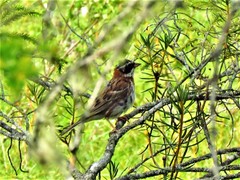
It breeds in wet coniferous woodland. Four to six eggs are laid in a nest in a bush or on the ground. Its natural food consists of seeds, and when feeding young, insects. This bird is similar in size to a reed bunting. It has white underparts with reddish flank, pink legs and a pink lower mandible. The summer male has a black head with a white throat and supercilium and a reddish breast band.

The female has a heavily streaked brown back and brown face with a whitish supercilium. She resembles a female reed bunting, but has the reddish flank streaks, a chestnut nape and a pink, not grey, lower mandible. The call is a zit, similar to that of a song thrush (Turdus philomelos), and the song is a melancholic delee-deloo-delee. Wikipedia →

Sounds

Call0:14

Sweden · 2026

© Lars Edenius · XC1174783 · CC BY-NC-SA 4.0

Song0:46

Sweden · 2026

© Jens Morin · XC1156573 · CC BY-NC-SA 4.0

Alarm call0:55

Sweden · 2024

© Thomas Bergman · XC916023 · CC BY-NC-SA 4.0

Global Distribution

Parks Where Found

# Park Country Daily sighting probability
1 Nikko National Park 🇯🇵 Japan
<5%

More parks will be added in future updates.

Cities Where Found

# City Country Daily sighting probability
1 Sendai 🇯🇵 Japan
~20%
2 Jinhua 🇨🇳 China
~20%
3 Seoul 🇰🇷 South Korea
~10%
4 Busan 🇰🇷 South Korea
~10%
5 Nagoya 🇯🇵 Japan
<5%
6 Beijing 🇨🇳 China
<5%
7 Tokyo 🇯🇵 Japan
<5%
8 Shanghai 🇨🇳 China
<5%
9 Hangzhou 🇨🇳 China
<5%
10 Nanjing 🇨🇳 China
<5%

Before you go

What are the chances of seeing a Rustic Bunting in Jinhua?

Possible

About 20% of wildlife watchers report a Rustic Bunting sighting in Jinhua on a given day, based on 10 verified sightings from GBIF citizen-science data. It is the 39th most-seen of the 74 birds we can rate there. Over three days the chance rises to about 40%, and over a week to about 70%, if each day is a fresh chance.

When is the best time to see a Rustic Bunting in Jinhua?

December

In that month about 40% of wildlife watchers report a Rustic Bunting in Jinhua on a given day, against about 10% in April–June and August–October, the lowest months. That is one of Jinhua's driest months, with about 65 mm of rain against 300 mm in June. January–March and July have too few records to rate.

Is Jinhua the best place to see a Rustic Bunting?

Among the best

Of the 13 cities where we can rate Rustic Bunting sightings, Jinhua ranks 2nd at about 20%, level with the leaders once rounded. The best odds are in Sendai (Japan, about 20%).

Which relatives of the Rustic Bunting live in Jinhua?

Same genus: Emberiza

The closest relatives of the Rustic Bunting that you can see in Jinhua (genus Emberiza, Old World Buntings) are Black-faced Bunting (about 30%), Tristram's Bunting (about 20%) and Yellow-browed Bunting (about 10%), with each one's daily chance of a sighting.

Where does the Rustic Bunting sighting chance come from?

GBIF citizen-science records

It is estimated from how often the Rustic Bunting is recorded against all the birds logged in Jinhua (10 verified sightings), calibrated against known sighting rates. Figures are rounded to the nearest 10% because citizen-science data supports honest approximations, not decimals, and months with records from fewer than five people show "—". How it works.

← Back to Jinhua