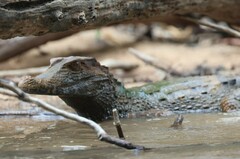
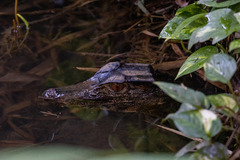
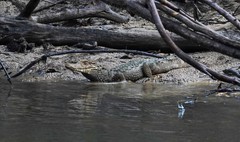
Cuvier's Smooth-fronted Caiman

Cuvier's Smooth-fronted Caiman

Paleosuchus palpebrosus

Silhouette: PhyloPic

LCLeast ConcernNTVUENCR
Daily sighting probability ~20% · Possible
at João Pessoa

In 3 days ~50% in a week ~80%

7 Verified sightings at João Pessoa
August Best month
☀️🌙 Day & Night When it's spotted

About the Cuvier's Smooth-fronted Caiman

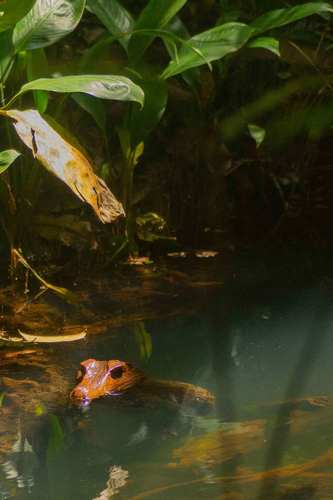
Cuvier's dwarf caiman (Paleosuchus palpebrosus) is a small crocodilian in the alligator family from northern and central South America. It is found in Bolivia, Brazil, Colombia, Ecuador, French Guiana, Guyana, Paraguay, Peru, Suriname, Trinidad and Venezuela. It lives in riverine forests, flooded forests near lakes, and near fast-flowing rivers and streams. It can traverse dry land to reach temporary pools and tolerates colder water than other species of caimans. Other common names for this species include the musky caiman, the dwarf caiman, Cuvier's caiman, and the smooth-fronted caiman (the latter name is also used for P. trigonatus). It is sometimes kept in captivity as a pet and may be referred to as the wedge-head caiman by the pet trade community.

Cuvier's dwarf caiman was first described by the French zoologist Georges Cuvier in 1807 and is one of only two species in the genus Paleosuchus, the other species being P. trigonatus. Their closest relatives are the other caimans in the subfamily Caimaninae. With a total length averaging 1.4 m (4.6 ft) for males and up to 1.2 m (3.9 ft) for females, Cuvier's dwarf caiman is not only the smallest extant species in the alligator and caiman family, but also the smallest of all crocodilians (unless the Congo dwarf crocodile is considered a valid species). An adult weighs around 5 to 7 kg (11 to 15 lb). Its lack of size is partly made up for by its strong body armor, provided by the bony bases to its dermal scales, which provides protection against predators. Juvenile dwarf caimans mainly feed on invertebrates, but also small fish and frogs, while adults eat larger fish, amphibians, and invertebrates, such as large molluscs. This caiman sometimes uses a burrow as shelter during the day and in the Pantanal may aestivate in the burrow to stay cool in the dry season. The female buries her eggs on a mounded nest and these take about 3 months to hatch. She helps the hatchlings to escape from the nest and provides some parental care for the first few weeks of their lives. This caiman has a wide range and large total population, and the IUCN lists its conservation status as being of least concern. Wikipedia →
Global Distribution

Parks Where Found

# Park Country Daily sighting probability

More parks will be added in future updates.

Cities Where Found

# City Country Daily sighting probability
1 João Pessoa 🇧🇷 Brazil
~20%

Zoos & Centres Where Found

# Zoo / Centre Country
1 San Diego Zoo 🇺🇸 United States In captivity
2 Shedd Aquarium 🇺🇸 United States In captivity
3 ZooParc de Beauval 🇫🇷 France In captivity
4 Aquarium of Genoa 🇮🇹 Italy In captivity
5 Barcelona Zoo 🇪🇸 Spain In captivity
6 Paris Zoological Park 🇫🇷 France In captivity
7 Brno Zoo 🇨🇿 Czechia In captivity
8 Kaliningrad Zoo 🇷🇺 Russia In captivity
9 Aquarium du palais de la Porte Dorée 🇫🇷 France In captivity
10 Toronto Zoo 🇨🇦 Canada In captivity
11 Bronx Zoo 🇺🇸 United States In captivity
12 Los Angeles Zoo 🇺🇸 United States In captivity
13 Toledo Zoo 🇺🇸 United States In captivity
14 Detroit Zoo 🇺🇸 United States In captivity
15 Wildlife World Zoo 🇺🇸 United States In captivity
16 São Paulo Zoo 🇧🇷 Brazil In captivity
17 Zoo La Barben 🇫🇷 France In captivity
18 Oklahoma City Zoo and Botanical Garden 🇺🇸 United States In captivity
19 Saint Louis Zoo 🇺🇸 United States In captivity
20 Night Safari 🇸🇬 Singapore In captivity
21 Singapore Zoo 🇸🇬 Singapore In captivity
22 Gembira Loka Zoo 🇮🇩 Indonesia In captivity
23 Cameron Park Zoo 🇺🇸 United States In captivity
24 Philadelphia Zoo 🇺🇸 United States In captivity
25 Mesker Park Zoo and Botanic Garden 🇺🇸 United States In captivity
26 Chapultepec Zoo 🇲🇽 Mexico In captivity
27 Krakow Zoo 🇵🇱 Poland In captivity
28 El Paso Zoo 🇺🇸 United States In captivity
29 Faunia 🇪🇸 Spain In captivity
30 Rosamond Gifford Zoo 🇺🇸 United States In captivity
31 Aquarama Barcelona 🇪🇸 Spain In captivity
32 Magnetic Hill Zoo 🇨🇦 Canada In captivity
33 John Ball Zoo 🇺🇸 United States In captivity
34 Johnsons of Old Hurst 🇬🇧 United Kingdom In captivity
35 Skopje Zoo 🇲🇰 North Macedonia In captivity
36 Topeka Zoo 🇺🇸 United States In captivity
37 Oasi Naturalistica di Sant'Alessio 🇮🇹 Italy In captivity
38 River Wonders 🇸🇬 Singapore In captivity
39 Bioparque Los Ocarros 🇨🇴 Colombia In captivity
40 Reptile Gardens 🇺🇸 United States In captivity
41 The Living Planet Aquarium 🇺🇸 United States In captivity
42 Zoológico de Fauna Sudamericana 🇧🇴 Bolivia In captivity
43 Aquarium of Cattolica 🇮🇹 Italy In captivity
44 Dierenpark Zie-ZOO 🇳🇱 Netherlands In captivity
45 Oregon Coast Aquarium 🇺🇸 United States In captivity
46 ZooAmerica 🇺🇸 United States In captivity
47 Capron Park Zoo 🇺🇸 United States In captivity
48 Crocoparc Agadir 🇲🇦 Morocco In captivity
49 St. Augustine Alligator Farm Zoological Park 🇺🇸 United States In captivity
50 Zoo de Martinique 🇫🇷 France In captivity

Before you go

What are the chances of seeing a Cuvier's Smooth-fronted Caiman in João Pessoa?

Possible

About 20% of wildlife watchers report a Cuvier's Smooth-fronted Caiman sighting in João Pessoa on a given day, based on 7 verified sightings from GBIF citizen-science data. It is the 10th most-seen of the 15 reptiles we can rate there. Over three days the chance rises to about 50%, and over a week to about 80%, if each day is a fresh chance.

When is the best time to see a Cuvier's Smooth-fronted Caiman in João Pessoa?

July and August

In those months about 40% of wildlife watchers report a Cuvier's Smooth-fronted Caiman in João Pessoa on a given day, against under 5% in January–April, June and September–November, the lowest months.

What time of day is best to see a Cuvier's Smooth-fronted Caiman?

Between 7 and 10 pm

Across all the parks we cover, that three-hour window holds the most Cuvier's Smooth-fronted Caiman sightings with a recorded time, and about 6 in 10 of them come between 6 pm and 6 am: it is seen both by day and at night.

Where else can you see a Cuvier's Smooth-fronted Caiman?

Only João Pessoa, in our data

João Pessoa is the only city on Wallace's Line with enough records to rate Cuvier's Smooth-fronted Caiman sightings: about 20% of wildlife watchers there report one on a given day.

Where does the Cuvier's Smooth-fronted Caiman sighting chance come from?

GBIF citizen-science records

It is estimated from how often the Cuvier's Smooth-fronted Caiman is recorded against all the reptiles logged in João Pessoa (7 verified sightings), calibrated against known sighting rates. Figures are rounded to the nearest 10% because citizen-science data supports honest approximations, not decimals, and months with records from fewer than five people show "—". How it works.

← Back to João Pessoa