
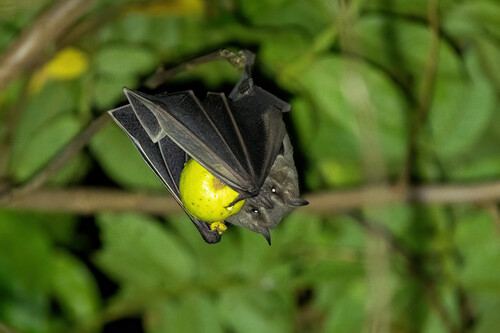
Greater Bulldog Bat

Greater Bulldog Bat

Noctilio leporinus

Silhouette: T. Michael Keesey · PhyloPic

LCLeast ConcernNTVUENCR
Daily sighting probability ~20% · Possible
at João Pessoa

In 3 days ~50% in a week ~80%

5 Verified sightings at João Pessoa
October Best month
🌙 Nocturnal When it's spotted

About the Greater Bulldog Bat

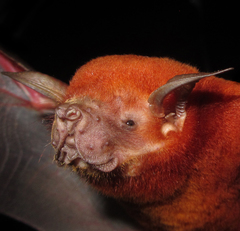
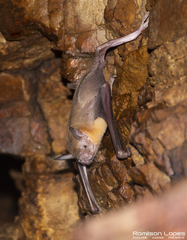
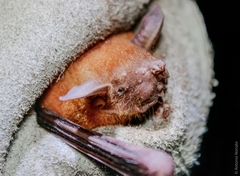
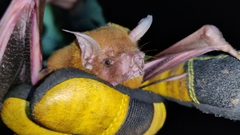
The greater bulldog bat or fisherman bat (Noctilio leporinus) is a species of fishing bat native to Latin America (Spanish: murciélago pescador; Portuguese: morcego-pescador). The bat uses echolocation to detect water ripples made by the fish upon which it preys, then uses the pouch between its legs to scoop the fish up and its sharp claws to catch and cling to it. It is not to be confused with the lesser bulldog bat, which, though belonging to the same genus, merely catches water insects, such as water striders and water beetles.

It emits echolocation sounds through the mouth like Myotis daubentoni, but the sounds are quite different, containing a long constant frequency part around 55 kHz, which is an unusually high frequency for a bat this large.

The greater bulldog bat is a large bat, often with a combined body and head length of 10.9 to 12.7 cm (4.3 to 5.0 in). It generally weighs from 50–90 grams (1.8–3.2 oz). Males tend to be larger than females, with the former averaging 67 grams (2.4 oz) and the latter averaging 56 grams (2.0 oz). They also differ in fur color. Males have bright orange fur on the back while females are dull gray. However, both sexes... Wikipedia →

Global Distribution

Parks Where Found

# Park Country Daily sighting probability

More parks will be added in future updates.

Cities Where Found

# City Country Daily sighting probability
1 João Pessoa 🇧🇷 Brazil
~20%

Before you go

What are the chances of seeing a Greater Bulldog Bat in João Pessoa?

Possible

About 20% of wildlife watchers report a Greater Bulldog Bat sighting in João Pessoa on a given day, based on 5 verified sightings from GBIF citizen-science data. It is the 12th most-seen of the 13 mammals we can rate there. Over three days the chance rises to about 50%, and over a week to about 80%, if each day is a fresh chance.

When is the best time to see a Greater Bulldog Bat in João Pessoa?

October

In that month about 40% of wildlife watchers report a Greater Bulldog Bat in João Pessoa on a given day, against under 5% in April, June–September and November–January, the lowest months. That is one of João Pessoa's driest months, with about 25 mm of rain against 230 mm in June.

What time of day is best to see a Greater Bulldog Bat?

Between 7 and 10 pm

Across all the parks we cover, that three-hour window holds the most Greater Bulldog Bat sightings with a recorded time, and about 8 in 10 of them come between 6 pm and 6 am: it is mostly seen at night.

Where else can you see a Greater Bulldog Bat?

Only João Pessoa, in our data

João Pessoa is the only city on Wallace's Line with enough records to rate Greater Bulldog Bat sightings: about 20% of wildlife watchers there report one on a given day.

Where does the Greater Bulldog Bat sighting chance come from?

GBIF citizen-science records

It is estimated from how often the Greater Bulldog Bat is recorded against all the mammals logged in João Pessoa (5 verified sightings), calibrated against known sighting rates. Figures are rounded to the nearest 10% because citizen-science data supports honest approximations, not decimals, and months with records from fewer than five people show "—". How it works.

← Back to João Pessoa