Fairy Flycatcher

Fairy Flycatcher

Stenostira scita

Silhouette: Sheatherius · PhyloPic

LCLeast ConcernNTVUENCR
Daily sighting probability <5% · Rare
at Johannesburg

In 3 days ~10% in a week ~30%

152 Verified sightings at Johannesburg
9 In 1 park From 2019 to 2026
June Best month
☀️ Diurnal When it's spotted

About the Fairy Flycatcher

The fairy flycatcher or fairy warbler (Stenostira scita) is a small passerine bird. Formerly placed in the Old World flycatcher family, Muscicapidae, it is now separated with some other "odd flycatchers" as the new family Stenostiridae (Beresford et al. 2005, Fuchs et al. 2006). It is the only member of the genus Stenostira.

It is an endemic resident breeder in southern Africa in Botswana, South Africa, Lesotho and Namibia, and a vagrant to Zimbabwe and Eswatini. Stenostira scita is a common seasonal migrant, breeding in karoo scrub and fynbos in the southern highlands, and migrating north in to spend the southern winter in thorn scrub at lower altitudes.

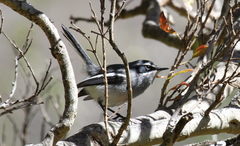
The fairy flycatcher is 11–12 cm in length. The adult is pale grey above with a black mask through the eye and a white supercilium. The wings are black with a long white stripe, and the long black tail has white sides. The throat is white, the breast is pale grey, and the belly is white with a pinkish-grey wash to its centre. The sexes are alike, but the juvenile is browner than the adult. The eye is brown and the bill and legs are black.

The fairy flycatcher is monogamous unless its mate dies, when... Wikipedia →

Sounds

Alarm call0:45

South Africa · 2022

© Dawie de Swardt · XC748963 · CC BY-NC-SA 4.0

Song0:48

South Africa · 2022

© Lynette Rudman · XC726755 · CC BY-NC-SA 4.0

Call0:45

South Africa · 2018

© Toby Esplin · XC445902 · CC BY-NC-SA 4.0

Global Distribution

Parks Where Found

# Park Country Daily sighting probability
1 Golden Gate Highlands National Park 🇿🇦 South Africa
~10%

More parks will be added in future updates.

Cities Where Found

# City Country Daily sighting probability
1 Johannesburg 🇿🇦 South Africa
<5%
2 Pretoria 🇿🇦 South Africa
<5%

Before you go

What are the chances of seeing a Fairy Flycatcher in Johannesburg?

Rare

Under 5% of wildlife watchers report a Fairy Flycatcher sighting in Johannesburg on a given day, based on 152 verified sightings from GBIF citizen-science data. It is the 90th most-seen of the 219 birds we can rate there. Over three days the chance rises to about 10%, and over a week to about 30%, if each day is a fresh chance.

When is the best time to see a Fairy Flycatcher in Johannesburg?

May to September

In those months about 10% of wildlife watchers report a Fairy Flycatcher in Johannesburg on a given day, against under 5% in October to April, the lowest months. Those are among Johannesburg's driest months, with about 10 mm of rain a month against 130 mm in December.

What time of day is best to see a Fairy Flycatcher?

Between 9 am and noon

Across all the parks we cover, that three-hour window holds the most Fairy Flycatcher sightings with a recorded time, and about 9 in 10 of them come between 6 am and 6 pm: it is a daytime animal.

Is Johannesburg the best place to see a Fairy Flycatcher?

Yes

Of the 2 cities where we can rate Fairy Flycatcher sightings, Johannesburg has the highest daily chance: under 5%. Next come Pretoria (South Africa, under 5%).

Which relatives of the Fairy Flycatcher live in Johannesburg?

Same order: Passeriformes

The closest relatives of the Fairy Flycatcher that you can see in Johannesburg (order Passeriformes, Perching Birds) are Southern Masked Weaver (about 80%), Common Bulbul (about 80%) and Cape Sparrow (about 80%), with each one's daily chance of a sighting.

Where does the Fairy Flycatcher sighting chance come from?

GBIF citizen-science records

It is estimated from how often the Fairy Flycatcher is recorded against all the birds logged in Johannesburg (152 verified sightings), calibrated against known sighting rates. Figures are rounded to the nearest 10% because citizen-science data supports honest approximations, not decimals, and months with records from fewer than five people show "—". How it works.

← Back to Johannesburg