Cape White-eye

Cape White-eye

Zosterops virens

Silhouette: Ferran Sayol · PhyloPic

LCLeast ConcernNTVUENCR
Daily sighting probability ~50% · Likely
at Johannesburg

In 3 days ~90% in a week >90%

2,035 Verified sightings at Johannesburg
8,720 In all 11 parks From 2019 to 2026
February Best month
☀️ Diurnal When it's spotted

About the Cape White-eye

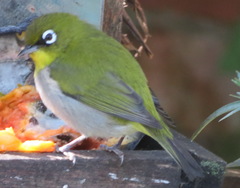
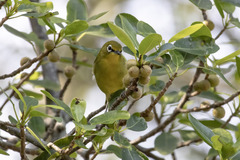
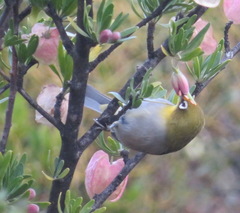
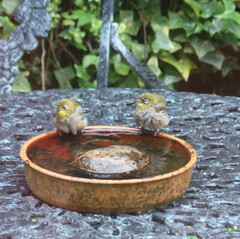
The Cape white-eye (Zosterops virens) is a small passerine bird in the white-eye family. It is native to southern Africa. It is commonly found in suburbia, parks and gardens, besides a variety of mesic to well-watered habitats.

These subspecies interbreed where they come into contact. The Orange River white-eye (Z. pallidus) has been split from the Cape white-eye. This species is about 12 cm long with rounded wings, strong legs, and a conspicuous ring of white feathers round the eyes. The upperparts are green, and the throat and vent are bright yellow.

They are very vocal, and constantly keep in touch with soft trilled pee, pree or pirreee call notes. The song consists of repeated long jerky phrases of sweet reedy notes, varying in pitch, volume and... Wikipedia →

Sounds

Call0:49

South Africa · 2025

© Tristan Spurway · XC1031081 · CC BY-NC-SA 4.0

Song0:42

South Africa · 2021

© Lynette Rudman · XC683140 · CC BY-NC-SA 4.0

Alarm call0:42

South Africa · 2018

© Tim Cockcroft · XC411730 · CC BY-NC-SA 4.0

Global Distribution

Parks Where Found

# Park Country Daily sighting probability
1 Table Mountain National Park 🇿🇦 South Africa
~70%
2 Garden Route National Park 🇿🇦 South Africa
~70%
3 Golden Gate Highlands National Park 🇿🇦 South Africa
~50%
4 Addo Elephant National Park 🇿🇦 South Africa
~20%
5 De Hoop Nature Reserve 🇿🇦 South Africa
~20%
6 West Coast National Park 🇿🇦 South Africa
~20%
7 Pilanesberg National Park 🇿🇦 South Africa
~20%
8 Hluhluwe-Imfolozi Park 🇿🇦 South Africa
~10%
9 iSimangaliso Wetland Park 🇿🇦 South Africa
~10%
10 uMkhuze Game Reserve 🇿🇦 South Africa
~10%
11 Kruger National Park 🇿🇦 South Africa
<5%

Cities Where Found

# City Country Daily sighting probability
1 Cape Town 🇿🇦 South Africa
~70%
2 Pretoria 🇿🇦 South Africa
~60%
3 Johannesburg 🇿🇦 South Africa
~50%
4 Durban 🇿🇦 South Africa
~50%

Before you go

What are the chances of seeing a Cape White-eye in Johannesburg?

Likely

About 50% of wildlife watchers report a Cape White-eye sighting in Johannesburg on a given day, based on 2,035 verified sightings from GBIF citizen-science data. It is the 10th most-seen of the 219 birds we can rate there. Over three days the chance rises to about 90%, and over a week to over 90%, if each day is a fresh chance.

When is the best time to see a Cape White-eye in Johannesburg?

April and September–February

In those months about 60% of wildlife watchers report a Cape White-eye in Johannesburg on a given day, against about 40% in June and July, the lowest months.

What time of day is best to see a Cape White-eye?

Between 7 and 10 am

Across all the parks we cover, that three-hour window holds the most Cape White-eye sightings with a recorded time, and nearly all of them come between 6 am and 6 pm: it is a daytime animal.

Is Johannesburg the best place to see a Cape White-eye?

3rd of 4

Of the 4 cities where we can rate Cape White-eye sightings, Johannesburg ranks 3rd at about 50%. The best odds are in Cape Town (South Africa, about 70%) and Pretoria (South Africa, about 60%).

Which relatives of the Cape White-eye live in Johannesburg?

Same order: Passeriformes

The closest relatives of the Cape White-eye that you can see in Johannesburg (order Passeriformes, Perching Birds) are Southern Masked Weaver (about 80%), Common Bulbul (about 80%) and Cape Sparrow (about 80%), with each one's daily chance of a sighting.

Where does the Cape White-eye sighting chance come from?

GBIF citizen-science records

It is estimated from how often the Cape White-eye is recorded against all the birds logged in Johannesburg (2,035 verified sightings), calibrated against known sighting rates. Figures are rounded to the nearest 10% because citizen-science data supports honest approximations, not decimals, and months with records from fewer than five people show "—". How it works.

← Back to Johannesburg