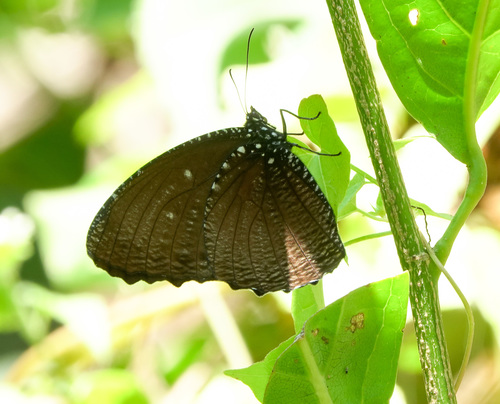
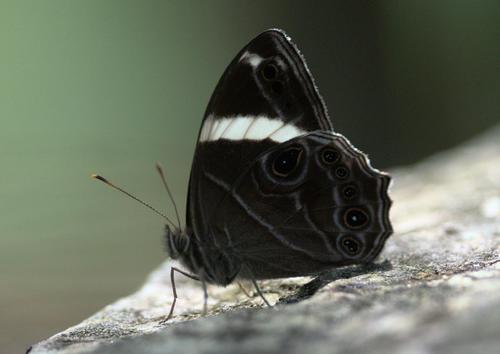
Banded Treebrown
Daily sighting probability ~20% · Possible
at Kathmandu

In 3 days ~40% in a week ~70%

10 Verified sightings at Kathmandu
19 In 1 park From 2019 to 2026
November Best month
☀️ Diurnal When it's spotted

About the Banded Treebrown

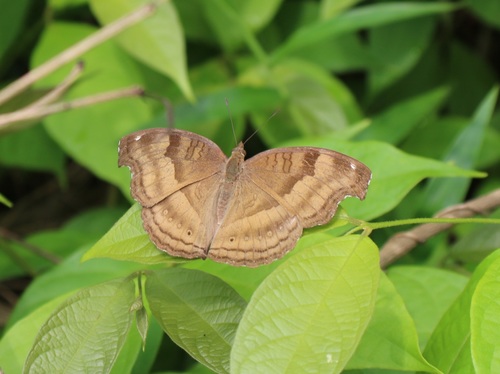
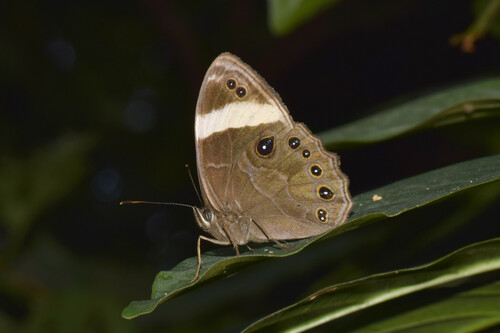
Lethe confusa, the banded treebrown, is a species of butterfly belonging to the satyr family that is found mainly in Southeast Asia and in parts of South Asia. It is about 50–55 mm in expanse, with the upper surface of wings predominantly brown in colour. The forewing has a sub-apical white band and pale spot on the apex. The underside of the hindwing has a large ocellus or and a series of spots along the margin. It is found in bamboo forests.

Hindwing dentate at apex of vein 4. Upperside ground colour Vandyke brown; forewing crossed by an oblique, slightly curved, discal white band, the margins of the band more even and regular than in the female of Lethe rohria; beyond this are two obliquely placed preapical white spots. Hindwing uniform, ocelli of the underside showing through.

Underside uniform brown; forewings and hindwings with subbasal, subterminal and terminal sinuous lilacine-white lines; forewing with the oblique discal white bar as on the upperside, followed by a subapical lilacine patch bearing three small ocelli in vertical order, and with a very short, oblique, white bar joining it to the costa. Hindwing with a sinuous, irregular, angulated discal lilacine... Wikipedia →
Global Distribution

Parks Where Found

# Park Country Daily sighting probability
1 Cuc Phuong National Park 🇻🇳 Vietnam
~40%

More parks will be added in future updates.

Cities Where Found

# City Country Daily sighting probability
1 Kathmandu 🇳🇵 Nepal
~20%
2 Hong Kong 🇨🇳 China
~10%
3 Tuen Mun 🇨🇳 China
~10%
4 Guangzhou 🇨🇳 China
~10%

Before you go

What are the chances of seeing a Banded Treebrown in Kathmandu?

Possible

About 20% of wildlife watchers report a Banded Treebrown sighting in Kathmandu on a given day, based on 10 verified sightings from GBIF citizen-science data. It is the 31st most-seen of the 71 insects we can rate there. Over three days the chance rises to about 40%, and over a week to about 70%, if each day is a fresh chance.

When is the best time to see a Banded Treebrown in Kathmandu?

November

In that month about 40% of wildlife watchers report a Banded Treebrown in Kathmandu on a given day, against under 5% in April–May, July–August and December–February, the lowest months. That is one of Kathmandu's driest months, with almost no rain against 280 mm in July.

What time of day is best to see a Banded Treebrown?

Between 8 and 11 am

Across all the parks we cover, that three-hour window holds the most Banded Treebrown sightings with a recorded time, and about 9 in 10 of them come between 6 am and 6 pm: it is a daytime animal.

Is Kathmandu the best place to see a Banded Treebrown?

Yes

Of the 4 cities where we can rate Banded Treebrown sightings, Kathmandu has the highest daily chance: about 20%. Next come Hong Kong (China, about 10%) and Tuen Mun (China, about 10%).

Where does the Banded Treebrown sighting chance come from?

GBIF citizen-science records

It is estimated from how often the Banded Treebrown is recorded against all the insects logged in Kathmandu (10 verified sightings), calibrated against known sighting rates. Figures are rounded to the nearest 10% because citizen-science data supports honest approximations, not decimals, and months with records from fewer than five people show "—". How it works.

← Back to Kathmandu