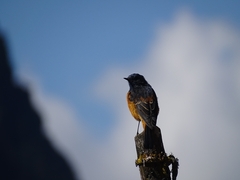

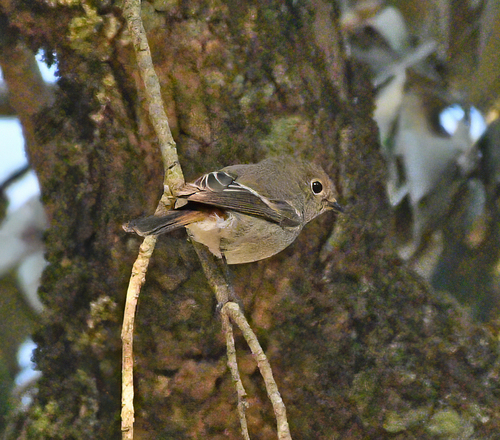
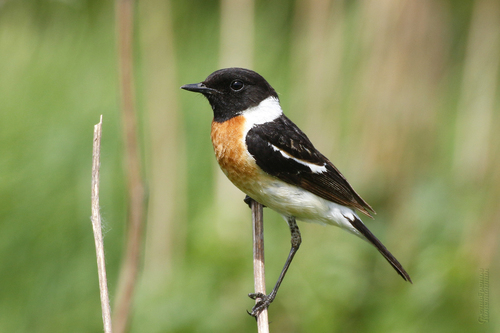
Blue-fronted Redstart

Blue-fronted Redstart

Phoenicurus frontalis

Silhouette: Martin Bulla, based on François Desbordes' illustration · PhyloPic

LCLeast ConcernNTVUENCR
Daily sighting probability <5% · Rare
at Kathmandu

In 3 days ~10% in a week ~20%

174 Verified sightings at Kathmandu
288 In all 3 parks From 2019 to 2026
January Best month
🌅 Crepuscular When it's spotted

About the Blue-fronted Redstart

The blue-fronted redstart (Phoenicurus frontalis) is a species of bird in the family Muscicapidae, the Old World flycatchers. It breeds in central China and the Himalayas (where it winters in the southern foothills, as well as in southern Yunnan, the Patkai and northern Indochina. Its natural habitat is temperate forests. The female is brownish-grey, with paler underparts.

Media related to Phoenicurus frontalis at Wikimedia Commons Wikipedia →

Sounds

Song1:02

China · 2025

© Ding Li Yong · XC1017703 · CC BY-NC-ND 4.0

Call0:34

China · 2024

© Peter Boesman · XC916398 · CC BY-NC-ND 4.0

Call0:21

India · 2024

© Lars Lachmann · XC890503 · CC BY-NC-SA 4.0

Global Distribution

Parks Where Found

# Park Country Daily sighting probability
1 Langtang National Park 🇳🇵 Nepal
~50%
2 Jiuzhaigou National Park 🇨🇳 China
~30%
3 Royal Manas National Park 🇧🇹 Bhutan
<5%

Cities Where Found

# City Country Daily sighting probability
1 Kunming 🇨🇳 China
~10%
2 Shanghai 🇨🇳 China
~10%
3 Kathmandu 🇳🇵 Nepal
<5%
4 Chengdu 🇨🇳 China
<5%

Before you go

What are the chances of seeing a Blue-fronted Redstart in Kathmandu?

Rare

Under 5% of wildlife watchers report a Blue-fronted Redstart sighting in Kathmandu on a given day, based on 174 verified sightings from GBIF citizen-science data. It is the 111th most-seen of the 312 birds we can rate there. Over three days the chance rises to about 10%, and over a week to about 20%, if each day is a fresh chance.

When is the best time to see a Blue-fronted Redstart in Kathmandu?

December to March

In those months about 10% of wildlife watchers report a Blue-fronted Redstart in Kathmandu on a given day, against under 5% in April to November, the lowest months. Those are among Kathmandu's driest months, with about 15 mm of rain a month against 280 mm in July.

What time of day is best to see a Blue-fronted Redstart?

Between 3 and 6 am

Across all the parks we cover, that three-hour window holds the most Blue-fronted Redstart sightings with a recorded time, and about half of them come between 6 am and 6 pm: it is most active around dawn and dusk.

Is Kathmandu the best place to see a Blue-fronted Redstart?

3rd of 4

Of the 4 cities where we can rate Blue-fronted Redstart sightings, Kathmandu ranks 3rd at under 5%. The best odds are in Kunming (China, about 10%) and Shanghai (China, about 10%).

Which relatives of the Blue-fronted Redstart live in Kathmandu?

Same genus: Phoenicurus

The closest relatives of the Blue-fronted Redstart that you can see in Kathmandu (genus Phoenicurus, True Redstarts) are Hodgson's Redstart (about 10%) and Plumbeous Water Redstart (about 10%), with each one's daily chance of a sighting.

Where does the Blue-fronted Redstart sighting chance come from?

GBIF citizen-science records

It is estimated from how often the Blue-fronted Redstart is recorded against all the birds logged in Kathmandu (174 verified sightings), calibrated against known sighting rates. Figures are rounded to the nearest 10% because citizen-science data supports honest approximations, not decimals, and months with records from fewer than five people show "—". How it works.

← Back to Kathmandu