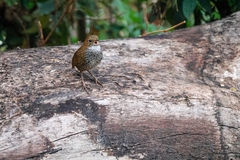
Scaly-breasted Wren-Babbler

Scaly-breasted Wren-Babbler

Pnoepyga albiventer

Silhouette: Sheatherius · PhyloPic

LCLeast ConcernNTVUENCR
Daily sighting probability <5% · Rare
at Kathmandu

In 3 days <5%

31 Verified sightings at Kathmandu
46 In all 2 parks From 2019 to 2026
December Best month
☀️ Diurnal When it's spotted

About the Scaly-breasted Wren-Babbler

The scaly-breasted cupwing or scaly-breasted wren-babbler (Pnoepyga albiventer) is a species of bird in the Pnoepyga wren-babblers family, Pnoepygidae. It is found in southern and eastern Asia from the Himalayas to Indochina.

The Taiwan cupwing was once treated as a subspecies of the scaly-breasted cupwing. The Chinese cupwing has been merged into this species. The scaly-breasted cupwing is a very small babbler with almost no tail, around 9 cm long and weighing between 19 and 23 g. The plumage is olive on the back and lightly scalloped on the chest.

The natural habitat of the scaly-breasted cupwing is subtropical moist montane forest. Within that habitat it is usually found near water. The species undertakes some altitudinal migration, moving closer to sea level during the winter over some of its range.

Collar, N. J. & Robson, C. 2007. Family Timaliidae (Babblers) pp. 70 – 291 in; del Hoyo, J., Elliott, A. & Christie, D.A. eds. Handbook of the Birds of the World, Vol. 12. Picathartes to Tits and Chickadees. Lynx Edicions, Barcelona. Wikipedia →

Sounds

Song0:27

China · 2025

© JJSUN · XC1068803 · CC BY-NC-SA 4.0

Alarm call0:35

India · 2019

© Prashant Kumar · XC511785 · CC BY-NC-SA 4.0

Call1:24

Bhutan · 2019

© Rolf A. de By · XC509690 · CC BY-NC-SA 4.0

Global Distribution

Parks Where Found

# Park Country Daily sighting probability
1 Langtang National Park 🇳🇵 Nepal
~10%
2 Jim Corbett National Park 🇮🇳 India
<5%

Cities Where Found

# City Country Daily sighting probability
1 Kathmandu 🇳🇵 Nepal
<5%

Before you go

What are the chances of seeing a Scaly-breasted Wren-Babbler in Kathmandu?

Rare

Under 5% of wildlife watchers report a Scaly-breasted Wren-Babbler sighting in Kathmandu on a given day, based on 31 verified sightings from GBIF citizen-science data. It is the 213th most-seen of the 312 birds we can rate there. Over three days the chance rises to under 5%, if each day is a fresh chance.

When is the best time to see a Scaly-breasted Wren-Babbler in Kathmandu?

Any time of year

In every month with enough records, under 5% of wildlife watchers report a Scaly-breasted Wren-Babbler in Kathmandu on a given day, so our monthly data shows no clear season.

What time of day is best to see a Scaly-breasted Wren-Babbler?

Between 7 and 10 am

Across all the parks we cover, that three-hour window holds the most Scaly-breasted Wren-Babbler sightings with a recorded time, and about 9 in 10 of them come between 6 am and 6 pm: it is a daytime animal.

Where else can you see a Scaly-breasted Wren-Babbler?

Only Kathmandu, in our data

Kathmandu is the only city on Wallace's Line with enough records to rate Scaly-breasted Wren-Babbler sightings: under 5% of wildlife watchers there report one on a given day.

Where does the Scaly-breasted Wren-Babbler sighting chance come from?

GBIF citizen-science records

It is estimated from how often the Scaly-breasted Wren-Babbler is recorded against all the birds logged in Kathmandu (31 verified sightings), calibrated against known sighting rates. Figures are rounded to the nearest 10% because citizen-science data supports honest approximations, not decimals, and months with records from fewer than five people show "—". How it works.

← Back to Kathmandu