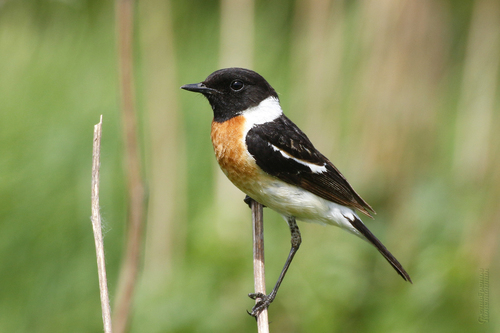
Variable Wheatear

Variable Wheatear

Oenanthe picata

Silhouette: PhyloPic

LCLeast ConcernNTVUENCR
Daily sighting probability <5% · Rare
at Kathmandu

In 3 days <5% in a week ~10%

81 Verified sightings at Kathmandu
10 In 1 park From 2019 to 2026
November Best month
☀️ Diurnal When it's spotted

About the Variable Wheatear

The variable wheatear (Oenanthe picata) is a species of bird in the family Muscicapidae. It is found in Afghanistan, Egypt, India, Iran, Kazakhstan, Lebanon, Nepal, Oman, Pakistan, Russia, Tajikistan, Turkmenistan, the United Arab Emirates, and Uzbekistan.

Its natural habitat is hot deserts. The variable wheatear is a bird of arid and semi-arid region, and is locally abundant in barren rocky areas, sand dunes with scrub vegetation, cultivation, ravines, outside villages and nomadic encampments.

It is polymorphic and has three distinct morphs. Black-bellied phase (opistholeuca). Male (adult). Entirely jet black except rump, under tail-coverts, base and sides of tail which are white; central rectrices and terminal band of tail black. Female has black parts replaced by sooty black.

White-bellied phase (picata) Male (adult). Like the preceding but belly white. Female similar to male but black parts replaced by grayish brown; belly more buffish. White-crowned phase (capistrata). Male (adult). Like picata, with white belly and black throat, but crown and nape white. Female similar to male but black parts and crown earthy brown; belly more buffish.

The geographical dominance... Wikipedia →

Sounds

Call0:35

India · 2014

© Frank Lambert · XC165823 · CC BY-NC-ND 4.0

Song0:08

India · 2012

© vir joshi · XC113653 · CC BY-NC-SA 3.0

Global Distribution

Parks Where Found

# Park Country Daily sighting probability
1 Ranthambore National Park 🇮🇳 India
<5%

More parks will be added in future updates.

Cities Where Found

# City Country Daily sighting probability
1 Jodhpur 🇮🇳 India
~10%
2 Kathmandu 🇳🇵 Nepal
<5%
3 Islamabad 🇵🇰 Pakistan
<5%

Before you go

What are the chances of seeing a Variable Wheatear in Kathmandu?

Rare

Under 5% of wildlife watchers report a Variable Wheatear sighting in Kathmandu on a given day, based on 81 verified sightings from GBIF citizen-science data. It is the 165th most-seen of the 312 birds we can rate there. Over three days the chance rises to under 5%, and over a week to about 10%, if each day is a fresh chance.

When is the best time to see a Variable Wheatear in Kathmandu?

November

In that month about 10% of wildlife watchers report a Variable Wheatear in Kathmandu on a given day, against under 5% in December to October, the lowest months. That is one of Kathmandu's driest months, with almost no rain against 280 mm in July.

What time of day is best to see a Variable Wheatear?

Between 8 and 11 am

Across all the parks we cover, that three-hour window holds the most Variable Wheatear sightings with a recorded time, and nearly all of them come between 6 am and 6 pm: it is a daytime animal.

Is Kathmandu the best place to see a Variable Wheatear?

2nd of 3

Of the 3 cities where we can rate Variable Wheatear sightings, Kathmandu ranks 2nd at under 5%. The best odds are in Jodhpur (India, about 10%).

Where does the Variable Wheatear sighting chance come from?

GBIF citizen-science records

It is estimated from how often the Variable Wheatear is recorded against all the birds logged in Kathmandu (81 verified sightings), calibrated against known sighting rates. Figures are rounded to the nearest 10% because citizen-science data supports honest approximations, not decimals, and months with records from fewer than five people show "—". How it works.

← Back to Kathmandu